Translate

zondag 25 mei 2025

Report it ! Please take a moment to read what you can do to help against horrifying abuse and shocking cruelty with animals online particularly Facebook

 23 May 2025: Take action against online animal cruelty during Report It! Week
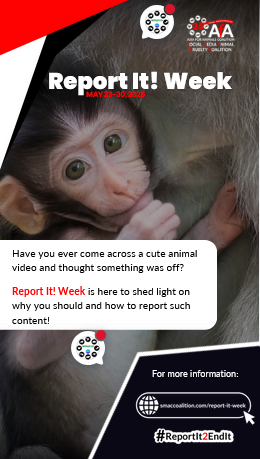
Report It Week

Report It! Week (23-30 May) is an event organised by the Social Media Animal Cruelty Coalition (SMACC), a collective of 34 animal protection organisations, including Action for Primates. It is a time dedicated to raising global awareness about online animal cruelty and reinforcing a powerful message on the importance of reporting this type of content to social media platforms.

During Report It! Week, SMACC is urging social media companies to take meaningful action against animal cruelty content shared on their platforms. SMACC calls upon these companies to respond to reports from the public and animal protection experts by promptly removing abusive content. The coalition also invites platforms to collaborate with its experts to strengthen animal welfare policies and improve content moderation systems—ensuring that cruelty to animals has no place online.

Report It! Week will drive home the message that reporting matters. By raising awareness, we aim to influence social media users and companies to stop overlooking this cruelty.

What You Can Do To Help

Please join us in taking action during Report It! Week.

For more information, visit: https://www.smaccoalition.com/report-it-week

New data released by SMACC, reveal that shocking and harmful animal cruelty content continues to be rife on social media platforms. During 2024, 80,972 cruelty related links were identified by the public and assessed by the coalition. Facebook accounted for 87.5% of those links reported. Non-human primates (especially macaques), dogs and cats featured heavily in this cruel content.

Disturbing content of deliberate and gratuitous abuse involving animals, including baby monkeys, is posted on channels and by online groups, with some channels monetised. Particularly horrifying has been the disturbing escalation in the violence, torture and death inflicted upon baby monkeys. Other harmful content, however, may not always be easy to spot. Animal cruelty does not just comprise physical harm—it includes keeping wild animals as 'pets'; dangerous staged 'rescues' where an animal is deliberately placed in potentially harmful situations with the film maker then playing the role of 'rescuer'; and forcing animals to do unnatural tricks for 'entertainment'.


SMACC researchers also collected a separate set of data:

  • 2,050 links were collected and analysed—1,094 from Facebook and 39 from Instagram—confirming that more than half of the total originated from Meta platforms; of the 1,133 Meta links, only 36.3% have been removed
  • On Facebook, 24.5% of content is categorised as 'deliberate physical torture', while Instagram more frequently hosts content portraying 'animals as entertainers' (35.9%)


Despite social media platforms implementing policies against such content, the data demonstrate gaps in identifying and removing the flagged content.

Online animal cruelty is increasingly being recognised within global legal frameworks. The legislative landscape around digital safety is rapidly evolving, with governments placing more defined responsibilities on platforms to mitigate online harms, including animal cruelty. Under the UK's Online Safety Act 2023, animal cruelty is classified as priority illegal content. Platforms are required to proactively detect and swiftly remove such material, with non-compliance resulting in fines of up to £18 million or 10% of global annual revenue, enforced by Ofcom.

zaterdag 24 mei 2025

Grand jury indicts 11 more individuals for involvement with online groups dedicated to monkey torture & mutilation: The jugde said: "torture and abuse beyond disturbing"


[Photo: Captive baby long-tailed macaque, Indonesia; Action for Primates]


CINCINNATI – An indictment was unsealed today charging 11 defendants from across the United States for their alleged involvement with online groups dedicated to creating and distributing videos depicting acts of extreme violence and sexual abuse against monkeys.

The indictment alleges the individuals conspired with previously charged defendant Nicholas T. Dryden, of Cincinnati, to create and distribute so-called “animal crush videos.”

The indictment details 79 overt acts in which defendants allegedly paid Dryden who then paid a minor in Indonesia to commit the requested acts on camera.

The videos alleged to have been created as part of the conspiracy depicted, among other things, monkeys having their genitals burned and cut with scissors, as well as being sodomized with a wooden skewer and a spoon.

Photo: Action for Primates

Those charged include:

NameAlso Known AsResidence
Ernest D. ChavezLaxArizona
Hugh T. CampbellTim TempletonPennsylvania
Carter G. FawcettCaptainColorado
Brady O. ShellhammerBeglu, BbbegluLouisiana
Jimmy WongYasser LopezNew York
Kimberly A. AnglinKim AnglinConnecticut
Mark M. SampieriThe Chef, SainTConnecticut
Victoria S. HaskinsCat Face, Sparkles Fancy PantsLouisiana
Vance H. BeadlesMr. GreenKentucky
Mary L. LongoriaR6, R6exNorth Carolina
Patrick C. NaylorYANTF, YANTF 2xNorth Carolina
 

“The acts of torture and abuse of young monkeys alleged in this case are beyond disturbing,” stated FBI Cincinnati Special Agent in Charge Elena Iatarola. “As a result of the work of the FBI, U.S. Fish and Wildlife Service, and our partners, those involved in the conspiracy to create and distribute these repulsive videos are being held accountable.”

If convicted as charged, these defendants face maximum penalties of five years in prison.

It is alleged that the 11 individuals conspired with Nicholas T. Dryden, from Cincinnati (who is currently in jail awaiting sentencing) and gave him money to pay a minor in Indonesia to commit requested acts of violence and abuse on camera. Dryden directed the teenager on ways to torture, mutilate and kill the monkeys. The videos distributed depict the most horrifying brutality, including monkeys having their genitals burned and cut with scissors, as well as being sodomised with a wooden skewer and a spoon. If convicted as charged, these people face maximum penalties of five years in prison.
Action for Primates and Lady Freethinker, who first exposed the sadistic world of online monkey torture groups in 2021, are grateful to law enforcement agencies for continuing to track down and prosecute these sadistic and depraved individuals.

Acting United States Attorney Kelly A. Norris for the Southern District of Ohio; Acting Assistant Attorney General Adam Gustafson of the Department of Justice’s Environmental & Natural Resources Division (ENRD); and Elena Iatarola, Special Agent in Charge, Federal Bureau of Investigation (FBI), Cincinnati Division; made today’s announcement.

The U.S. Fish and Wildlife Service and FBI investigated the case.

Senior Trial Attorney Adam C. Cullman of the Justice Department’s Environmental Crimes Section and Assistant U.S. Attorney Timothy D. Oakley for the Southern District of Ohio are prosecuting the case.

An indictment merely contains allegations, and defendants are presumed innocent unless proven guilty in a court of law.

# # #

Updated  May 16th
 

vrijdag 23 mei 2025

Persbericht: Ruim 3000 protestkaarten in één dag tegen geplande octopuskwekerij op het Spaanse Eiland Gran Canaria ( links naar veel informatie )


22 mei 2025 – Binnen 1 dag hebben ruim 3000 mensen een digitale protestkaart gestuurd naar het Bureau voor Toerisme op het Spaanse eiland Gran Canaria.  De boodschap: houd het eiland een natuurlijk paradijs zonder octopuskwekerij. De actie is een initiatief van Dierenwelzijnsorganisatie Compassion in World Farming Nederland (CIWF). Ze roepen op om de eerste commerciële octopuskwekerij ter wereld tegen te houden. Volgens de organisatie brengt de geplande kwekerij ernstig dierenleed én ecologische schade met zich mee.


Octopussen in tanks: een nachtmerrie

Op Gran Canaria liggen plannen klaar voor een industriële kwekerij waarin jaarlijks meer dan een miljoen octopussen zouden worden gehouden. De dieren zouden in kale, krappe bakken opgesloten zitten, ver van hun natuurlijke leefomgeving.[1] Octopussen zijn buitengewoon intelligente en gevoelige dieren die in het wild solitair leven. In gevangenschap is geen ruimte voor hun natuurlijke gedrag, geen methode om ze pijnloos te doden, en geen wetgeving die hun welzijn beschermt.” zegt campagneleider Rebecca van Eijden van CIWF Nederland. “Ze horen simpelweg niet thuis in een kwekerij.”


Milieuproblemen en groeiende wereldwijde weerstand

Naast ernstig dierenleed brengt de octopuskweek volgens CIWF grote risico’s met zich mee voor het milieu. Octopussen zijn carnivoren en hebben veel vis nodig als voer, wat leidt tot extra druk op wilde visbestanden en verdere overbevissing. Bovendien veroorzaken de kwekerijen watervervuiling en schade aan mariene ecosystemen.[2]


Digitale protestkaart sturen

De actie van CIWF sluit aan bij de groeiende roep om bescherming van het eiland. Lokale bewoners protesteerden vorige week tegen de impact van massatoerisme.[3] De geplande octopuskwekerij dreigt volgens CIWF nog meer ecologische schade en commerciële uitbuiting naar het eiland te brengen. Via digitale protestkaarten roepen bezorgde Nederlanders het Bureau voor Toerisme op om een standpunt in te nemen tegen de plannen en het eiland als natuurparadijs te behouden.


Compassion in World Farming

Compassion in World Farming is een internationale organisatie die opkomt voor het welzijn van dieren in de veehouderij, op het land en in het water. Zij streeft wereldwijd naar een diervriendelijkere, duurzame en gezonde veehouderij. Voor dieren, mensen en aarde.


Bronnen:

[1] CIWF Rapport Octopus factory farming: a recipe for disaster: ciwf-rapport-octopus-factory-farming.pdf

[2] CIWF Rapport Exposing the environmental risks of octopus farming 2179-octopus-report-2024-5b-digital.pdf

[3] AD: Duizenden mensen protesteren tegen massatoerisme op Canarische Eilanden: 'Geen paradijs meer'


Extra info:

Webnieuws over de actie: https://www.ciwf.nl/nieuws/nieuwe-actie-stop-de-octopuskwekerij-op-gran-canaria/.


Compassion in World Farming publiceerde in 2021 het rapport Octopus Farming: A Recipe for Disaster dat wereldwijd tot opschudding leidde. Hierin wordt aangetoond dat de octopuskweek leidt tot ernstig dierenleed en schadelijke milieueffecten. Een jaar geleden lanceerde CIWF samen met Eurogroup for Animals het rapport Uncovering the Horrific Reality of Octopus Farming - haar gezamenlijke reactie op de plannen van Nueva Pescanova.


In een eerdere milieu-effectrapportage over de plannen werden verschillende risico’s benoemd, waaronder het gebrek aan transparantie over afvalverwerking. Ook internationaal groeit de kritiek. In de Verenigde Staten hebben staten zoals Californië en Washington octopuskwekerijen verboden. En in Nederland werd in 2023 een motie aangenomen waarin de regering werd opgeroepen zich tegen octopuskweek uit te spreken in Brussel.


Rebecca Van Eijden
Communications Manager


rebecca.vaneijden@ciwf.nl | www.ciwf.nl
Compassion in World Farming komt op voor een diervriendelijkere en duurzame veehouderij: voor dieren, mensen en de aarde
​


donderdag 22 mei 2025

A dangerous conflict between rival criminal groups in Mexico forced Animal Sanctuary Ostok to evacuate 700 rescued exotic animals away from violence


A dangerous conflict between rival criminal groups in the Sinaloa cartel has forced an animal sanctuary in Culiacán, Mexico, to quietly evacuate around 700 exotic animals.


The Ostok Sanctuary, which has rescued animals from circuses, illegal trade, and private homes, moved tigers, lions, elephants and other animals to safety as gun violence increased in the area.

The sanctuary sits on the outskirts of Culiacán, a city now trapped in daily gun battles, kidnappings, and extortion. Two powerful groups inside the Sinaloa cartel are fighting for control, making the region extremely unsafe for people and animals at the sanctuary.


Ostok has been operating for over 20 years and houses lions, tigers, jaguars, crocodiles, monkeys, elephants, and many other animals.

Many were rescued from abuse, neglect, or abandoned by former owners involved in organized crime. Staff members who care for the animals said the violence made it impossible to continue safely.


Staff member robbed at gunpoint

One staff member was robbed at gunpoint while delivering food. Vets could not reach the sanctuary to treat injured animals, including an elephant with a painful foot wound.


A silent evacuation of the animals

Staff said armed groups appeared near the sanctuary grounds, raising fears that the site could be attacked or looted.

To protect the animals and the team, the sanctuary organized a silent evacuation. Staff moved the animals quietly over several days to a temporary shelter in Mazatlán with help from the Mexican National Guard. The goal was to avoid drawing attention from violent groups in the area.

Staff say the move was emotionally hard, and they remain worried that the violence might follow them.

Text Animal Reader  photos from news papers Mexico


woensdag 21 mei 2025

310 animals removed from Coast Game Park Safari Oregon ( US ) after many years of complaints from visitors of neglect, lack of food, water and veterinary care


 Note: Content and images of sickly or dead animals in this article may upset some readers.

On May 18, investigators finished a four-day search at the West Coast Game Park Safari, resulting in the seizure and relocation of 310 animals to accredited sanctuaries and rescue facilities. KATU News has reached out to Oregon State Police ( OSP ) for more information regarding the relocation.

"It would be nice if it didn't reopen, it should shut down completely." said Arianna Lopez, a concerned member of the community. "In one of the inspection reports a few years ago, they found a dead tiger in the freezer."

Lopez's claim has been confirmed by a routine inspection done at the safari on Jan. 22 of this year.

The operation, led by OSP in collaboration with local, state, and federal partners, was part of a lengthy criminal investigation into the facility's operations.

During the search, a chicken and a kinkajou were euthanized due to their physical condition, in addition to a camel euthanized earlier in the investigation.

"Animal care has been a primary consideration during the investigation," said the Oregon State Police. Veterinary staff evaluated dietary needs and provided fresh feed for each species, with the Oregon Humane Society purchasing food.

The Oregon Humane Society told KATU News that while they are unable to disclose more information regarding the seizures and relocations at this time, the operation would not have been possible without the collaboration of all the agencies involved.

The safari is not accredited by the Association of Zoos and Museums, but three other zoos in Oregon are.

“So for the Oregon State Police, it really started last fall. That took us some time to go through the investigation, really obtain the evidence needed to get to this operation," said Kyle Kennedy, an Oregon State Police trooper.


Veterinarians diagnosed one camel at the West Coast Game Park Safari in Coos County with "multiple serious medical conditions" and noted it was "suffering." Considering transport would likely result in death, authorities decided "humane euthanasia was the appropriate option."


In a 2015 inspection report, an inspector wrote, "This and the previous inspection are indicating a possible pattern of personnel not performing adequate daily assessment of animal health and communicating that information to supervisors and the attending veterinarian."

The park received an official warning of violations of federal laws in March of 2023, but evidently continued to operate.

A Dec. 2024 USDA inspection stated the safari had only one staff member to care for over 300 animals, which inspectors deemed insufficient. A representative from the park said at the time that several recent hires were not a sufficient fit for the park, and the challenge of finding help in the area was significant.


Before the OSP investigation this month, the most recent inspection happened in April, with an inspector writing that two older lions, male and female, and a black African leopard were seen with "decreased muscle mass with hips, ribs, and spine prominently displayed under the skin."

The inspector wrote that this was a persistent issue that had not been evaluated or treated by a veterinarian to diagnose the source of the decrease in body condition.

Other troubling findings in past reports include the finding of big cats with ribs showing, rodent droppings in food, and problems with enclosures.


In Feb. of this year, KATU News reached out to a spokesperson at the USDA with questions regarding the various violations and the lack of action.

The spokesperson said at the time they were unable to provide additional information outside the available public records, and that the agency will "continue to inspect this facility at a frequency determined by compliance history to ensure any previously documented non-compliances are corrected and to ensure that AWA-regulated animals are protected to the fullest extent of Federal law."

The park has come under scrutiny many different times over the years by different organizations. PETA has a petition online to shut the safari down, as well as ForceChange.

Oregon's WildCat Ridge Sanctuary asked on their website for people to not support the facility.

"A rundown Bandon roadside zoo"

PETA released different statements in 2024 regarding the park, calling it a "rundown Bandon roadside zoo."

The organization sent a letter to the Oregon State Police Captain and the Oregon Department of Justice Senior Assistant Attorney General in Oct. of last year, calling for an investigation.

PETA Foundation Senior Director of Captive Wildlife Debbie Metzler gave KATU News a statement on the investigation, saying, "After years of brazenly flouting bare minimum animal welfare laws, West Coast Game Park Safari must finally face up to the suffering it inflicted on scores of animals it kept confined in filthy, decrepit enclosures," the statement said.

"PETA is calling for this hellhole to be permanently shut down, the survivors to get the care they desperately need, and everyone to avoid roadside zoos as if lives depended on it, because they do."


Coos County Sheriff Gabe Fabrizio said they received complaints and reports about the conditions at the safari, but were unable to handle it sufficiently due to a lack of resources. "Our limited resources and our size, just logistically, we weren’t able to handle it ourselves."

"There's no way we had enough manpower or other resources to do it. So, thankfully, OSP stepped in with their investigation and they coordinated this massive response with just so many different agencies, local, state, federal, all these agencies," said Fabrizio

According to press release sent by OSP, all the organizations involved with the investigation evaluated animal welfare on scene. "This assessment includes an animal’s physical condition, food quality, water supply, sanitation, enclosure conditions, and care sufficient to preserve their health and well-being."

KATU News reached out to West Coast Game Park Safari on May 16, awaiting response.

The park remains closed, and community members are advised to avoid the area.

PAST COVERAGE: Camel euthanized as authorities evaluate, relocate animals from Oregon safari park

The Oregon Humane Society, Oregon Department of Fish and Wildlife, and Oregon Department of Agriculture were involved in assessing the animals' welfare, focusing on their physical condition, food quality, water supply, and enclosure conditions.