Translate

maandag 22 december 2025

In a landmark victory for animal protection, the Dutch parliament has voted to ban the public sale and use of fireworks across the country, with the law set to take effect on New Year’s Eve 2026


photo: Sierre Club US

In a landmark victory for animal protection, the Dutch parliament has voted to ban the public sale and use of fireworks across the country, with the law set to take effect on New Year’s Eve 2026. This decision marks a major shift toward safeguarding both animals and people from the dangers and trauma caused by fireworks each year.


For animals, fireworks are far more than a loud celebration, they are terrifying and often life-threatening. Companion animals frequently panic, run away, or injure themselves trying to escape the deafening blasts. Wildlife suffers immensely as well, with birds startled into dangerous flight patterns, animals abandoning nests, and many experiencing overwhelming stress that can lead to shock or death.


A majority of Dutch MPs supported a nationwide consumer fireworks ban, citing serious concerns for public safety and animal welfare. However, lawmakers also approved a motion to postpone the ban’s start date, acknowledging the potentially significant compensation claims expected from fireworks suppliers. Despite this delay, the decision establishes a clear timeline to phase out personal fireworks once and for all.

The human toll has become impossible to ignore. On last New Year’s Eve alone, two people were killed and 1,162 others required emergency treatment for burns, eye injuries, and other serious harm caused by fireworks. These staggering figures have helped solidify growing support for a ban that many say is long overdue.

The Netherlands now joins a growing list of countries and cities around the world taking bold steps to eliminate the harmful tradition of consumer fireworks. By prioritizing safety and compassion, the nation has set a powerful precedent of what it means to protect animals, people, and communities.

zondag 21 december 2025

Animal welfare organisations are concerned about Japan's growing exotic animal cafe trend for human entertainment ( video )


Animal Welfare Charities Demand Urgent Legislative Reform in Japan


A growing animal welfare crisis is unfolding in Japan, as the trend of keeping primates as pets, along with the proliferation of exotic animal cafes across major cities, raises significant ethical and welfare concerns. Global recognised charity Wild Welfare, in collaboration with the Japanese Coalition for Animal Welfare (JCAW), are urgently calling for critical legislative reforms to address these pressing animal welfare and public health issues.

Fennec Foxes in cramped Animal Cafe window, Tokyo, Japan.

Wild Welfare works tirelessly with partners around the globe to safeguard the welfare of captive wild animals in zoos, aquariums, rescue centres and sanctuaries. Along with JCAW, an organisation dedicated to raising animal welfare standards in Japan through public education and the lobbying of policymakers, a joint petition letter to the Japanese government seeking significant changes in the ‘Act on Welfare and Management of Animals’ has been developed and sent to the Japanese government for consideration.

The Japanese government is poised to review and revise the country’s animal welfare law, making now the ideal time to ensure that vital key animal welfare considerations are included within the new bill. Wild Welfare and JCAW jointly published the powerful letter, which directly addresses important issues regarding the trend for keeping pet primates and the inherent welfare issues within exotic animal cafes across Japan.
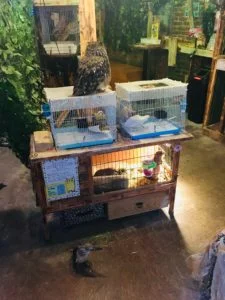
Animals stacked in cages inside an animal café in Japan.

Animals stacked in cages inside an animal café in Japan.

The letter highlights the complexities of proper husbandry required to appropriately care for highly intelligent and socially complex primates. “By not providing suitable environments and species appropriate social opportunities, the welfare of the animals is compromised, which can lead to abnormal behaviours and suffering. Although the owners might be providing care (food and water), they will not be able to meet the behavioural and psychological needs of the animals, as well as it being very difficult to appropriately provide for their nutritional and veterinary care needs” explained Simon Marsh, Director at Wild Welfare.

The joint letter further elaborates on how the absence of properly enriched environments and specialised treatments can fundamentally erode the physical and psychological health of non domesticated animals placed in these unnatural settings.

The collective appeal also outlines the increasing issue of Japan’s growing exotic animal cafe trend. Wild Welfare and JCAW have shown particular concern for the welfare of a diverse array of wild animals exhibited within these locations. From nocturnal owls confined indoors under bright unnatural light for many hours of the day, to socially complex animals such as meerkats kept segregated from groups. These unnatural and artificial environments force a high level of direct human interaction onto the animals, taking away the choice or control each animal has over their own life. “There is no place in a modern society for the keeping of exotic species in cafes for human entertainment” Simon expressed.

Wild Welfare and JCAW also highlight the heightened risk of zoonotic disease transmission within these confined and close contact facilities. As there are little to no effective national regulations governing these facilities, it is currently impossible to ensure both animals and customers are protected from the real risk of such disease exposure.

Two Prairie dogs in a small animal café cage.

Prairie dogs in a small animal café cage, Japan.

Another key issue raised by the appeal letter regards the troubling issue of illicit wildlife trade. Many of the thousands of exotic animals kept within Japanese animal cafes may also be pets, a number of which will be subject to international trade prohibitions. Without a robust system that allows traceability, there is a real risk that illegally traded animals may be exhibited at these cafe locations. In this circumstance, customers could unknowingly be supporting the illegal pet trade.

Wild Welfare and JCAW propose that deep legislative reform is necessary to tackle the many issues at hand. “Our joint letter makes a number of recommendations for reform, for instance, the prohibition or restriction of keeping primates as pets and close control of primate ownership. In the case of exotic animal cafes, the coalition recommends implementing a new regulatory framework for the industry” explained Simon.

two flamingos standing in an animal cafe in Japan

Two flamingos standing in a tiny pool by a chained Owl inside of an animal cafe in Tokyo.

The board members of the Japanese Coalition for Animal Welfare (JCAW), expressed how they are committed to lobbying for laws that protect all animals in Japan. “In recent years, there has been a global focus on issues regarding wildlife in captivity, and in Japan too, there is an array of unresolved issues related to the keeping of wildlife. JCAW believes that bringing each and every one of these issues to the attention of stakeholders as well as the general public would serve as the first step to creating a world that is compassionate to all animals.” said JCAW.

The comprehensive report is now available to download, with content currently only provided in a Japanese language version at https://www.dokyoren.com/250426/

“Our joint report with JCAW underscores Wild Welfare’s unwavering commitment to improving wild animal welfare globally” Simon exclaimed. It is hoped that this vital work by JCAW and Wild Welfare will encourage the government to act on the proposed suggestions and take real steps towards enhancing animal welfare across Japan, reducing the risk of zoonotic disease, and protecting the public, as well as conserving important wildlife by addressing the illegal trade of wild animals. 


Wild Welfare is devoted to improving the welfare of captive animals across the world. You can support our efforts by sharing this article, signing up to our newsletter, following our social media accounts (Facebook and Instagram), or by making an online donation. Every small contribution can help us to develop our vital accessible animal resources. Thank you.


zaterdag 20 december 2025

More than 10.000 shark fins seized in Peru with a value of $11 milion: fishermen cut the fins off whilst the sharks are alive and throw it back into the ocean to die


More than 10,000 shark fins have been seized in Peru in a major international operation, another powerful reminder of the horrific scale of the global shark fin trade.


I am sorry to have to show you this horric picture but unfortunatelly this how it goes. The fishermen cut the fins off whilst the shark is alive and then throws it back in the ocean where it slowly dies

On November 10, a joint operation led by the Organized Crime Investigation Division of the Environment Directorate of the National Police of Peru (DIVINCCOMA), with key support from the United States Fish and Wildlife Service (USFWS) and the Anti-Narcotics Affairs and Law Enforcement Section (INL), resulted in the seizure of 9.3 metric tons of shark fins in Callao, Peru. Three members of a transnational criminal network were arrested.

This historic seizure ranks among the largest shark fin busts in Latin America, delivering a significant blow against wildlife trafficking and the criminal networks driving the destruction of marine ecosystems.

The seized fins came from blue sharks, pelagic fox sharks, and common fox sharks, all species facing varying degrees of threat. Peruvian National Police estimate the shipment’s value at more than $11.2 million on the international market.

Investigators uncovered an illegal network that purchased fins from Ecuadorian fishermen, falsely declaring them as caught in Peruvian waters to move them through the supply chain. Once dried and stored in Callao, Peru, the fins were destined for export to China.

At the request of Peruvian authorities, INTERPOL provided digital forensics and analytical support to assist with follow-up transnational investigations. A November 19 report confirmed that those arrested were linked to a criminal scheme involving illegal extraction, trafficking of genetic resources, and organized environmental crime.

The shark fin trade is one of the most brutal forms of wildlife exploitation on the planet. Sharks are often hauled onto boats, their fins sliced off while they are still alive, and their mutilated bodies thrown back into the ocean to slowly suffocate or bleed to death. This cruelty is driven entirely by greed and profit.

Each year, tens of millions of sharks are killed for their fins, decimating shark populations worldwide. As apex predators, sharks play a critical role in maintaining balance in marine ecosystems. Their removal triggers ripple effects that destabilize food webs, degrade coral reefs, and push oceans closer to ecological collapse.

Illegal, unreported, and unregulated fishing also threatens Peru’s economy and coastal communities, with impacts felt far beyond its borders, including in the United States.

The USFWS provided financing, operational coordination, and specialized training throughout the investigation. Doug Ault, Deputy Director of Law Enforcement for the USFWS, stated, “This operation demonstrates the direct impact of cooperation between the United States and Peru to confront wildlife trafficking and organized environmental crime, which threaten marine ecosystems, local economies, and regional security.”

This operation was carried out by the same team that launched the Joint Planning and Coordination Center in Chorrillos in October. Funded by the USFWS, the center enhances Peru’s law enforcement capacity to counter illegal fishing, maritime trafficking, and other illicit activities in its waters.

World Animal News commends all investigators involved for their commitment to protecting sharks and other critical marine species. This seizure has saved countless sharks from a brutal fate, but the fight is far from over. The shark fin trade is driving our oceans toward ecological collapse, and it must end once and for all.


World Animal News

donderdag 18 december 2025

Whistle blower's video: Petition to ban use of dogs for toxicology tests reaches over 200,000 signatures 5 rescuers of 18 beagle puppies found guilty


MBR Acres is a facility that breeds dogs for animal testing in the UK. The verdict was given after a 12-day trial at Cambridge Crown Court.

The five beagle puppies rescuers, photo: Animal Rising

The rescue happened in December 2022. The five defendants, Eben Lazarus, Ben Newman, Hannah Hunt, Nathan McGovern, and Lewis Elliot, entered MBR Acres and took the puppies. They said they did it to save the dogs from a life of suffering.


This is the first legal case in the UK involving the “Open Rescue” method. Activists openly enter animal facilities to remove animals and then speak publicly about their actions.

The five said they were honest and acted out of compassion. But the jury decided they were guilty under the UK’s Theft Act.

Photo a beagle puppy  

More people are expected to go to court over the rescue. In total, 13 more individuals are facing burglary charges. Their trials are planned for January and February 2026.

’18 beagle puppies are alive’

After the verdict, Animal Rising co-director Ben Newman said: “The reality is that 18 beagle puppies are alive and free today because we took action. No verdict can erase that fact.”

“This case has shone a national spotlight on MBR Acres, and the cruelty of breeding dogs for experimentation, and the public response has been overwhelming,” he added.

During the trial, the court heard about the activists’ beliefs against animal testing. They spoke about a “bleeding license” used at MBR Acres, which allows for blood collection and terminal testing on healthy dogs. They also shared scientific sources that question the effectiveness of animal testing.

A petition asking the UK Home Office to shut down MBR Acres and rehome the dogs has already collected nearly 39,000 signatures.

The five activists say they stand by their actions, even if the court did not accept their defence.

“I respect the jury’s verdict, but I remain proud that 18 dogs were rescued from a life of experimentation and are now safe,” Hannah Hunt said.

   The Animal Reader

woensdag 17 december 2025

Across the world, animals are suffering – and Asia is no exception but I would like to show you that a small change for animal welfare is happening


https://youtu.be/foFNF7SUmik?si=0EnTukhfC_WBNTqw  This is what I mean from a life in misery and pain to freedom!!  www.animalsasia.org

In each cage a bear stolen from the wild some of the bears live 30 years in this horrific situation

While many people and local organisations care deeply for animals and inspire transformative change, certain traditional practices and industries continue to cause immense harm.


Many bears have to survive in very small rusty cages. 

In parts of Asia, some animals are still used in medicine, sold in brutal meat markets, or kept in poor conditions for entertainment.

Others are taken from the wild or the streets and denied the chance to live naturally and safely. These issues are complex, often rooted in history, poverty or lack of awareness.

Animals Asia works hand-in-hand with governments, local communities and grassroots groups to address the most urgent forms of animal suffering

What is bear bile farming?

Bear bile farming is the industrial exploitation of bears for their bile – a digestive fluid used in traditional Asian medicine. More than 10,000 bears, mostly moon bears but also sun and brown bears, are trapped in this cruel trade across Asia.

We’ve rescued bears in cages so small they couldn’t turn around or stand on all fours. Most are confined this way as cubs and can survive up to 30 years, suffering decades of physical pain and psychological trauma.

Bear rescues

Animals Asia has rescued over 270 bears from bile farms across Vietnam – each rescue the result of collaboration with government authorities, local enforcement agencies, traditional medicine practitioners and local communities.


We identify bears in need, negotiate their release, and carry out complex rescues. We transport each rescued bear safely to our sanctuaries, where their new lives begin.

Our approach is built on cooperation, not confrontation. We engage directly with bear farmers, listening with empathy and offering practical support.


Why does bear farming continue?

Despite bans in countries like Vietnam and Laos, bear bile farming continues due to demand and inconsistent law enforcement. Legal loopholes allow the practice to masquerade as pet ownership, and enforcement agencies are overstretched and under-resourced. In China, where the practice is still legal, farms operate on an industrial scale.

What is bear bile used for?

Bear bile contains ursodeoxycholic acid (UDCA), and is used to treat liver and gall bladder issues. It’s also found in other traditional remedies, cosmetics and even wine and toothpaste. 

https://www.animalsasia.org/celebrities-unite-to-help-free-the-final-bears-in-vietnam/

MEET THE BEARS IN THE SANCTUARIES


Bear rescues

Animals Asia has rescued over 270 bears from bile farms across Vietnam – each rescue the result of collaboration with government authorities, local enforcement agencies, traditional medicine practitioners and local communities.

We identify bears in need, negotiate their release, and carry out complex rescues. We transport each rescued bear safely to our sanctuaries, where their new lives begin.

Our approach is built on cooperation, not confrontation. We engage directly with bear farmers, listening with empathy and offering practical support.

Education and awareness

Animals Asia’s education programs reach schools, universities and communities where bile farming once thrived. In areas like Phung Thuong – a bear bile farming stronghold – our outreach has led to visible shifts in attitudes and public support for bear welfare.


We run workshops, bear-themed events and interactive lessons designed to teach empathy and environmental responsibility. Thousands of students across Vietnam have participated and brought the message home to their families.

We also run national public awareness campaigns. These include billboard campaigns, social media outreach, and media partnerships with local celebrities and influencers. Student groups and NGOs partner with us to amplify this message across Vietnam.

dinsdag 16 december 2025

Dog Houses for Animals in Turkey: The winter has begun and more than 150 dogs and 100 cats are living outside and it is cold !! ( Video's )


maandag 15 december 2025

80+ dogs rescued in 'heartbreaking' conditions from organized dogfighting iin Florida: many dogs suffering from wounds, open sores, and underweight


More than 80 dogs and puppies are finally safe following a multi-property suspected dogfighting bust in Clay and Union counties, Florida, putting an end to the suffering these animals endured at the hands of a brutal and illegal industry.


Humane World for Animals assisted local authorities with the rescue at the request of the Clay County Sheriff’s Office and the Union County Sheriff’s Office. Veterinarians from the University of Florida Veterinary Forensic Sciences Laboratory also provided critical on-scene support.

Search and seizure warrants were executed early in the morning of December 10 across three properties. What responders discovered was deeply disturbing. Many dogs were chained with heavy restraints, left with plastic barrels or makeshift structures as their only shelter. Others stood in their own feces inside filthy outdoor hutches and pens. On one Union County property, two young puppies were found whimpering alone, without their mother.

Across all three locations, responders observed dogs covered in scars consistent with dogfighting. Many were severely underweight and suffering from skin disease, open sores, and fresh wounds. One dog on the Clay County property was missing his foot; veterinarians determined he had suffered a traumatic amputation that had never been medically treated.

Investigators also uncovered clear signs of organized dogfighting, including treadmills and conditioning and breeding equipment on each property, tools used to force dogs into violent combat for human profit.


“Their scars tell a heartbreaking story—the sadness and suffering these dogs have endured is unimaginable,” said Kate MacFall, Florida state director for Humane World for Animals. “This is a complex, multi-agency collaboration, and we are grateful for the Clay County Sheriff’s Office and Union County Sheriff’s Office for investigating and bringing justice to these animals.”

“We take allegations of animal abuse or dogfighting very seriously, and we are grateful to the community members who stepped forward with information that set this investigation in motion,” said Clay County Sheriff Michelle Cook. “We appreciate the USDA and its agents for their dedicated investigative efforts, and we extend our thanks to Humane World for Animals for their invaluable assistance.”


Dogfighting inflicts horrific and often fatal injuries, including deep puncture wounds, broken bones, severe bruising, and internal trauma. Many dogs do not die during the fight itself, but later from dehydration, infection, blood loss, exhaustion, or shock. These dogs are deliberately bred and conditioned for violence from birth, the start of a lifetime defined by cruelty.


Humane World for Animals has documented that organized dogfighting frequently overlaps with other serious crimes, including weapons offenses, gambling, drug trafficking, and violence. Dogfighting is a felony offense, punishable by up to five years in prison for operating fights or for possessing, training, selling, transporting, or breeding dogs for fighting.

This year alone, Humane World for Animals has assisted authorities in Florida, South Carolina, and Indiana with the rescue of nearly 200 dogs from 12 properties linked to suspected dogfighting operations.

Following this rescue, Furry Friends Humane is transporting the dogs to a secure, confidential location, where Humane World for Animals responders and volunteers will provide urgent medical care, nourishment, and comfort. RedRover Responders volunteers will also assist with daily care as the dogs begin their long road to recovery.

Thanks to swift action and collaboration, these dogs will no longer be forced to suffer for a sick and violent industry. World Animal News is grateful to everyone involved in this lifesaving rescue, including Humane World for Animals, RedRover Responders, Furry Friends Humane, and the Clay County and Union County Sheriff’s Offices, as well as the investigators and community members whose courage helped bring this cruelty to an end.