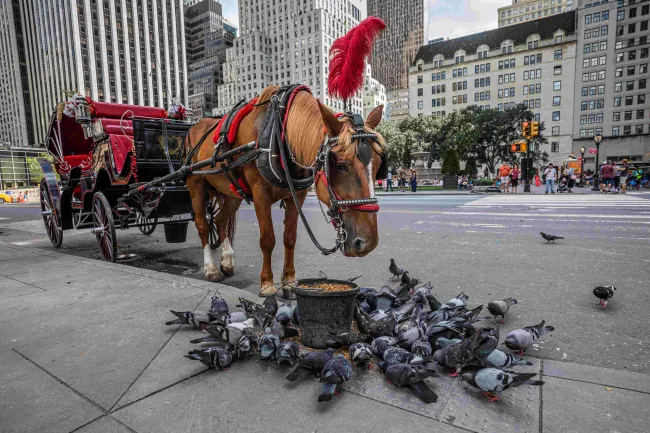
For decades, New York City's carriage horse industry has operated on a fantasy that these horse-drawn vehicles can carry some romance of an earlier time. But animals are not symbols; they are living, breathing individuals with needs, instincts and intentions all their own. By ending the use of horse-drawn carriages, the City Council has recognized that no maintenance of tradition should come at the expense of risks to animals and people.
The end of horse-drawn carriage rides in New York City is something to celebrate. It is an acknowledgement that the best way to honor horses is to refrain from asking them to keep carrying yesterday’s burdens amid today’s traffic, crowds, noise and other stressors. It is a recognition that we now understand and can provide what these animals need to thrive. Horses are highly sensitive animals with powerful flight instincts; they cannot exist happily or safely alongside the traffic, noise and congestion of New York City streets.
The end of this inhumane and outdated industry follows years of incidents that have endangered horses and people alike.
Just this past June, an 18-year-old tourist tragically died in a runaway carriage accident. And earlier that month, a 16-year-old carriage horse collapsed while pulling passengers in Central Park and later died. In the lead up to this vote, we issued a special report showing that the carriage horse industry is simply untenable in a place like New York. That report, Who is responsible for protecting New York City’s carriage horses?examines the inherent problems with keeping carriage horses in and around Manhattan’s Central Park as a tourist attraction. I’ve urged that the horses be retired to sanctuaries, and that drivers in this industry should be offered help to transition to other livelihoods, to ensure the end of this custom be as humane and compassionate as possible for everyone.
Dozens of rescues, sanctuaries and nonprofit organizations, including Humane World for Animals, have offered placement options for horses currently working in the city, and we look forward to the moment when the harnesses are finally unbuckled and the last New York City carriage horses are safely removed from the streets.
Kitty Block is president and CEO of Humane World for Animals.
After petting a carriage horse in New York's Central Park at the age of five, Alexus Lawson was hooked.
She has driven a carriage in Manhattan's most famous park, pulled by her horses, for six years. But since Lawson heard about the city's vote this week to outlaw the carriages over animal and public-safety concerns, she has been worried.
"What am I supposed to do with my horse?" asked the 28-year-old, referring to Starlight. "You're going to tell me I can't work with her anymore? How am I supposed to ensure her health?"
Lawson is one of roughly 200 horse-drawn carriage drivers in Central Park. Use of the carriages has been an at-times controversial tradition for over 160 years that has become a popular tourist activity.
On Thursday, New York City Councilvoted to pass a ban on the carriages, beginning in June 2028. The proposal is backed by Mayor Zohran Mamdani, who said he will help develop a transition plan for workers in the industry.
Several drivers told the BBC that they did not want new jobs and disputed claims their horses were mistreated - even as many New Yorkers and tourists welcomed the ban.
Drivers of horse-drawn carriages in Central Park are concerned for their future - while animal activists see the ban as a victory
Photo credit: Lions at the Camagüey Zoo Facebook/Yanaris Alvarez
As severe economic instability in Cuba continues, a worsening animal welfare crisis is emerging within its zoos, raising urgent concerns that can no longer be ignored.
Recent reports from April 2026 paint a deeply troubling picture. At the Casino Campestre Zoo, images and eyewitness accounts have sparked international concern, showing lions in visibly emaciated condition. They appear weak, severely malnourished, and described as skeletal in appearance, struggling to survive. These reports have prompted urgent calls for immediate intervention.
But this may not be an isolated case.
Across the country, multiple facilities are reportedly facing similar challenges as Cuba’s ongoing shortages of food, fuel, and basic resources take a devastating toll not only on people, but also on animals entirely dependent on human care.
Zoos are increasingly struggling to meet even the most basic standards of animal welfare. Caretakers, often working under extremely difficult conditions, are constrained by a lack of supplies, limiting their ability to provide consistent nutrition and adequate care.
Facilities such as the National Zoo of Cuba are not immune to the country’s broader economic crisis, raising serious questions about long term sustainability and animal welfare.
Meanwhile, attractions such as the Acuario Nacional de Cuba and the Delfinario de Cienfuegos continue to operate, though visitor experiences vary widely and growing ethical concerns are being raised about conditions and consistency of care.
This crisis raises a broader and urgent question: what happens to captive wildlife when the systems meant to protect them begin to fail?
Without immediate attention, resources, and international support, the suffering of these animals risks deepening further, hidden in plain sight behind bars that were never meant to become cages of neglect.
The global community cannot look away. Greater transparency, independent monitoring, and urgent intervention from Cuban authorities are needed to address these conditions and prevent further suffering.
Take action by contacting the Cuban government, along with international animal welfare and public authorities, to urge immediate intervention to protect the lions and other animals at the Casino Campestre Zoo, as well as at zoos and facilities across Cuba.
The management of the Zoo at the Casino Campestre in Camagüey issued a statement rejecting the allegations shared on social media regarding the abandonment and malnutrition of its animals, but subtly acknowledged that the country's economic crisis directly affects the facility.
The text, shared by Radio Camagüey on , describes the publications that circulated in recent days as "manipulation and slander," and claims that the workers care for the animals "with such diligence and dedication."
However, the statement itself acknowledges that the oldest lioness in the zoo, at 22 years old, "shows natural signs of deterioration due to her inability to digest food," although it attributes this to biological causes associated with her old age.
The institution claims to have five caretakers, a food preparation specialist, a biologist, and a veterinarian who monitor the animals' health daily.
Facebook capture / Radio Camagüey
Even so, the message concludes with a phrase that reveals the contradiction between the official discourse and reality: the zoo operates "despite the effects of the current economic situation in the country, from which it is not exempt."
The complaints that prompted the institutional response began last Thursday, when the Cuban Yanaris Álvarez published images of three lions from the Casino Campestre showing ribcages and visibly marked bones, severely atrophied muscles, and lying on a concrete floor surrounded by dry leaves in a neglected environment.
The next day, on Friday, citizen Pedro González reported in the Facebook group Revolico Camagüey that the zoo director prevented him and other neighbors from directly feeding the animals with meat, guava, bananas, and corn purchased with their own resources.
González's response was forceful: "Where is that diet when animals are dying of hunger? Where is the care when the water is dirty and the environment is unhealthy?"
The director suggested as an alternative that citizens donate food to the zoo staff so that it could be given to the animals, a proposal that the neighbors rejected. "We all know what usually happens with donations: they don't always reach those who truly need them," González explained.
The case of Casino Campestre, the largest zoo in Cuba with over 900 animals from 72 species, is not an isolated incident but part of a documented pattern of neglect in state facilities throughout the Island.
Cuba approved the Animal Welfare Decree-Law in 2021, with fines ranging from 500 to 4,000 Cuban pesos, but activists and independent organizations point out that the law lacks effective enforcement mechanisms and that state institutions rarely respond to complaints.
The statement made this Saturday is a notable exception, although its defensive tone and its veiled acknowledgment of the economic crisis as a limiting factor reveal that, behind the official words, the situation of the animals under state management remains critical.
This story follows the viral dog that gained attention for grieving its deceased owner outside a 7-Eleven store in Thailand.
Princess Siribha Chudabhorn of Thailand adopted the dog. (Photo Credits: Facebook)
Moo Daeng, the stray dog known for his unwavering loyalty, has found a new home in an unexpected place: a royal residence. Princess Siribha Chudabhorn of Thailand, the niece of King Maha Vajiralongkorn, has officially adopted Moo Daeng, ending his months of sorrow and uncertainty. The princess, deeply moved by Moo Daeng’s story, stepped in to provide him with a forever home. The dog became popular after waiting outside a 7-Eleven in Nakhon Ratchasima province for his late owner, who tragically passed away in November 2024.
Moo Daeng’s touching loyalty has led to him being called the “Hachiko of Korat," drawing a parallel to the famous Japanese Akita who waited for nine years for his late owner’s return.
In January, Moo Daeng’s heartbreaking story went viral on social media, leading locals to offer their care and support. Employees at the 7-Eleven provided food, blankets and even stuffed toys to comfort the dog. Despite their efforts, it was evident that its grief lingered deeply.
According to The Independent, last week, Princess Siribha Chudabhorn took to her official Facebook page to share the news of his adoption and to reassure his many admirers. “To all of Moo Daeng’s fans, I want to bring you up to speed so you don’t have to worry, feel anxious or have unanswered questions after all the recent drama," she said, as reported by Khaosod English.
Princess Siribha Chudabhorn revealed that she had first learned of Moo Daeng through a video highlighting the community’s fundraising efforts for his medical care. What struck her most was not just his physical condition, but the emotional toll of losing his beloved owner. “All my dogs have experienced trauma, whether through abuse, abandonment, or injury. But in Moo Daeng’s case, it’s severe depression," she explained. She noted that he was suffering from major depressive syndrome caused by the sudden loss of a loved one – something she herself has struggled with for nearly a decade, as reported by The Independent.