Translate

Posts tonen met het label Thailand. Alle posts tonen

dinsdag 3 november 2026

People for the Ethical Treatment of Animals ( PETA ) Kabang didn't choose to run but a rope was knotted around his neck


A Video No One Could Ignore

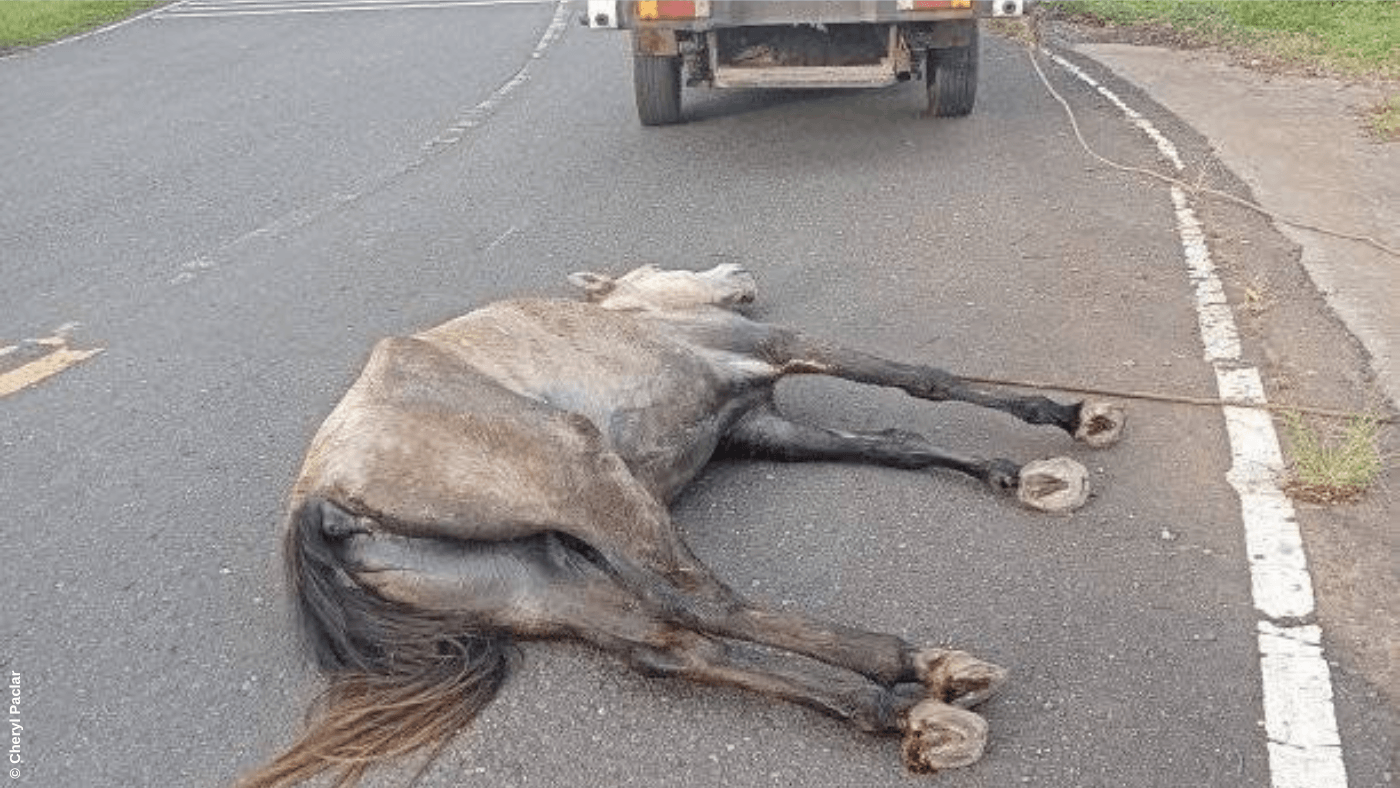
Kabang didn’t choose to run. A rope was knotted around his neck, the other end tied to a moving pickup truck—and for nearly 25 kilometers on a steep, winding cemented road, he had no choice but to run until he simply couldn’t anymore. He collapsed. And when the footage of his abuse went viral, PETA tracked Kabang down to an unlicensed ranch in Misamis Oriental and immediately began working to secure his release.
The Fight to Free Kabang
Getting custody of Kabang was anything but easy. PETA flew a team to the island, met with local government officials, and flew in an equine veterinarian. PETA refused to back down and kept pushing until full custody was secured. Kabang’s former owner was banned from caring for animals for life.

A Six-Day Journey to Safety
A PETA-arranged veterinary exam revealed that Kabang was suffering from severe lameness, hip pain, and hoof inflammation—conditions his former owner had never bothered to treat. PETA provided him with much-needed pain medication and prepared to transport him to a horse hospital.

When long-distance passenger ships and air cargo companies refused to transport a horse, PETA secured a horse trailer and truck and embarked on a six-day, more than 1,500-kilometer journey that included two ferry crossings, stopping frequently so Kabang could graze and rest.

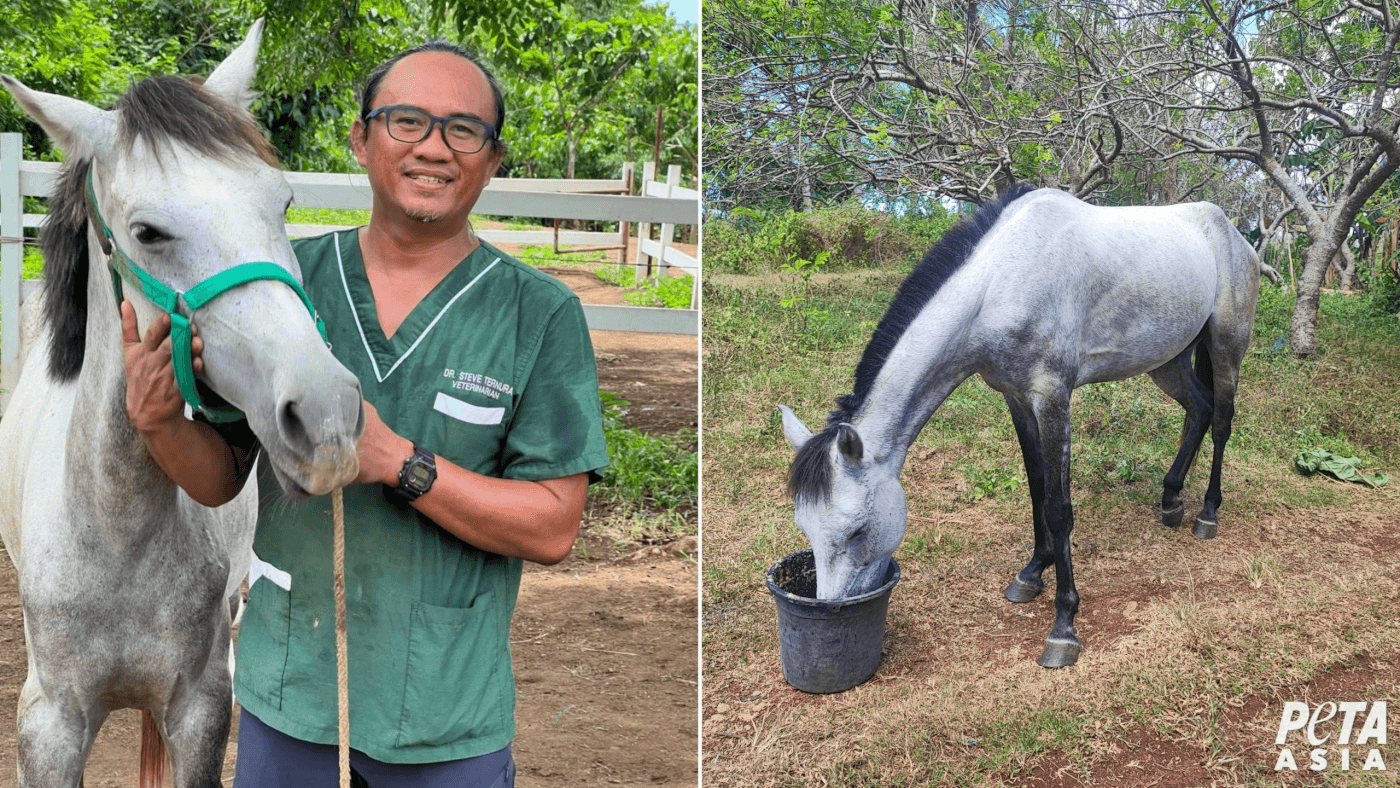
The equine veterinarian who accompanied Kabang throughout the entire journey stayed by his side through the difficult parts of trip—and by the time they arrived at the hospital in Batangas, he had already fallen in love with Kabang and asked to adopt him.

Kabang’s New Life
Today, Kabang lives free from exploitation. He spends his days in peace at his forever home, where he continues to recover in the company of other horses and a person who sees him for who he is—not what he can be used for.
What You Can Do
Kabang is free today because the footage of his abuse sparked nationwide outrage, and caring citizens shared the video with PETA—setting his rescue in motion. If you see an animal being abused, don’t look away—speak up, document it, and report

Your support makes rescues like Kabang’s possible—help us be there for the next animal who needs us.

Support PETA's Vital Work


zondag 25 oktober 2026

446 pieces of elephant ivory seized in Thailand: Behind every ivory seizure is a heartbreaking reminder of the suffering these magnificent animals endure for their tusks.


Photo Credit: Thailand’s Department of National Parks, Wildlife and Plant Conservation (DNP)

An investigation into suspected international wildlife trafficking continues in Thailand after authorities discovered 446 pieces of elephant ivory concealed inside timber logs at Laem Chabang Port in Chonburi Province.


The seizure was announced on October 7, after customs officials inspected two shipping containers declared as carrying 568 processed timber logs from Zambia.

Following intelligence shared by the United Nations Office on Drugs and Crime (UNODC) and the Wildlife Justice Commission (WJC), officers identified 32 modified logs containing hidden ivory and unidentified animal remains.

In a significant development announced on October 16, Thailand’s Department of National Parks, Wildlife and Plant Conservation confirmed that more than 70 officials participated in a detailed examination of the confiscated ivory and animal remains.

Wildlife forensic specialists collected DNA samples to help determine their origins. Preliminary examinations suggested that some of the unidentified animal remains could belong to a tiger or lion, although their species have not yet been confirmed. Authorities expect the DNA results to take approximately one to two months.

The investigation is also examining possible connections to wildlife trafficking cases in Southeast Asia. Thai officials have requested cooperation from CITES authorities in Vietnam and Laos to compare information from similar cases and determine whether the operations may be connected.

According to the department, evidence may also be shared with Thailand’s Department of Special Investigation (DSI) and INTERPOL if links to international organized crime are established.

The seizure underscores the devastating impact of the illegal ivory trade on elephants in both Africa and Asia, who continue to face the threat of poaching and exploitation.

The discovery of ivory and other animal remains concealed inside timber shipments also raises serious concerns about the methods used by criminal networks to transport illegally traded wildlife products across international borders.

Behind every ivory seizure is a heartbreaking reminder of the suffering these magnificent animals endure for their tusks.

World Animal News and Peace 4 Animals commend the authorities and organizations involved in uncovering this illegal shipment and urge continued international cooperation to identify and prosecute those responsible.

No elephant should ever lose their life for ivory. Protecting these extraordinary animals and ensuring a future where they can thrive in the wild must remain a global priority.


Origen: World Animal News

dinsdag 14 juli 2026

Wildlife Friends Foundation Thailand The Hidden Cost of a Selfie: The Truth About Lion Cafés ( 5 photos )


We receive hundreds of messages after viral videos expose the exploitation behind lion cafés. While this awareness is vital, many other videos continue to promote these venues as “cute” and “fun” – without realizing the suffering behind the scenes. Read our report on the Shocking Rise in Farmed and Captive Lions in Thailand and our Urgent Call for Government Action.

https://link.springer.com/article/10.1007/s44353-025-00040-4

Lions are not native to Thailand, and these cubs will never be released into the wild. They face a lifetime of captivity – simply to satisfy demand for close encounters. These lion cubs are not rescued. They are bred and rented or purchased from horrendous lion farms, where cubs are taken from their mothers at just a few weeks old. They are used for photos and cuddles until they grow too big – then, most are sent back to farms for breeding or face an even darker fate. These lions are exploited at every point of their lives. 


The conditions in these farms are dire. Lions are kept in barren cages for life, with females repeatedly bred to produce cubs for tourist attractions. All for a fleeting photo opportunity. Unfortunately, with the correct paperwork, it is legal to own a lion in Thailand.


Many people are particularly concerned about whether the lions are sedated – but that is just one part of a much bigger issue. Whether drugged or not, these animals should not be in cafés or used for human entertainment. The real problem is that they should never have been bred in the first place.

Wildlife interactions are never ethical


It’s not just lions. Any person or venue offering hands-on experiences with wildlife – whether it’s elephants, tigers, primates such as orangutans and slow loris, dolphins, or other animals – is exploiting them. We understand that animal lovers want to connect with wildlife, but true respect means observing animals from a distance in their natural environment, not forcing interactions for profit and entertainment.

Sedated for a selfie

What can you do?

  • Don’t like, share, or comment on videos featuring captive lions in a fun or positive way
  • Don’t visit places where you can interact with lions
  • Don’t pay for shows with big cats or any wildlife
  • Don’t pay to bottle-feed lions/ take photos with lions or any animal
  • Send a report through our Report Illegal Wildlife Trade form, and we’ll provide information on how to report this to the authorities. The more people who raise concerns, the more likely it is that action will be taken.

Report to the authorities

Please report any observations to the Department of National Park, Wildlife and Plant Conservation (DNP), which oversees wildlife management in Thailand, including the regulation of animals kept in private possession or zoos. They can be contacted via:

Phone: 1362
Facebook: DNP Facebook
Email: complain@dnp.mail.go.th or hotline1362@hotmail.com

For lions and other non-native wildlife listed under the CITES convention, please contact:

Phone: 095 314 5484 / 02-5610777 / 2912
Email: exocites@gmail.com or iwt_cites@dnp.mail.go.th or citesthailand@yahoo.com
Facebook: Non-Endemic Wildlife Management & CITES Thailand

If tourists stop paying for these experiences, the cycle of exploitation can end. 

Help spread awareness. Together, we can make a difference.

dinsdag 3 maart 2026

Authorities in Thailand are investigating after 72 tigers died suddenly at a popular tourist park where visitors can touch and pose with the animals.


A petting farm. This goes on all day. When this couple is told to stop, other people with a ticket  do exactly the same. The tigers are so docile that they are probably drugged. Please click on the video to enlarge. Mostly the teeth of the tigers are pulled or filed.

Mystery as 72 tigers suddenly die at Thai tourist park where visitors can touch the animals

Authorities in Thailand are investigating after 72 tigers died suddenly at a popular tourist park where visitors can touch and pose with the animals.

The deaths occurred in less than two weeks across two facilities at Tiger Kingdom Chiang Mai this month.

The provincial livestock department said tests detected canine distemper virus, though officials have not confirmed how the outbreak began.

At a press conference on Tuesday, authorities said the virus was no longer spreading, and no further tiger deaths had been recorded. No humans were infected.

The remains of the tigers have been buried, and a recommendation was made for the gravely ill tigers be euthanized, authorities said.

More than 240 tigers were housed at the two sites, according to local media. 

The facility advertises close-up encounters, allowing tourists to pet and take photos with the big cats. 

Canine distemper is a highly contagious disease that attacks the respiratory, gastrointestinal and nervous systems. 

Authorities in Thailand are investigating after 72 tigers died suddenly at a popular tourist park where visitors can touch and pose with the animals. Pictured: A Thai couple seen taking pictures next to a tiger at Tiger Kingdom

Authorities in Thailand are investigating after 72 tigers died suddenly at a popular tourist park where visitors can touch and pose with the animals. Pictured: A Thai couple seen taking pictures next to a tiger at Tiger Kingdom

The deaths occurred in less than two weeks across two facilities at Tiger Kingdom Chiang Mai this month

The deaths occurred in less than two weeks across two facilities at Tiger Kingdom Chiang Mai this month

The provincial livestock department said tests detected canine distemper virus, though officials have not confirmed how the outbreak began

The provincial livestock department said tests detected canine distemper virus, though officials have not confirmed how the outbreak began


It is most common in dogs but can infect big cats, often fatally. Officials also said samples from carcasses tested positive for a bacteria linked to respiratory illness.

Somchuan Ratanamungklanon, director of the national livestock department, said detecting illness in tigers can be difficult. 'By the time we realised they were sick, it was already too late,' he told local media.

Authorities have collected samples from the animals, their food and their surroundings. 

In 2004, nearly 150 tigers died or were euthanized during a bird flu outbreak at a zoo in Chonburi province, also linked to raw chicken feed. 

Staff at the Chiang Mai park have been placed under observation for 21 days, though none have fallen ill, Thai PBS reported.

Tiger Kingdom Chiang Mai has closed temporarily for two weeks while disinfection work is carried out. 

Animal rights groups said the outbreak exposed the risks faced by captive wildlife used for entertainment.

Wildlife Friends Foundation Thailand said in a statement that the tigers' deaths exposed the 'extreme vulnerability of captive wildlife facilities to infectious disease'.

Tragedies like this would be far less likely to happen if tourists stayed away from these attractions, Peta Asia said in a statement.


maandag 20 oktober 2025

VIDEO: The making of Happy Doggo: What started as one man is now a global organization, with employees, partners, and volunteers all over the world.


The making of Happy Doggo

What started as one man is now a global organization, with employees, partners, and volunteers all over the world.


2021

Humble beginnings

In early 2021, Niall Harbison was recovering from a near-death experience caused by substance abuse. In an effort to get back on track, he started jogging around Koh Samui, Thailand.

Observing many malnourished dogs, he started bringing food to some and sharing the videos online.


2022

Building momentum

Niall's videos started to attract the attention of people all over the world who wanted to help.

He began feeding and vaccinating as many dogs as he could, but he quickly realized that sterilization was the only way to fix the problem long-term.


2023

Going global

In 2023, Niall travelled to Europe, The US, and Dubai, organizing walks where dog lovers could meet up, chat, and talk about their collective goals to help street dogs.

Thousands of people turned up to talk to Niall. We found out how much dog lovers all over the world have been inspired to rescue dogs and help street dogs because of Niall and Happy Doggo's work


Today

Meanwhile, there were still hundreds of sick street dogs with nowhere to go. Niall secured a piece of land and set about making a sanctuary for dogs to recuperate, taking in only the most sick and vulnerable dogs. 


Today, Happy Doggo Land has capacity for 15 dogs, an on-site kitchen that prepares food for over 1,000 dogs a day, and a field clinic for Happy Doggo residents and visiting street dogs. In 2025, we will also begin construction on a state of the art hospital to treat an even wider range of injuries and illnesses.  


Tina's Hospital will be located adjacent to Happy Doggo Land. With approximately 3,117 square feet of medical facilities, it will host 2 operating theatres, diagnostic facilities such as x-rays, as well as an in-house lab, a pharmacy, and an intensive care unit.