Exploited And Abused, Chanchal Died Entertaining Tourists
The striking images have lingered across media platforms: Photographed in Jaipur, it’s a disturbing picture of an elephant named Chanchal painted bright pink, with a model sitting on her back. The elephant spent her entire life being ridden and exploited, and in her final days, suffered the indignity of being painted head-to-toe
The video is very difficult to understand. Watch it on YouTube and you can read the text in English
In recent days, a striking image has lingered across media platforms: Shot in Jaipur, it’s a disturbing picture of an elephant named Chanchal painted entirely in pink, with a model sitting on her back. At first glance, it appears whimsical. Almost surreal but look a little closer and you see an animal the size of a giant standing petrified like a prop. Viewers, including animal rights activists, expressed anger and questioned how exploitation of these gentle beings continues in the name of tourism and spectacle.
Then came another blow: The elephant’s owner said that approximately 70-year-old Chanchal had unfortunately died in February 2026 “due to old age”. This statement itself raised another bunch of red flags. Was this just another mask to cover-up for elephants like Chanchal who were constantly carrying the weight of tourists on their backs, which was slowly but surely wearing down their bodies?
Placed side by side, the viral spectacle and the reporting of her death are difficult to separate. The photoshoot exposed the reality of elephants whose lives are shaped not by choice, but by constant abuse and mistreatment. For years, she remained part of the city’s tourism economy, walking long hours, carrying people on a saddle and existing within a system that rarely prioritised her wellbeing.
Elephant rides in cities like Jaipur are often framed as cultural experiences. The imagery is familiar and seemingly normal for most Indians and tourists alike: decorated elephants, heritage backdrops, and the promise of something “authentic”. However, none of that is natural for the elephant, no matter how historically accurate it may seem.
At the centre of dominating elephants is phajaan, a ruthless process of traumatising them to such an extent that their spirits are broken. Young elephants are separated from their mothers, restrained, confined, and subjected to repeated torment until resistance becomes pointless. They are not trained, they are broken. They don’t learn obedience, they learn that the only way to survive is a quiet, fearful acceptance of a life where pain follows defiance, every single time. The ones that don’t submit eventually die from the torture.
Elephants love mud and sand when they live in the wild and are free
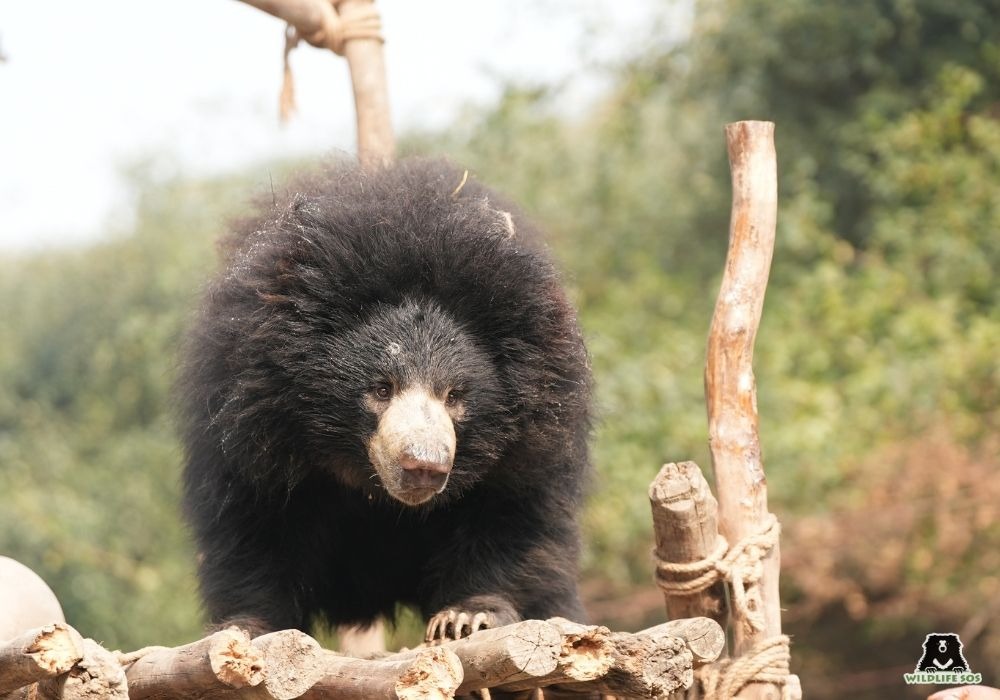
If energy could take shape, climb trees, and demand chunks of watermelon, it would probably look a lot like Jenny.
But Jenny’s story didn’t begin with all this play and curiosity that we’re about to tell you of. It began in the forests of Madhya Pradesh, where she was found as a tiny cub, just 2 months old, after a tragic encounter at the edge of human habitation. Separated from her mother far too soon, she was brought to our care at the Agra Bear Rescue Facility (ABRF) by the Madhya Pradesh Forest Department. Fragile and uncertain, Jenny was in need of constant support. What followed was a journey shaped by round-the-clock care, careful nutrition, and slow building of trust. Her journey with us turned fear into curiosity, and hesitation into the bold, spirited personality we see today.
[Photo (c) Wildlife SOS/Vineet Singh]
From the moment she wakes up, Jenny, now a year old, doesn’t just casually begin her day, she launches into it with utmost vigour. One minute she’s peeking out of her resting spot, and the next, she’s already plotting her next adventure, whether that’s conquering a log, splashing through water, or turning a simple tyre into a possible hula hoop!
With all that energy, we had to make sure that the little one has a big enclosure to exhaust all of it. In a way, keeping up with her vivacious spirit is a full-time job in itself. Inside her enclosure, there’s a curvy wooden hanging enrichment made of logs. She stands on her two legs, grabs the enrichment, and just as it turns, she too swings along with it! While doing so, what’s within it are the hidden dates that come tumbling down. She is also seen wrestling with this structure, in case it has more of these dates that haven’t made it through!
[Photo (c) Wildlife SOS/Mradul Pathak]
Jenny doesn’t just like water, she celebrates it! Her enclosure has a small pond, where she truly comes alive, splashing with such enthusiasm that it feels less like a bath time and more like a water park adventure. Water droplets fly in every direction as she stomps, rolls, and rejoices.
When North India saw heavy showers before the summer set in, most bears under our care did what one would usually expect of them: stayed dry and cosy within their indoor dens. Jenny, however, had other plans. She woke up, peeped out of her shed to “check” the weather, and within seconds decided that this was, in fact, the best muddy day ever. What followed was hopscotching through puddles, splashing, and turning the rainy day into a playful game day.
[Photo (c) Wildlife SOS/Sanjeev Marskole]
Inside Jenny’s enclosure stands a tall tree with a wooden platform built at the top, an enrichment designed to boost their climbing ability. Most bears enjoy it. If climbing had a scoreboard, the other bears would comfortably score a six, and a more jolly one like our recently rescued bear Gracie, who loves climbing trees, might reach a nine. But Jenny can simply outrun and demolish all records set by her forerunners at the centre. Her swiftness easily surpasses a measly scale of 10! She races up the tree, settles on the platform attached, and then casually starts playing with branches all around within the “verandah” made specially for her.
[Photo (c) Wildlife SOS/Atharva Pacharne]
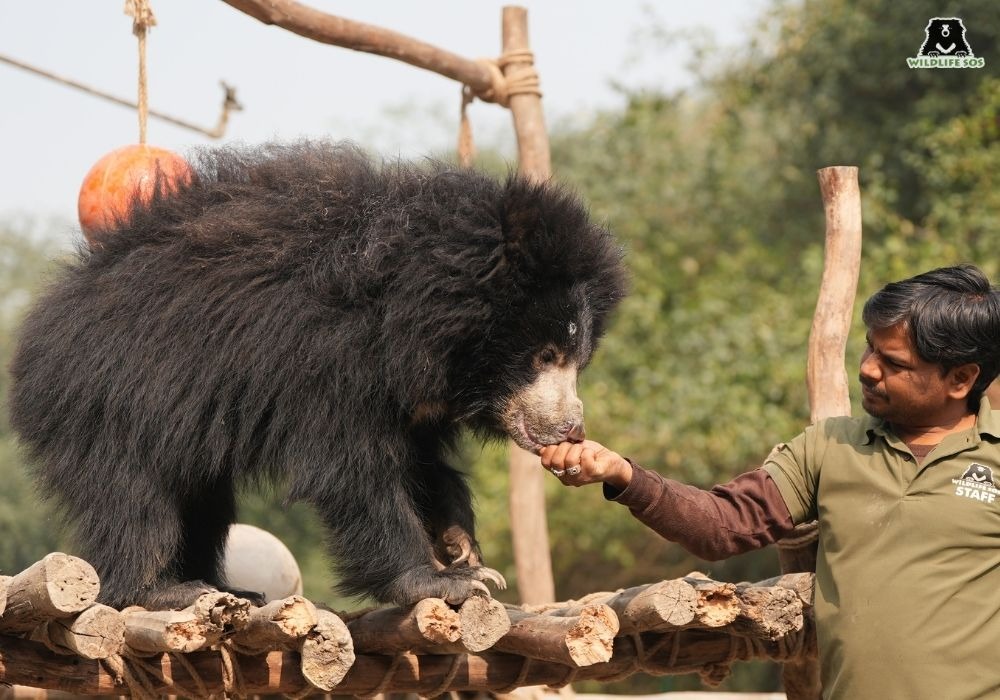
Jenny isn’t just active, she’s remarkably sharp. Target training cues that usually take time for other bears to recall are nothing but pieces of cake for Jenny. Take sleeve training, for instance, where she’s required to calmly present her forearm so the team can monitor her health. While many bears need time to understand the process, it only took two attempts for Jenny to figure it out. It’s the kind of learning curve that even makes her caregivers go, “Wow, that was fast!”
[Photo (c) Wildlife SOS/Sanjeev Marskole]
For Srinu Srikanta Maharana, Wildlife SOS’s Senior Research Assistant at ABRF who has been working closely with her, watching a young sloth bear grasp concepts this quickly is as fascinating as it is rewarding. While Jenny may be independent in her adventures, she shares a close bond with both Srinu and her caregiver, Deshraj. When Jenny first came to our centre, she was dealing with health challenges like diarrhoea that were brought on by stress. Specialised hand-rearing care was given to the cub, with required supplements blended into her milk formula she received. Caregivers were committed to provide constant nourishment, comfort, and reassurance to Jenny, which has worked wonders for her well-being.
[Photo (c) Wildlife SOS/Atharva Pacharne]
Graduating from milk, Jenny was led to a nourishing porridge, and it quickly won Jenny’s heart. Among fruits, watermelons and apples are her firm favourites, and she would choose them every single time over the others offered. With the onset of summer, there’s an all new fresh scent in the air: will mangoes make it to her list of favourites as well?
Jenny’s unstoppable curiosity and liveliness show how she’s growing up to be a healthy and happy sloth bear. Every run, every climb, every splash of water is a reflection of a bear who is thriving, physically and mentally. She is equal parts an athlete, an explorer and a problem-solver, an exceptional young bear who makes each day a joyful experience.
Jenny has brought a fresh zest of life at ABRF with her childhood mischief that we absolutely love. Donate today and help Wildlife SOS continue caring for sloth bears like Jenny.
On the last day of the year 2025, our team arrived in the scenic town of Sahibganj in the state of Jharkhand. We were alerted to a sloth bear which was rescued by the forest department. With unspoken concern in our hearts we wondered about the grave injustice that has happened to this yet unknown ursine.
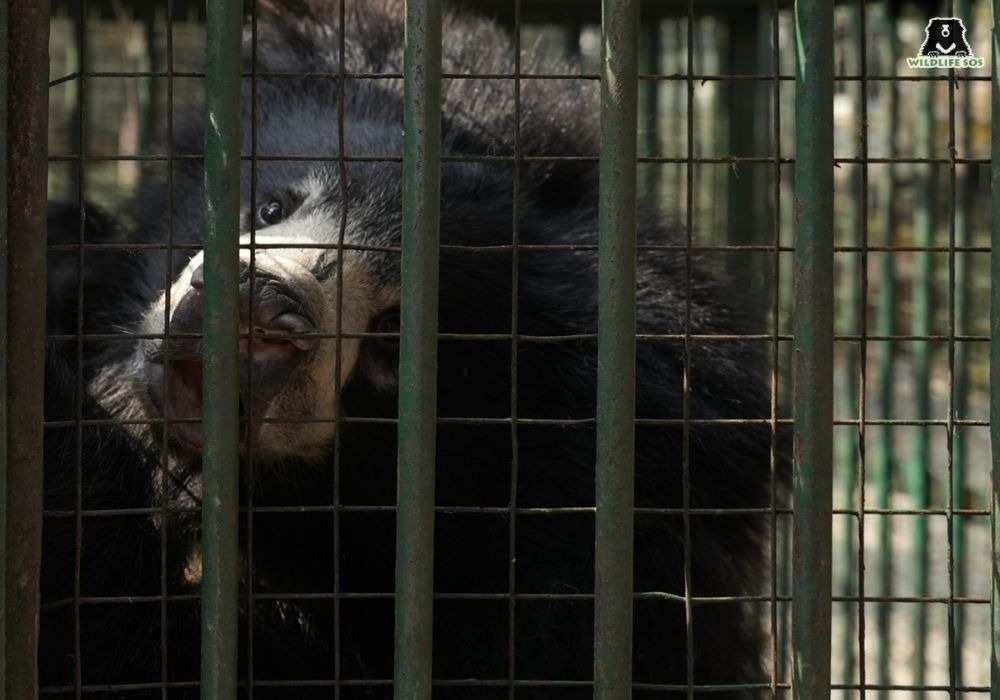
A ripple of shock went through the entire team as they entered the premises of the forest department. They saw what was last seen in the year 2009. A female sloth bear was crouched in a trap cage with a rope around her neck. Her muzzle was pierced, leading the team to believe that this was done to pass a tugging rope. All four of her canines were found to be smashed. That was the moment they knew very well that they had in fact come across a ‘dancing’ bear.
Wildlife SOS team immediately noted that the rescued sloth bear had a pierced muzzle, indicating how her future was being directed towards the cruel ‘dancing’ bear practice. [Photo (c) Wildlife SOS/ Vineet Singh]
Forest officials have previously reported poaching incidents near the Indo-Nepal border, and Wildlife SOS have also rescued a few bears that were being poached across borders to facilitate this practice in our border countries, but retrieving a ‘dancing’ bear had come in as a rare rescue.
There were no visible signs of infection at the time of assessment, however, she was suffering from diarrhoea and required immediate medical attention. [Photo (c) Wildlife SOS/ Vineet Singh]
Wildlife SOS had put in committed efforts to bring an end to this gruesome practice with the rescue of over 628 sloth bears, the last of which being Raju (Adit) 17 years ago. Through years of conducting rescue operations, ensuring legal action, providing rehabilitation care to the rescued bears, and alternative opportunities for livelihood to the Kalandar community reliant on the practice, the illegal trade was brought to a halt in India. However, we kept a lookout for bears being poached, especially near the Indo-Nepal border, from where Ron, Molly and three more bears were rescued from being smuggled for this very trade in 2019.
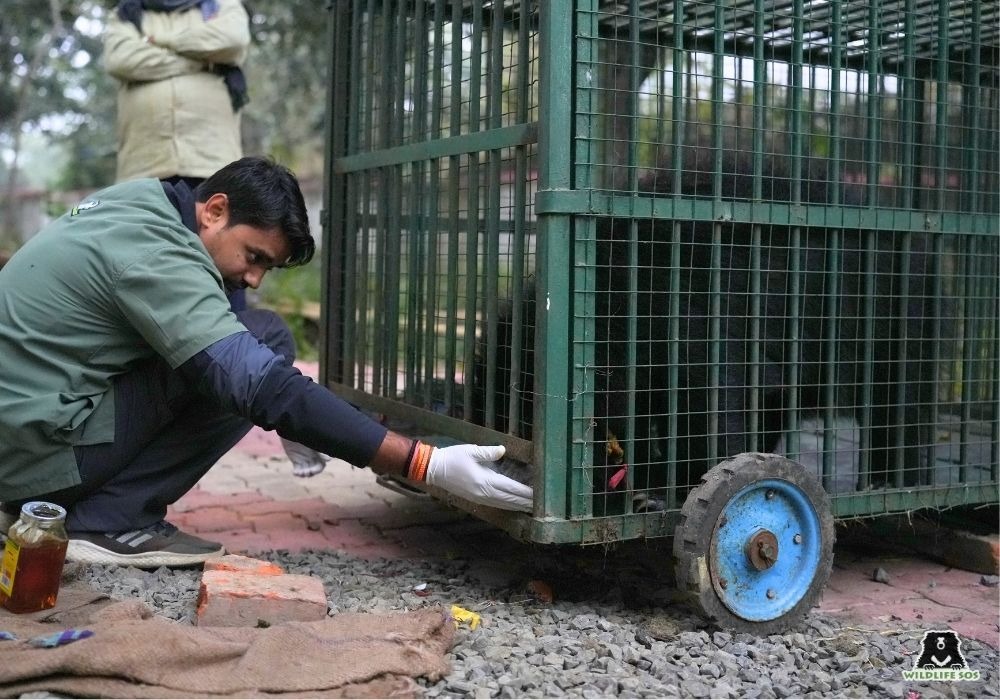
Our proficient veterinarians ensured the ursine was well enough to start her journey to the sanctuary. [Photo (c) Wildlife SOS/ Vineet Singh]
The years of experience and studying sloth bear trade closely led to the understood conclusion that the bear rescued in Jharkhand was separated from her mother at a tender age.
Without maternal guidance for survival skills, releasing the rescued bear back into the unknown wild posed a great threat to her life. Considering our expertise with rehabilitating sloth bears, the forest department of Jharkhand handed over this young sloth bear’s safe and long-term care to Wildlife SOS.
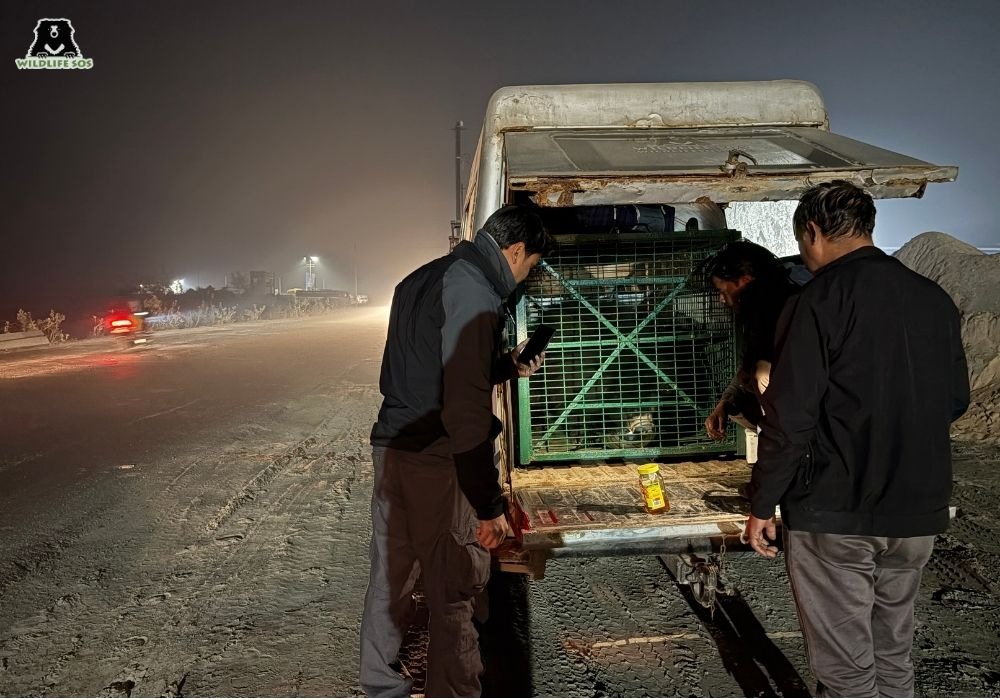
The young bear’s journey from Jharkhand to our centre in Agra took place over two days, covering over 1,250 km with frequent pitstops to ensure she was well fed and in good health. [Photo (c) Wildlife SOS/ Vineet Singh]
Wildlife SOS has four rehabilitation centres specifically for the care of sloth bears, the first of which being the Agra Bear Rescue Facility (ABRF) that was established in 1999 in Uttar Pradesh in collaboration with the Uttar Pradesh Forest Department,. When this bear arrived at ABRF, we helped her turn over a new leaf in her life. This new beginning came with a new name as well. She was introduced to the entire family of Wildlife SOS and our benevolent supporters as Lissy — a name in remembrance to one of Wildlife SOS’s long-time friend and supporter, Lis Key. Lis worked tirelessly with International Animal Rescue (IAR), a UK-based conservation organisation that has been instrumental in helping us end the brutal ‘dancing’ bear practice since the very beginning. Her everlasting compassion for wildlife now lives on with Lissy.
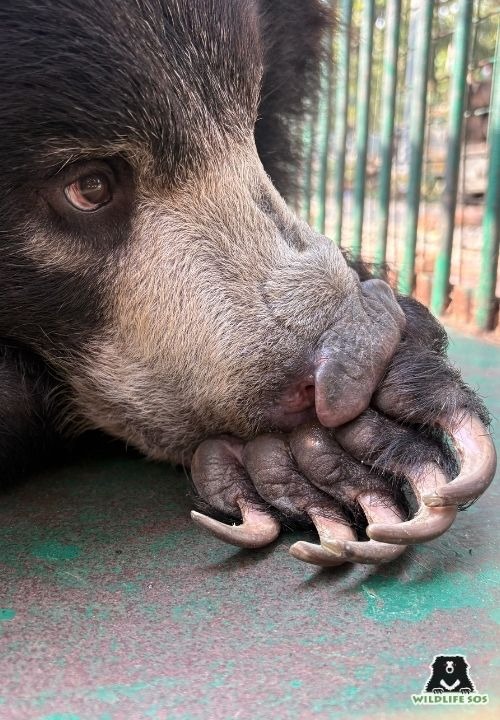
Lissy’s frizzy fur and her immaculate eyes reveal what she has suffered. [Photo (c) Wildlife SOS/ Mradul Pathak]
Care and Comfort
Currently, Lissy is under careful observation in a three month quarantine that is part of the rehabilitation protocol we consistently follow. This period allows the veterinary team to understand medical issues the bear is facing, conduct health assessments, and curb any possibility of infection or disease. In turn, the calm environment reduces stress levels of the rescued bear, and even gives the bear time to adjust into its surroundings and develop trust in the care being given.
Lissy was undergoing digestive discomfort and faecal inconsistency. Upon further investigation, endoparasites were detected and our team quickly provided Lissy with her first deworming dose and essential vaccinations. Medical assessments are crucial as they will serve as a bedrock for her well-being. To supplement these, our dedicated team is also monitoring Lissy’s behaviour, understanding her needs and her preferences.
Healthy meals are an essential part of Lissy’s care. She receives multi-millet porridge blended with fresh vegetables twice a day. Vitamin and mineral supplements are mixed in her food for easy consumption. Lissy quickens her pace towards her full feeding bowl everyday. And a peculiar yet endearing habit of hers reveals itself when she lowers her head into it — Lissy likes to make bubbles with her nose while slurping her porridge!
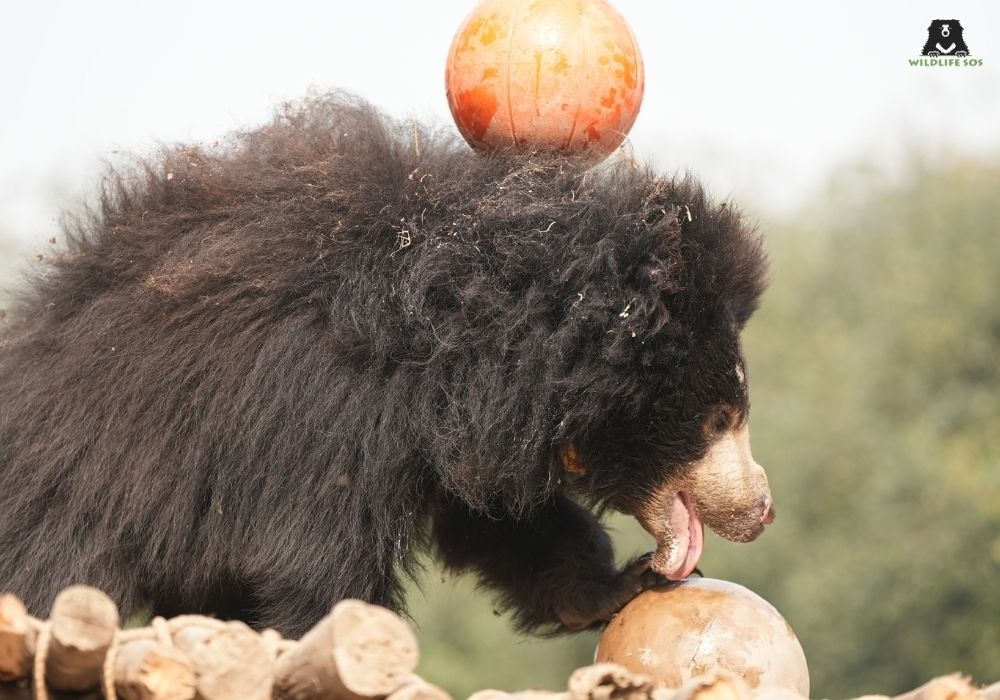
Lissy has been introduced to enrichment balls that are covered with peanut butter and filled with dates. Her fascination in exploring them each day shows how playful and enthusiastic she is. She is finally surrounded by earth, nature’s gift to sloth bears and their insectivorous appetite, and has begun to dig pits in search of ants and termites, reclaiming an inherent habit of sloth bears that had so far remained subdued.
For the very first time, Lissy is exploring her ability to climb and has been doing so on the wooden platform created by the staff, who have been present to help her feel secure since her arrival. [Photo (c) Wildlife SOS/ Mradul Pathak]
While she is a lively bear, Lissy is cautious around human beings. This comes as a natural reaction for a bear who has so far only witnessed insensitive treatment by her former captors. However, she is gradually building trust with her caregivers, and their soft interactions with her are laying out this friendly bridge. As she takes her steps forward on it, Lissy is slowly being introduced to operant conditioning as well that involves responding to cues for comfortable medical examinations. Gentle gestures are helping Lissy gain confidence in this process, which is visible in Lissy’s willingness to participate. There’s another reason behind why Lissy remains highly active during this time. She is now well aware that every session comes with a sweet, rewarding promise of receiving dollops of honey!
The smell of peanut butter on enrichments is undoubtedly captivating for Lissy and the sloth bears at ABRF, serving as a major attraction to follow and remain physically engrossed for hours. [Photo (c) Wildlife SOS/ Mradul Pathak]
Join Lissy in her journey of healing by becoming a monthly donor for Wildlife SOS and stay up to date on how she is settling into her new home!
Lissy will continue to remind us of our deep and steadfast alliance with International Animal Rescue that has played a vital role in Wildlife SOS’s mission to free bears from exploitation and, preventing cubs from being poached from the wild to feed this cruel practice. Wildlife SOS has fought the injustice of the ‘dancing’ bear practice once before, and we will not hesitate to do so again. If you witness a sloth bear being abused, exploited, or forced to perform, please email us directly at info@wildlifesos.org or use this hotline for an immediate response: +91 9971699727.
Wildlife SOS has rescued, rehabilitated and released many animals over the past 30 years. The everyday work at our centres includes our caregivers and veterinarians tirelessly dedicating hours to care for the animals. During the structured routine, certain episodes emerge and reflect the quirky behaviour of our resident animals. Their cheerful, unique and interesting acts truly make for unforgettable tales.
Recently, a baby elephant, gravely injured and requiring utmost attention, arrived at the Elephant Hospital Campus.
Bani is learning to stand
Over the past few months, our team of veterinarians and caregivers have devoted themselves to focus on her health and employ every possible technique to restore her well-being.
Taking a bath and playing with one of the elephant keepers
While baby Bani’s care came as a colossal challenge, the team and Bani took up this journey with courage and might. Every positive move she made had our team cheer with delight. One of the ways Bani showed signs of healing was through her mischievous conduct that she began to slowly reveal. She is now amicably called a “bundle of joy” that never fails to bring a smile to everyone’s face!
The story of Zara is one that I will never forget She is one of the 300 begging elephants still active on the streets of India. Zara was saved by WildlifeSOS and although in pain due to her previous life, she is happy and loves eating her watermelons.
The story of 'begging elephant' Zara rescued by Wildlife SOS India in 7 photos: From a Hel to heaven
Begging for money in chains
An emaciated female elephant, that dragged herself through the day, with the overbearing weight of a carrier, will no longer suffer after being rescued by Wildlife SOS. Her frail structure held testimony to the life that she lived as a begging elephant moving from pillar-to-post.
Saved by WildlifeSOS just in time. Mentally and physically broken. A blanket to keep her warm
Wildlife SOS named her “Zara” which means princess – something that she rightly would have been, in her herd in the wild, but the evil clutches of illegal wildlife poaching snatched that joy from her and pushed her into a lifetime of captivity.
On the way to a good life. Thank you Wildlife SOS I have been following you for 20 years and I am so proud of you !!
Due to Zara’s rapidly deteriorating health, primarily affecting her joints, her owner was unable to meet her urgent medical needs. The nationwide lockdown that was imposed because of the COVID-19pandemic, was the primary cause for Zara’s owner not being able to begin her medical treatment. As soon as relaxations were levied, he was determined that his elephant would live a better life under the care of Wildlife SOS at the Elephant Hospital situated in Mathura. The Elephant Hospital opened its gates for Zara’s arrival and to provide her with the necessary medical treatment that would give her the relief she rightfully deserves.
When Zara arrived at the Elephant Hospital, the fresh air and the unfamiliar whiff of her lush green surroundings made her cautious, as well as anxious.
At just the tender age of 21, Zara has developed a serious case of osteoarthritis that has seriously affected her forelimbs and compromised her posture and gait. Her right forelimb, in particular, is damaged, along with an inflamed elbow joint that is the main reason of the slight limp that she has as she walks.
It is heartbreaking to imagine that with such a seriously compromised leg, that she was able to survive all these years of abuse. It is clear that Zara has an unfathomable amount of strength and willpower. Zara also has a wound on her left elbow and shoulder, which will be regularly cleaned and dressed with antiseptic ointment for quick recovery.
Her joints, however, are of serious concern and the Wildlife SOS veterinarians will be conducting X-Rays, as well as a complete blood report to assess the exact condition and seriousness of her limbs. Zara will be administered joint supplements and anti-inflammatory ointment for relief.
Zara’s right fore limb is the primary cause of concern for the veterinarians. Zara presently weighs 1970kgs, which is visible in the distinct, protruding shape of her spine that is due to her malnourishment. To everyone’s relief, her vision is proper and she is slightly anxious about her new surroundings, which is why the elephant care staff and veterinarians are giving her the time that she needs.
Her first ever shower!! What a joy,
Even in her pain and discomfort, Zara appears to have a zeal for life as she was quick to take a liking to her bucket of watermelons and splash her trunk around! Her enclosure is equipped with mud beds for her support, to take the weight off of her legs, and for her to rest. Although Zara just wishes to look around her enclosure and watch her neighbors, the resident pachyderms instead.
While Zara has been on a tiring journey, emerging from her past life and taking small steps into her new home, Wildlife SOS requests everyone to keep her in your prayers while their team of veterinarians, elephant care staff, and hospital staff work to make her comfortable.
She will no longer be paraded around on hot tarmac roads, or have just a few stalks of dry grass and bananas while tethered to a confined, concrete space, pushing to break free.
As this fragile and battered creature finds comfort in her new home, Wildlife SOS requests that you show her your support and love by making a donation HERE!