Translate

Posts tonen met het label begging. Alle posts tonen

donderdag 23 juli 2026

Elephant Zara 20 years of begging on the streets of India mentally and physically broken, rescued by Wildlife SOS India


An emaciated female elephant, that dragged herself through the day, with the overbearing weight of a carrier, will no longer suffer after being rescued by Wildlife SOS. Her frail structure held testimony to the life that she lived as a begging elephant moving from pillar-to-post.


Saved by Wildlife SOS just in time. Mentally and physically broken. A blanket to keep her warm

Wildlife SOS named her “Zara” which means princess – something that she rightly would have been, in her herd in the wild, but the evil clutches of illegal wildlife poaching snatched that joy from her and pushed her into a lifetime of captivity.


On the way to a better life. Thank you Wildlife SOS I have been following you for 20 years and I am so proud of you !!

Due to Zara’s rapidly deteriorating health, primarily affecting her joints, her owner was unable to meet her urgent medical needs. The nationwide lockdown that was imposed because of the COVID-19 pandemic, was the primary cause for Zara’s owner not being able to begin her medical treatment. As soon as relaxations were levied, he was determined that his elephant would live a better life under the care of Wildlife SOS at the Elephant Hospital situated in Mathura. The Elephant Hospital opened its gates for Zara’s arrival and to provide her with the necessary medical treatment that would give her the relief she rightfully deserves.

When Zara arrived at the Elephant Hospital, the fresh air and the unfamiliar whiff of her lush green surroundings made her cautious, as well as anxious.


At just the tender age of 21, Zara has developed a serious case of osteoarthritis that has seriously affected her forelimbs and compromised her posture and gait. Her right forelimb, in particular, is damaged, along with an inflamed elbow joint that is the main reason of the slight limp that she has as she walks.

It is heartbreaking to imagine that with such a seriously compromised leg, that she was able to survive all these years of abuse. It is clear that Zara has an unfathomable amount of strength and willpower. Zara also has a wound on her left elbow and shoulder, which will be regularly cleaned and dressed with antiseptic ointment for quick recovery.

Her joints, however, are of serious concern and the Wildlife SOS veterinarians will be conducting X-Rays, as well as a complete blood report to assess the exact condition and seriousness of her limbs. Zara will be administered joint supplements and anti-inflammatory ointment for relief.


Zara’s right fore limb is the primary cause of concern for the veterinarians. Zara presently weighs 1970kgs, which is visible in the distinct, protruding shape of her spine that is due to her malnourishment. To everyone’s relief, her vision is proper and she is slightly anxious about her new surroundings, which is why the elephant care staff and veterinarians are giving her the time that she needs.


Her first ever shower!! What a joy, 

Even in her pain and discomfort, Zara appears to have a zeal for life as she was quick to take a liking to her bucket of watermelons and splash her trunk around! Her enclosure is equipped with mud beds for her support, to take the weight off of her legs, and for her to rest. Although Zara just wishes to look around her enclosure and watch her neighbors, the resident pachyderms instead.

While Zara has been on a tiring journey, emerging from her past life and taking small steps into her new home, Wildlife SOS requests everyone to keep her in your prayers while their team of veterinarians, elephant care staff, and hospital staff work to make her comfortable.

She will no longer be paraded around on hot tarmac roads, or have just a few stalks of dry grass and bananas while tethered to a confined, concrete space, pushing to break free.

As this fragile and battered creature finds comfort in her new home, Wildlife SOS requests that you show her your support and love by making a donation HERE!

Elephant Manu also rescued from begging in the streets  ( video )


.www.wildlifesos.org


zondag 7 juni 2026

The cruel exploitation of Barbary macaques in Morocco dressed in children's clothes and begging is heartbreaking: Please take action !!


Poor little monkey locked up in this small wooden  cage begging to get out.

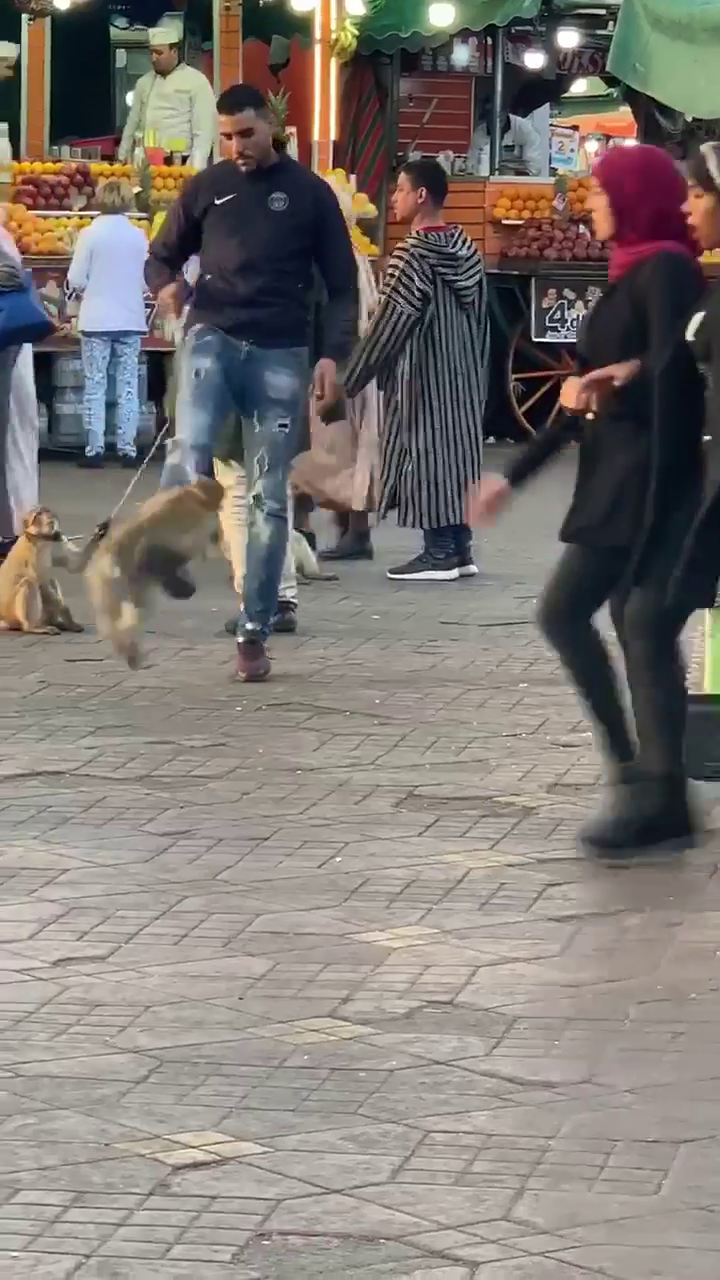
Disturbing photo's of Barbary macaques dressed in children's clothes, chained by the neck and dragged around by street handlers touting for photos and selfies to 'entertain' tourists, has been shared with Action for Primates by East Lothian Uncaged who recently filmed the monkeys at the Jemaa el-Fnaa square market in Marrakesh, Morocco. 


Making the monkey smile for a photo. The poor abused animal is also wearing nail polish.

Other heartbreaking images show imprisoned macaques reaching out from within dark wooden crates in which they are held and transported. Exposure to crowds of people and loud noises and the chaos of the busy streets would be extremely frightening and distressful for the macaques. The cruel and selfish exploitation of these macaques is morally reprehensible.


The Barbary macaque (Macaca sylvanus) is native to the Atlas Mountains of Algeria and Morocco, with a small population in Gibraltar. The species is classified as Endangered with a decreasing population trend, on the International Union for Conservation of Nature (IUCN) Red List of Threatened Species, and listed in CITES Appendix I (threatened with extinction). Major threats to the survival of wild populations of Barbary macaques include habitat loss and their capture and trade. Captured in the wild within Morocco, these macaques are sold as 'pets' and to supply the cruel photo prop trade for tourists, in particular in open air markets, such as Jemaa el-Fnaa in Marrakesh.

Barbary macaque being kicked by handler, Morocco; Nelly Moulin
Macaque being kicked by handler
Nelly Moulin

Earlier video footage previously shared with Action for Primates by Nelly Moulin also revealed the shocking way in which the macaques are treated by street handlers in Morocco. At the Jemaa el-Fnaa square market, street handlers were filmed dragging and physically abusing struggling and cowering young Barbary macaques.

The exploitation and physical and psychological cost to these wild animals for 'entertainment' is unacceptable.

Please speak up for the Barbary macaques:

  1. Write to the following:
    • Morocco tourist information centre, choosing the relevant country: https://www.visitmorocco.com/en/contact
    • Morocco embassy in your country: https://www.embassy-worldwide.com/country/morocco/
    • Urge the above to protect Barbary macaques by
      • enforcing the legislation that prevents their capture and 'possession';
      • taking action against the illegal trade; and
      • confiscating those macaques who are being exploited and abused as photo props by street handlers and re-homing them to genuine sanctuaries for rehabilitation and eventual release to a free-living state
    • Avoid tourist attractions that involve captive wildlife and always submit complaints to tourist and embassy outlets in individual countries as well as to travel and holiday companies.


maandag 28 april 2025

The story of 'begging elephant' Zara rescued by Wildlife SOS India in 7 photos: From a Hel to heaven


Begging for money in chains

An emaciated female elephant, that dragged herself through the day, with the overbearing weight of a carrier, will no longer suffer after being rescued by Wildlife SOS. Her frail structure held testimony to the life that she lived as a begging elephant moving from pillar-to-post.


Saved by WildlifeSOS just in time. Mentally and physically broken. A blanket to keep her warm

Wildlife SOS named her “Zara” which means princess – something that she rightly would have been, in her herd in the wild, but the evil clutches of illegal wildlife poaching snatched that joy from her and pushed her into a lifetime of captivity.


On the way to a good life. Thank you Wildlife SOS I have been following you for 20 years and I am so proud of you !!

Due to Zara’s rapidly deteriorating health, primarily affecting her joints, her owner was unable to meet her urgent medical needs. The nationwide lockdown that was imposed because of the COVID-19 pandemic, was the primary cause for Zara’s owner not being able to begin her medical treatment. As soon as relaxations were levied, he was determined that his elephant would live a better life under the care of Wildlife SOS at the Elephant Hospital situated in Mathura. The Elephant Hospital opened its gates for Zara’s arrival and to provide her with the necessary medical treatment that would give her the relief she rightfully deserves.

When Zara arrived at the Elephant Hospital, the fresh air and the unfamiliar whiff of her lush green surroundings made her cautious, as well as anxious.


At just the tender age of 21, Zara has developed a serious case of osteoarthritis that has seriously affected her forelimbs and compromised her posture and gait. Her right forelimb, in particular, is damaged, along with an inflamed elbow joint that is the main reason of the slight limp that she has as she walks.


It is heartbreaking to imagine that with such a seriously compromised leg, that she was able to survive all these years of abuse. It is clear that Zara has an unfathomable amount of strength and willpower. Zara also has a wound on her left elbow and shoulder, which will be regularly cleaned and dressed with antiseptic ointment for quick recovery.

Her joints, however, are of serious concern and the Wildlife SOS veterinarians will be conducting X-Rays, as well as a complete blood report to assess the exact condition and seriousness of her limbs. Zara will be administered joint supplements and anti-inflammatory ointment for relief.


Zara’s right fore limb is the primary cause of concern for the veterinarians. Zara presently weighs 1970kgs, which is visible in the distinct, protruding shape of her spine that is due to her malnourishment. To everyone’s relief, her vision is proper and she is slightly anxious about her new surroundings, which is why the elephant care staff and veterinarians are giving her the time that she needs.


Her first ever shower!! What a joy, 

Even in her pain and discomfort, Zara appears to have a zeal for life as she was quick to take a liking to her bucket of watermelons and splash her trunk around! Her enclosure is equipped with mud beds for her support, to take the weight off of her legs, and for her to rest. Although Zara just wishes to look around her enclosure and watch her neighbors, the resident pachyderms instead.

While Zara has been on a tiring journey, emerging from her past life and taking small steps into her new home, Wildlife SOS requests everyone to keep her in your prayers while their team of veterinarians, elephant care staff, and hospital staff work to make her comfortable.

She will no longer be paraded around on hot tarmac roads, or have just a few stalks of dry grass and bananas while tethered to a confined, concrete space, pushing to break free.

As this fragile and battered creature finds comfort in her new home, Wildlife SOS requests that you show her your support and love by making a donation HERE!


zondag 5 januari 2025

Wildlife SOS India is begonnen met een actie om de 300 olifanten gedwongen te bedelen in drukke grote steden in India, te bevrijden ( video en petitie )


Ending The Brutal Centuries-Old Practice Of ‘Begging’ Elephants


https://action.wildlifesos.org/page/162957/petition/1?ea.tracking.id=Website_Button    PETITIE

Wildlife SOS has a bold plan to save all of India’s begging elephants within the next 5 years. By 2030, the ambitious initiative could make begging elephants a thing of the past.

When Wildlife SOS first began the campaign to bring an end to ‘dancing’ bears, most people said it couldn’t be done. In the late 1990s, we embarked on a nationwide effort to save all sloth bears that languished at the end of the rope. By 2009, headlines read “There are no more ‘dancing’ bears in India!” It took a decade of focus to overcome seemingly insurmountable challenges, but Wildlife SOS was able to achieve what seemed impossible to most … every last dancing bear in India was rescued and brought to sanctuary.

Since then, Wildlife SOS has become the leading advocate for captive elephants by building India’s first:

  • Humane Elephant Rescue Centers with compassionate care and management techniques.
  • India’s first Elephant Hospital using modern equipment and medical practices.
  • A specially designed ambulance to rescue elephants in distress.
  • Programs to handle elephants through positive conditioning using a protected contact wall.

“Wildlife SOS has been saving elephants for more than a decade, and we have seen firsthand what begging elephants are forced to endure. We have rescued many, but tragically, some elephants have succumbed to their untreated injuries before help could reach them. These situations have been immensely heartbreaking, yet driving us to action. We knew we couldn’t stand by and wait for another tragedy, now is the time to lead an organised effort to end the cruel practice of begging elephants once and for all.” – Kartick Satyanarayan, CEO and Co-Founder, Wildlife SOS

Signs of a Begging Elephant: Pari – This photo was taken the moment we got Pari to a safe area during her rescue. Note the: 1) Spear or bullhook to induce fear and cause pain. 2) Crude, ill-fitting saddle or “howdah”. 3) Untreated, infected wounds. 4) Fractured and emaciated legs. 5) Glass, nails and metal embedded in her footpads. 6) Severe foot injuries and infection. 7) Starvation and malnutrition from poor quality food. 8) Longing for kindness, companionship and compassion.

To help India’s begging elephants, Wildlife SOS understands the systemic problems and the steps that need to be taken to affect change. We’re ready to lead a visionary campaign to bring an end to begging elephants.

What exactly is a begging elephant? These elephants are rented-out or leased for money, and in India there are almost 300 that meet these criteria. Usually captured in the wild and broken to obey commands, they can be seen, night and day, near highways or walking in chains on the busy streets in major cities. Often illegally owned or held without legal approvals, the elephants are isolated, deprived of medical care and proper nutrition, and are tightly chained when not working. Even though they can be the centre of attention at weddings and ceremonies, their suffering goes unnoticed and they are worked until they collapse.

Many of the elephants Wildlife SOS has rescued or attempted to save were classified as begging elephants. Elephants like Lakshmi, Pari, Moti, Emma, Bhola, Raju, Mohan, Nina, Asha, and Zara were all rescued from a brutal life of begging. Like most of the estimated 2,700 Indian captive elephants, they faced the unbelievably cruel “phajaan” process to mentally break their spirit before being trafficked and sold into captivity.

These elephants suffer endlessly, and we are determined to bring this heartbreaking practice to an end. Our five-step initiative involves helping these elephants with the following programs:

  1. Rescue – Getting the elephants off the streets and into rescue centers like ours where they will be properly cared for.
  2. Outreach – Providing medical care to the elephants currently on the streets. We believe giving the elephants a reprieve from their suffering shouldn’t wait until they are rescued.
  3. Prevention – Preventing more elephants from ending up on the streets by supporting law enforcement and anti-poaching programs.
  4. Education – Build community awareness about the suffering of these elephants, and communicating their critical health needs.
  5. Training – Focus on teaching modern skills to handlers and veterinarians to deliver quality care to elephants.

Once again, we know that saving all the begging elephants is an ambitious and costly goal, and one that many might say is unobtainable. Wildlife SOS saved every last dancing bear, and we have the determination and focus to save every last begging elephant. That is our goal, and we won’t be deterred.

We hear a chorus of people who say they love elephants and are determined to make their lives better, and we can do this together. We have the foundational pieces in place to take decisive action, and with the support of the international community who are passionate about elephants, we know the time is right to show leadership and help these precious elephants. Our children will look back in horror that we let this cruel practice continue, or they will look back in pride that we were the generation to put an end to begging elephants in India.

You can start by signing our petition and pledge that, together, we will bring an end to begging elephants by 2030. [SIGN THE PETITION]