Poor little monkey locked up in this small wooden cage begging to get out.
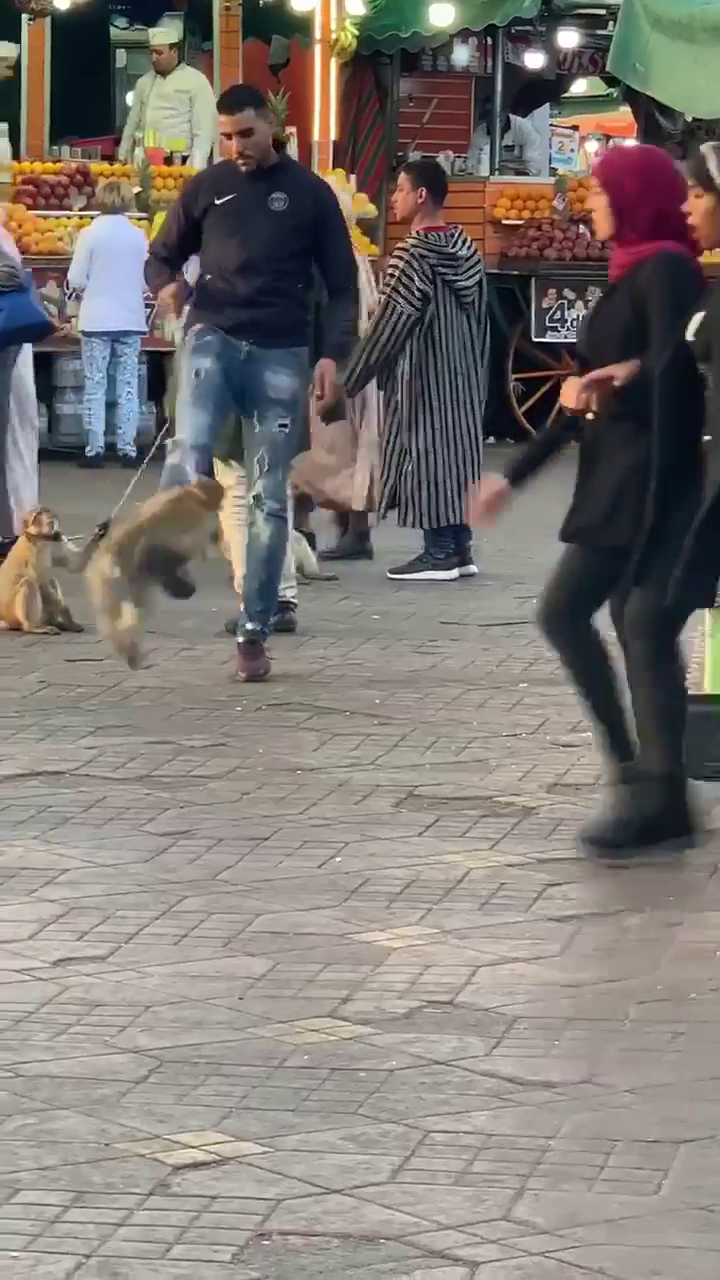
Disturbing photo's of Barbary macaques dressed in children's clothes, chained by the neck and dragged around by street handlers touting for photos and selfies to 'entertain' tourists, has been shared with Action for Primates by East Lothian Uncaged who recently filmed the monkeys at the Jemaa el-Fnaa square market in Marrakesh, Morocco.
Making the monkey smile for a photo. The poor abused animal is also wearing nail polish.
Other heartbreaking images show imprisoned macaques reaching out from within dark wooden crates in which they are held and transported. Exposure to crowds of people and loud noises and the chaos of the busy streets would be extremely frightening and distressful for the macaques. The cruel and selfish exploitation of these macaques is morally reprehensible.
The Barbary macaque (Macaca sylvanus) is native to the Atlas Mountains of Algeria and Morocco, with a small population in Gibraltar. The species is classified as Endangered with a decreasing population trend, on the International Union for Conservation of Nature (IUCN) Red List of Threatened Species, and listed in CITES Appendix I (threatened with extinction). Major threats to the survival of wild populations of Barbary macaques include habitat loss and their capture and trade. Captured in the wild within Morocco, these macaques are sold as 'pets' and to supply the cruel photo prop trade for tourists, in particular in open air markets, such as Jemaa el-Fnaa in Marrakesh.Macaque being kicked by handler Nelly Moulin
Earlier video footage previously shared with Action for Primates by Nelly Moulin also revealed the shocking way in which the macaques are treated by street handlers in Morocco. At the Jemaa el-Fnaa square market, street handlers were filmed dragging and physically abusing struggling and cowering young Barbary macaques.
The exploitation and physical and psychological cost to these wild animals for 'entertainment' is unacceptable.
enforcing the legislation that prevents their capture and 'possession';
taking action against the illegal trade; and
confiscating those macaques who are being exploited and abused as photo props by street handlers and re-homing them to genuine sanctuaries for rehabilitation and eventual release to a free-living state
Avoid tourist attractions that involve captive wildlife and always submit complaints to tourist and embassy outlets in individual countries as well as to travel and holiday companies.
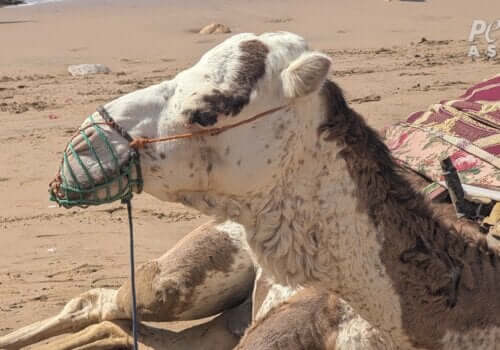
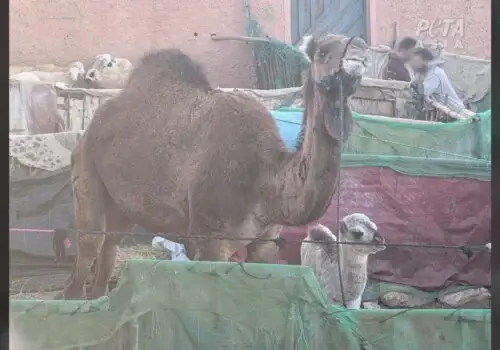
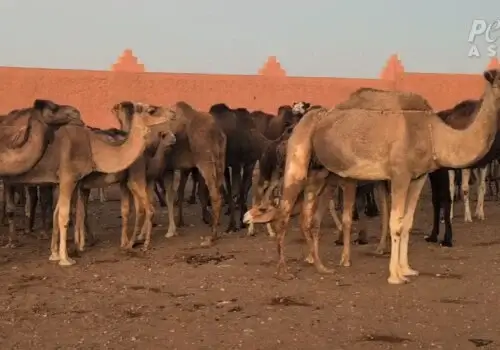
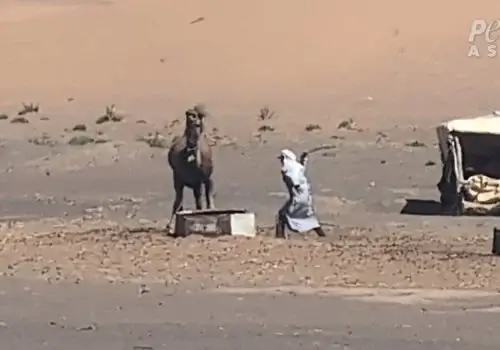
The shocking footage shows camels tethered with ropes only a few meters long, exposed to a heavy sandstorm, and forced to transport tourists all day in the scorching heat. One operator was filmed repeatedly hitting a tethered camel with a long stick as the animal desperately tried to avoid the blows. A ride operator told investigators that camels, which can live up to 40 years, are typically used for about five years. After that, they are killed or sold for their meat.
See the individual
Camels are intelligent, social creatures with needs, desires, and interests. When free to roam in their natural habitat, they live in herds and communicate with each other through sounds and body movements. As a sign of friendship, camels sometimes blow on each other's faces. But these animals endure a lifetime of misery and suffering in the tourist industry.
Global pattern of cruelty
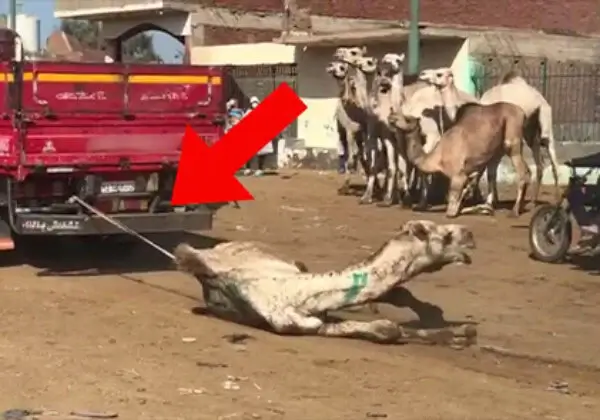
Previous PETA Asia investigations into camel and horse riding in Egypt revealed similar abuses: animals were beaten bloody, forced to carry people in the scorching heat without shade or water, and, if old, sick, or injured, were dumped as waste or sent to slaughter. Following information from PETA entities, Airbnb, Flash Pack, Scott Dunn, Travel Republic, and many other companies have pledged to stop promoting animal rides at the Giza Pyramids.
How you can help
Tourists who pay for camel rides perpetuate this heartless, inhumane industry. Whether in Morocco, the United Arab Emirates, Jordan, Gran Canaria, Egypt, or anywhere else, camel rides and excursions are a form of camel exploitation . If you're planning a vacation, leave animals out of your itinerary.
Take action for animals abused and exploited for tourist trips:
FIFA urged to take stand against culling of dogs ahead of World Cup
Animal protection organisations are appalled at claims that Morocco plans to cull millions of street dogs ahead of co-hosting the 2030 World Cup, and areappealing to FIFA to take a stand.The country agreed to carry out a Trap Neuter Release (TNR) programme in 2024, however circulating media reports now indicate that the country has abandoned these plans and is resorting to cruel and crude killing methods instead, such as shooting and poisoning.
In a letter to FIFA, Eurogroup for Animals, Deutscher Tierschutzbund, Animals de Rua, Animal Protection Denmark, DJGT, La SPA, FOUR PAWS, LAV and SEY point out that killing street dogs is not an appropriate means of reducing the population of strays in the long term.
In addition, the killing of dogs is also in breach of law in Morocco, which requires stray animals to be caught and sterilised. The TNR method is also important for disease control, as animals vaccinated against rabies can contribute permanently to herd immunity, thereby protecting the public from infection. Killing dogs is not effective with regards to rabies control, as unvaccinated animals take the place of those killed.
The 2030 World Cup will be co-hosted by Spain and Portugal, in addition to Morocco. FIFA are headquartered in Switzerland, meaning several European countries could be complicit in this cruel and unnecessary culling of homeless companion animals.
The treatment of stray dogs in Morocco could draw international attention and cast a shadow over the World Cup and FIFA, which will deter many animal-friendly football fans from experiencing the event and Morocco’s culture.
The effect would be short-term at best. New dogs take the place of the animals that have been killed because dogs migrate from neighbouring areas and more young animals survive… In the five years leading up to the World Cup, Morocco still has enough time to reduce the population of street dogs in a humane way. We call on FIFA to use its influence to put pressure on the local authorities. Killing millions of animals would be cruel and pointless.
Luca Secker, Animal Protection Specialist, Deutscher Tierschutzbund
Goats are famous for their climbing ability, but most members of the field-dwelling goat community can’t put those skills to use. Cue the goat tower. These strange structures serve no real practical purpose, but they’re funny and make for great photos.
A wise looking goat in his tower. (Getty Images)
The idea dates back to 13th century Portugal, when a winemaker decided goats didn’t belong in a field. To provide his goats with a terrain he thought they would enjoy more, he constructed the world’s first goat tower, and the small building came to define the wine estate.
To this day, the vineyard at Quinta Da Aveleda has a goat tower, and they are proud of their unique little role in history, as well as the way they inspired the others. While only a handful of goat towers have popped up around the world, Francisco Guedes Almeida, heir of the Aveleda winemakers, once encountered one by chance in South Africa, unaware of the direct link to his family home.
A goat tower at Fairview Wines Estate in Paarl, South Africa.
“I was doing my master’s degree in wine and traveling the world when I went to this place in South Africa,” Almeida told UOL. “I immediately called my uncle saying: ‘I’m in a place that feels like home. It has a goat tower like I’ve never seen. I’ve only seen it in Aveleda.’ And my uncle said, ‘You’re in Fairview.’ This producer made goat cheese and when he visited Aveleda in the 1960s he asked for permission to build one on his property. We still have his letter today.”
The tower Almeida encountered was at Fairview Cheese & Wine Farm in Paarl, South Africa. As well as this one and the tower in Quinta da Aveleda, there are two famous goat towers in the United States – the Tower of Baaa in Illinois and the tower at Silky O’Sullivan’s Bar in Memphis. There are also goat towers at Ekeby Farm in Moss, Norway, and the Torre de Cabras at Finca el Rocio near Córdoba, Argentina.
There is also a digital goat tower, found in GoatVille on the Goat Simulator video game. While it might sound like a niche market for a video game, Goat Simulator (similar to goat towers) took the internet by storm and the game sold by the millions.
I wrote about goats in trees in Morocco before Enjoy
Morocco is experiencing its worst drought in decades, making it increasingly difficult for farmers to grow crops in this western region of Marakesh-Safi. Beginning in the early 2000s, some started treeing their goats to earn tips from tourists. The income source dwindled after the coronavirus pandemic hit in early 2020. But after the country’s lockdown ended, the goat-display business resumed—and with it, criticism from animal welfare advocates such as Liz Cabrera Holtz, Wildlife Campaign Manager at World Animal Protection, a UK-based global nonprofit.
“These animals are being manipulated and exploited,” she says. “They're not moving freely. They don't have access to food, water, or even shade. Being forced to stay in trees for hours is not a normal behavior."
‘Flying goats’
The goats perched in Morocco’s trees are “trained to do it as a spectacle,” says Marrakech-based tour guide Mohamed Elaamrani. “They can climb trees and even mountains, and they’re really good at it. Some of my guests refer to them as flying goats. They want to see them because there’s nothing like this anywhere else in the world.”
The argan nut contains one to three oil-rich argan kernels. Extraction yields from 30% to 50% of the oil in the kernels, depending on the method It takes about 40 kilograms (88 lb) of dried argan fruit to produce only one litre of oil.
Extraction is key to the production process. To extract the kernels, workers first dry argan fruit in the open air and then remove the fleshy pulp. Some producers remove the flesh mechanically without drying the fruit. Moroccans usually use the flesh as animal feed. A tradition in some areas of Morocco allows goats to climb argan trees to feed freely on the fruits. The kernels are then later retrieved from the goat droppings, considerably reducing the labour involved in extraction at the expense of some potential gustatory aversion. In modern practice, the peels are removed by hand.
Workers gently roast kernels they will use to make culinary argan oil. After the argan kernels cool, workers grind and press them. The brown-coloured mash expels pure, unfiltered argan oil. Finally, they decant unfiltered argan oil into vessels. The remaining press cake is protein-rich and frequently used as cattle feed.
Plantation of argans
After the first sales in the US of the cosmetic product in 2003, demand soared and production increased. In 2012 the Moroccan government planned for increased production, then around 2,500 tonnes, to 4,000 tonnes by 2020.
It was found that stocks of argan oil were being diluted with oils such as sunflower, as the extraction process for pure argan oil can be difficult, and is costly. In 2012, the Moroccan government started to randomly pull argan shipments and test for purity before exporting.
By 2020, production had greatly increased, especially after studies had suggested health benefits. Almost all of the oil is sourced in Morocco, and is forecast to reach 19,623 US tons (17,802 ton) in 2022, up from 4,836 (4387 ton) in 2014; in value terms, US$1.79 billion (£1.4 billion).
The area of producing the oil is expanding: in 2020 it had started near the city of Agadir, 175 kilometres (109 mi) south of the traditional argan-producing area of Essaouira, and is due to expand north.
40 kilograms (88 lb) of dried argan fruit produces only one litre of oil. Mechanically extracted oil production has started, with the industrial scale driving down prices, impacting the small co-operatives, where work is mostly done by Berber women in the traditional, labour-intensive way. Mechanically produced oil can cost as little as US$22 a litre, less than half the cost of oil made by the cooperatives. This can have a great social impact. However, the huge cosmetics company L'Oréal has pledged to source all of its argan oil from the small co-operatives that sign up to the principles of fair trade.
Environmental
The argan tree provides food, shelter and protection from desertification. The trees' deep roots help prevent desert encroachment. The canopy of argan trees also provides shade for other agricultural products, and the leaves and fruit provide feed for animals.
The argan tree also helps landscape stability, helping to prevent soil erosion, providing shade for pasture grasses, and helping to replenish aquifers.
Producing argan oil has helped to protect argan trees from being cut down. In addition, regeneration of the Arganeraie has also been carried out: in 2009 an operation to plant 4,300 argan plants was launched in Meskala in the province of Essaouira
Social
The production of argan oil has always had a socio economic function. At present, its production supports about 2.2 million people in the main argan oil–producing region, the Arganeraie.
Much of the argan oil produced today is made by a number of women's co-operatives. Co-sponsored by the Social Development Agency with the support of the European Union, the UCFA (Union des Cooperatives des Femmes de l’Arganeraie) is the largest union of argan oil co-operatives in Morocco. It comprises 22 co-operatives that are found in other parts of the region.
As of 2020, there were around 300 small firms, mostly co-operatives, in the area about 25 kilometres (16 mi) inland from Essaouira, on the Atlantic coast. The women who harvest the seeds are mostly of the Berber ethnic group, with traditional skills dating from generations ago.
The success of the argan co-operatives has also encouraged other producers of agricultural products to adopt the co-operative model.[20] The establishment of the co-operatives has been aided by support from within Morocco, notably the Foundation Mohamed VI pour la Recherche et la Sauvegarde de l’Arganier (Mohammed VI Foundation for Research and Protection of the Argan Tree),[21] and from international organisations, including Canada's International Development Research Centre and the European Commission.[citation needed]
However, despite many working a very long day, the women usually make less than US$221 (£170 stg) a month (and even as low as US$50), which is below Morocco's recommended national minimum wage. Zoubida Charrouf, a chemistry professor at Mohammed V University of Rabat is an advocate for higher salaries, as well as the author of studies into its health benefits. She says that some companies pay drivers to bring tourists to their facilities, to sell them the oil, rather than pay their workers properly. Morocco's minister of agriculture has asked for Charrouf's help in forcing firms to join trade bodies and commit to paying staff the minimum wage.
Salima (Sally) is our founder and SFT was her childhood dream. Born from a Moroccan father and British mother, she was raised in Tangier and grew up seeing the suffering of the strays on the streets, desperately needing help. In 2013 she returned to Tangier to turn her dream into a reality.
Sally’s mission is for the humans and animals in Tangier to live in harmony. And for every animal to be shown the care and compassion they deserve.
She believes that the key to this is to educate the community and be an example for others to follow.
DR LAHRECH
Dr Lahrech is an honorary member of SFT. He is a vet based in Tangier and works day and night to help the sanctuary.
From treating and neutering strays for our TNVT programme to attending to emergency cases at all hours.
We are so very lucky to have this man working with the sanctuary. We owe him a great deal
Cruel and illegal ways to kill dogs’
Moroccan authorities are using cruel and illegal ways to cull the stray dogs. These methods include poisoning them with a deadly chemical called strychnine, shooting them in public, and reportedly beating surviving dogs to death with shovels,The Daily Mailreported.
The International Animal Welfare and Protection Coalition (IAWPC) has said that up to three million dogs could be killed in this campaign. The organisation also launched a campaign titled “Morocco’s Ugly Secret”.
“Almost every day, individuals acting on behalf of the Moroccan Government, tour the streets: Shooting dogs around the clock armed with rifles and pistols. Rarely killed outright, wounding is a major consequence. Poisoning dogs using either ‘stick’ type implements with a syringe on the end containing the poison, to stab the unsuspecting dogs in the body, or through the alternative method of feeding them poisoned bait by hand,” IAWPC said. The International Animal Welfare and Protection Coalition

.jpg)
.jpg)
.jpg)
.jpg)



.jpg)


.webp)
.jpg)
