Translate

Posts tonen met het label country. Alle posts tonen

maandag 14 juli 2025

Argentina is the first country in the world to voluntary relocate captive elephants to a sanctuary in Brazil: The story of elephant Kenya the last elephant to leave


Today marks a monumental step in the journey of Kenya, a 44-year-old female African elephant, as Global Sanctuary for Elephants (GSE) begins transporting her from Ecoparque Mendoza in Argentina to Elephant Sanctuary Brazil (ESB).


 Kenya’s departure closes a chapter spanning 136 years of elephant captivity in Argentina, which began in 1889 when the first elephants arrived in Buenos Aires. With this relocation, Argentina becomes the first country in the world to voluntarily and ethically relocate all its captive elephants to sanctuary. 

This momentous move is the culmination of years of careful preparation, training and respect for Kenya’s pace, and she is now en route to a life of healing, autonomy and potential companionship in the vast, wild sanctuary habitat.


Arriving at Global Sanctuary for Ellephants in Brazil she enjoys a sand bath

For four decades, Kenya has lived in the confined, sterile environment of Ecoparque Mendoza, a small, hard-packed yard surrounded by concrete with little to engage her mind or her senses. Despite her imposing size and striking beauty, Kenya’s life has been marked by loneliness, boredom and frustration. But now, all of that begins to change as she embarks on a new chapter of her life, one where her needs will be met with the respect and care she deserves. Kenya has shown remarkable progress in her training, and today, she willingly entered her transport crate, ready for the next phase of her journey. Her GSE caregivers and ecoparque staff have ensured that her comfort and well-being are prioritized at every step of her move.

“This is not just about relocating Kenya. It’s about restoring her dignity, her autonomy and her sense of self as an elephant,” said Scott Blais, co-founder and CEO of GSE. “We owe Kenya a future where healing is possible, where her voice is heard and where she’s free to just be an elephant — on her own terms.”

This move reflects a significant shift in how the world is beginning to view elephants in captivity. Across the globe, more and more facilities like Ecoparque Mendoza are voluntarily relocating their elephants to sanctuaries, recognizing that the needs of these intelligent and emotionally complex individuals cannot be fully met within the confines of traditional captive environments. 


Kenya's journey to ESB is part of a growing movement that prioritizes the emotional, physical and social well-being of elephants, offering them the opportunity to live as close to their natural lives as possible. This trend is a clear signal that the world is starting to understand and respect elephants not just as attractions, but as beings deserving of dignity and autonomy.

The relocation journey is underway, and Kenya is being transported under the watchful care of experienced elephant caregivers, veterinary professionals and a security team to ensure her comfort and safety throughout the process. Over the course of the five-day journey, every aspect of Kenya’s physical and emotional welfare will be carefully attended to.

Once she arrives at ESB, Kenya will be given access to a vast natural habitat where she can roam, forage and interact with the life that thrives in her space. For the first time in nearly 40 years, she will have the opportunity for companionship with another elephant, Pupy, a female African elephant who was welcomed to ESB in April 2025. At ESB, Kenya will be able to reconnect with her natural behaviors, build new bonds if she chooses and begin healing from the years of isolation and captivity she has endured.

“This is a turning point in Kenya’s life,” said Blais. “We’re grateful for the support of Ecoparque Mendoza and the many individuals who have helped make this moment possible.”

Kenya’s journey is a reminder of the incredible resilience of elephants and the transformative power of sanctuary. For updates on her relocation and to learn more about how you can support Kenya’s transition, visit:

globalelephants.org/a-promise-for-kenya

About Global Sanctuary for Elephants:

Global Sanctuary for Elephants is a U.S. 501(c)(3) nonprofit organization committed to protecting, rescuing and providing sanctuary for captive elephants worldwide. At their accredited, wild-habitat sanctuary, Elephant Sanctuary Brazil, they deliver unmatched care to elephants rescued from zoos, circuses and other detrimental environments. Their approach is characterized by an integrative view of elephant welfare, a dedication to recognizing the individuality of each elephant and a commitment to providing them with the highest level of autonomy possible.

Global Sanctuary for Elephants is the recipient of the Global Federation of Animal Sanctuaries’ 2022 Outstanding International Sanctuary Award and Candid’s 2025 Platinum Seal of Transparency.

Kara Edwards
Global Sanctuary for Elephants
+1 615-219-9445
email us here
Visit us on social media:
LinkedIn
Bluesky
Instagram
Facebook
YouTube
TikTok
X

donderdag 20 februari 2025

Humane World for Animals : Cockfighting is illegal in all 50 states US but still flourishing across the country where in Kansas City 400 roosters were rescued and euthanized


You don’t need to see a cockfight in progress to comprehend the misery, suffering and death that animal fighting causes. All you need to do is look at the breeding operations that service the cockfighting industry—barren, dismal and hopeless places, every one of them—and there are thousands across the country, even though cockfighting is illegal in all 50 states and under federal law.  

But in Kansas, it appears, there’s now one fewer site of such cruelty, because, on Jan. 25, law enforcement officials from the Sumner County Sheriff’s Office served a search and seizure warrant and took action at a property in Mulvane, near Wichita. With responders from Humane World for Animals and Humane Society of Greater Kansas City there to assist, officials found more than 400 roosters and hens in small wire or wooden structures with little protection from freezing temperatures. Some of the birds were afflicted with eye and nasal discharge—the signs of apparent respiratory illness, particularly concerning right now—and two roosters were covered in dried blood, with open wounds.  

The response teams found cockfighting paraphernalia too, including transport boxes, scales and gaffs—sharp blades attached to roosters’ legs during fights. Our experts identified the birds on site as gamefowl, a term for birds selectively bred and raised for aggression and fighting.  

A detective working the case credited previous training with our teams as indispensable to her work at the scene. This was encouraging because educating humane and law enforcement agents is a priority for us. This week, our Humane World for Animals Law Enforcement Training Center co-hosted a cockfighting investigations webinar with the National Sheriffs’ Association, an active partner in the campaign to end cockfighting. Nearly 400 officers registered, many from states in which cockfighting is a major law enforcement concern.  

In addition to such training activities, we support prosecutors and other law enforcement personnel with their assessment and handling of complex cases. We’re also pursuing a comprehensive agenda to fortify state-level laws in key states, including Kentucky, Georgia, California, Maryland, Florida and Texas. We’re particularly committed to working in the 11 states that do not prohibit breeding and trafficking gamefowl for fighting. 

In a cynical play, cockfighters and their allies in a few state capitals have organized faked-up civic organizations that exist for a single, dishonorable purpose: to reduce or eliminate penalties for cockfighting. These “gamefowl commissions” host rallies, raise funds and make political contributions in support of attempts to decriminalize cockfighting. Known cockfighters have even surfaced as “expert witnesses” in these efforts. In Oklahoma last year, this nearly Orwellian approach resulted in a dangerous proposal to reduce penalties for cockfighting and dogfighting to a misdemeanor—which, we’re glad to report, stalled out in the legislature.  

In the 21st century, of course, cockfighting is not merely a criminal industry but an incubation system for dangerous diseases, including the highly pathogenic avian influenza H5N1 now ravaging commercial flocks of chickens and plaguing big cats and other animals at wildlife rescue centers, to name just several of the most prominent instances of zoonotic transmission. Together, the real risk of disease spread and the poor prospects for placement of roosters trained to be aggressive mean that animals from situations like the one in Mulvane are generally not adopted out; in this case, all the animals had to be euthanized at the scene. 

Cockfighting is a serious crime. That's no radical position. It is the law in all 50 states, and multiple polls through the years have helped to make it clear that people from coast to coast—in states red, blue and purple—disapprove of cockfighting. Most recently, a July 2024 poll we commissioned found that 90% of Democrats, 88% of Republicans and 87% of independents support stronger laws on the issue.  

Recognizing the severity of the problem, the National Sheriffs’ Association has formally declared animal fighting a crime of violence, urging all levels of government to uphold and strengthen penalties.   

At the federal level, we have successfully pressed for animal fighting upgrades to the Animal Welfare Act on five occasions. At this time, our focus is on enforcement and most recently, we’ve encouraged the government to maintain strong sentencing guidelines for animal fighting offenses because of our understanding that cockfighting and dogfighting are malicious crimes and frequently connected to other serious criminal activities.  

With animal fighting classified as a felony crime under the AWA, we’ve also sought to encourage better collaboration between the U.S. Department of Agriculture and the Department of Justice (along with other partners) through appropriations requests and other means. This is challenging at present, as potential agency cuts could result in fewer staff positions, smaller budgets, weaker cross-reporting and less funding for state, local and tribal law enforcement efforts. 

We’ll keep pushing. Time and again, our team members hear from legislators and others surprised that cockfighting continues after all the negative publicity it has received and all the laws that have passed. Not enough people understand that cockfighting is a multi-million dollar industry in which participants are willing to take their chances of discovery and arrest in situations where the financial rewards of participation far outweigh the risks. 

That’s why we push lawmakers and government agencies to step up their efforts to make anti-cockfighting laws tougher and to see that they are better enforced. Not just in this country, either. We are increasingly focused on the global dimensions of this problem, because cockfighters are shipping animals all over the world for profit. Beyond causing massive animal suffering, what they’re doing threatens to exacerbate the spread of avian diseases. We’ve done some important work to curb animal fighting in Costa Rica, India and the EU, for example. In Costa Rica, where cockfighting is illegal, we helped to turn back a legal challenge from cockfighters who tried to argue they had a cultural right to fight roosters under the constitution.  

Cockfighting’s cruelty is not a matter of opinion. It’s an objective fact, and the same is true for its obvious public health and safety risks. We can’t afford to be complacent about it, and we can’t afford to let policymakers be complacent either. The massive suffering the birds endure propels our efforts to get at the root causes of cockfighting, in order to stop it for good. 

Sara Amundson is president of Humane World Action Fund. 

Category

dinsdag 18 februari 2025

Argentina has a big problem: luxurious neighbourhoods are being taken over bij thousands of capybaras, the original inhabitants of the country ( 5 photos )


In one of Argentina's most luxurious neighborhoods, a heated debate has erupted over contraception for special animals. The original inhabitants of the neighborhood just outside Buenos Aires, the capybaras, are taking over the neighborhood, much to the horror of the villa residents.

The cute rodents fight each other and also take on dogs. The city council wants to control the uncontrolled population growth of the capybaras by means of special contraception and sterilization. To the anger of some parties.


According to estimates, the Nordelta neighbourhood is now home to more than a thousand capybaras, or carpinchos, as they are called in Argentina. "The carpincho itself is not a problem," a spokesman for the neighbourhood association told El País . "But if they start fighting with each other or with our dogs, it can lead to traffic accidents, for example."

"From my window I can see eight carpinchos, some of them are in the water. The family consists of about fifteen members," says the neighborhood association spokesperson who has lived in Nordelta for twenty years. Since 2020, he has seen a significant increase in the number of capybaras.


The rodents have no enemies in the luxury residential area and grow rapidly: each female can have a litter twice a year. The capybara can sometimes have up to eight offspring. So the city council has decided to inject two doses of contraceptives into 250 animals. This ensures that reproduction stops and the total population growth decreases.


Anger over contraceptive plan


It has not reached that point yet, because the injection program has been postponed due to rainfall. In the meantime, other parties are calling for alternative solutions. For example, there is a group of neighbors who call themselves Carpinchos Nordelta - Somos Su Voz (Nordelta Capybaras - We are your voice).

They are disappointed that there has been little consultation on the measures to be taken and that real estate developers have ignored proposals such as the creation of biological corridors or protected areas.


The National Council for Scientific and Technical Research (Conicet) is now even involved. They are supposed to monitor the contraceptive program, but they did not recommend it themselves. In the meantime, they are working on an alternative project in which they perform vasectomies on five dominant males from the colonies in the luxury neighborhood.

Meanwhile, environmental activists have also come forward and are calling for no action to be taken against the capybaras. They want a law to be passed as soon as possible to protect the animals' habitat and prevent further construction.


By Eimert Pruis


More information:   www.time.com


Gated communities are known for their manicured lawns, swimming pools, and wealthy residents. In Argentina, they’re also known as the home of the world’s largest rodents.

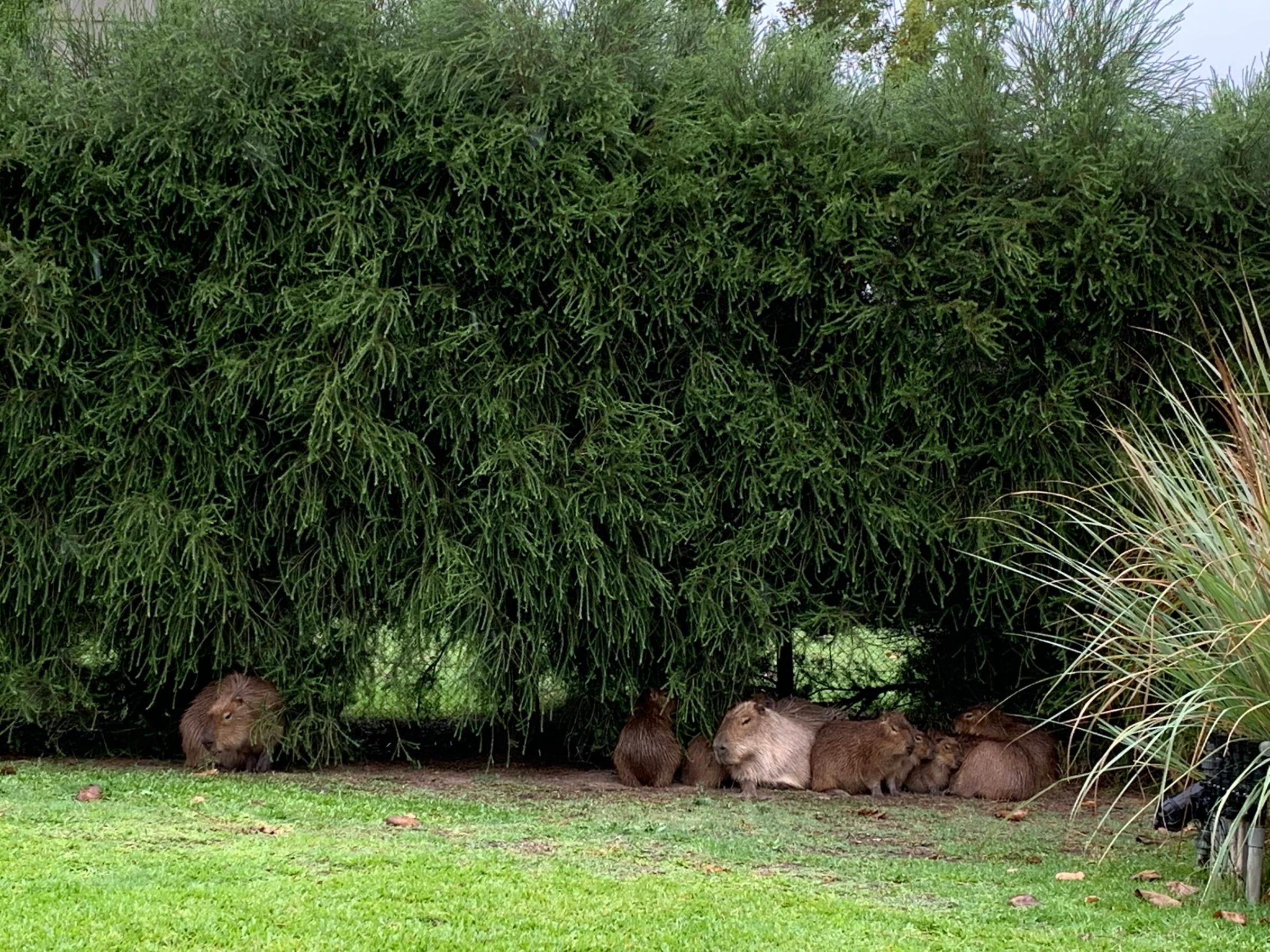
On a drizzly afternoon in March 2022, a family of nine capybaras—the larger ones weighing in at around 130 pounds—huddle together under the hedges that surround a famous soccer player’s mansion. Munching intently on the grass, they barely look up when approached by cars or humans. These are just a few of the hundreds of capybaras that have taken over Nordelta, a private neighborhood on the outskirts of Buenos Aires, over the last two years.

The capybaras have always been present here. For the first two decades after the community’s construction in 1999, they kept themselves hidden, coming out only at night and darting from trees to lakes. But that began to change in 2020. With Nordelta’s well-heeled human residents confined to their homes by Argentina’s long and strict COVID-19 lockdown, its furrier inhabitants thrived. Spreading out across now empty parks, they reproduced rapidly, boosting their numbers by 16% in one year, according to estimates by local scientists. Then, after an unusually dry winter hit Argentina in June 2021, killing much of the grass in public areas, the capybaras got even bolder, crossing roads and venturing into private gardens.

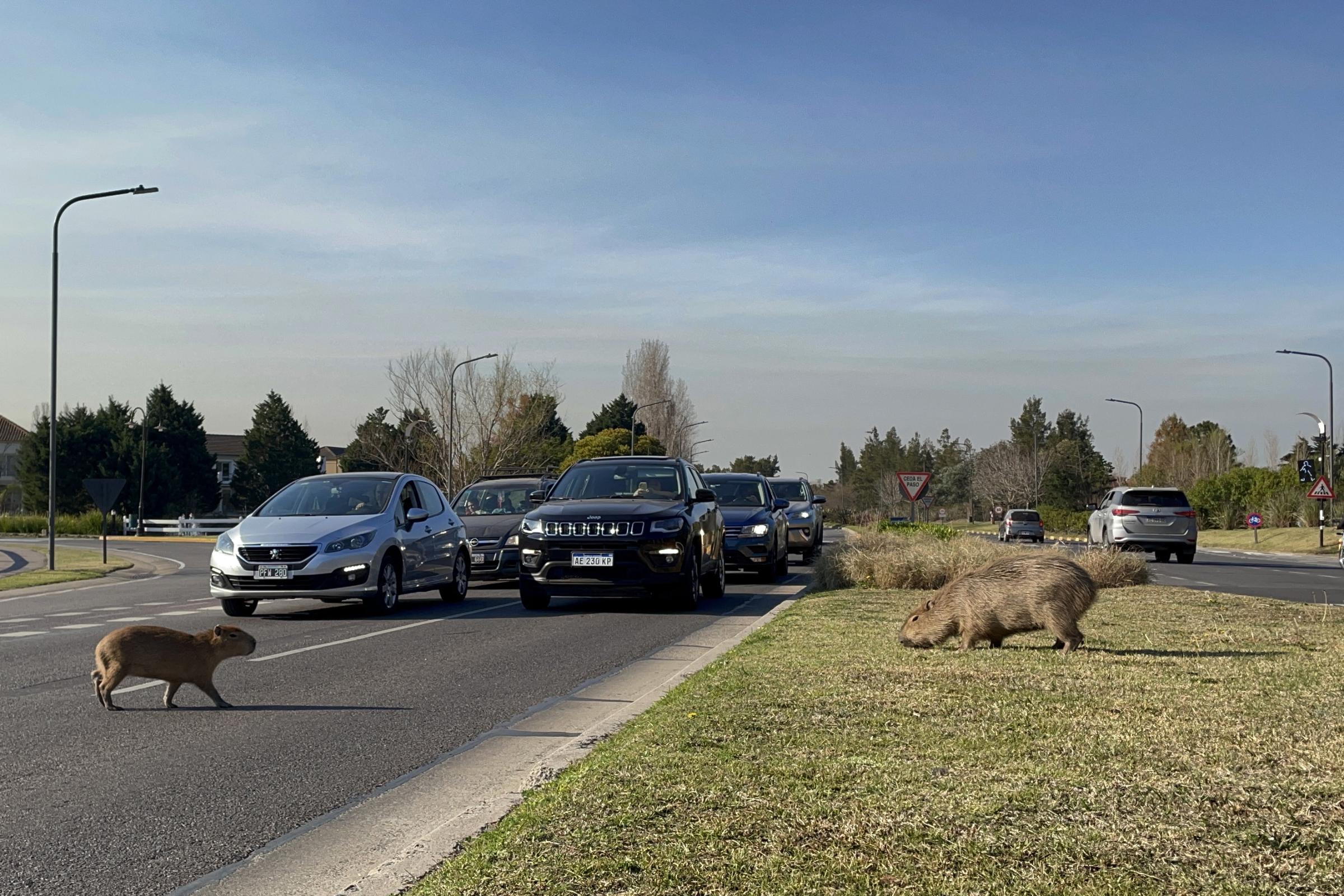
“That’s where the conflict started,” says Marcelo Canton, head of communications for the Nordelta Residents Association. The capybaras—known as “carpinchos” in Argentina—ate up lawns and massacred rose bushes. They caused traffic accidents, knocking delivery drivers from their bikes. Perhaps worst of all, for a country fiercely devoted to pets, the capybaras began to face off with dogs that confronted them on their new territory, causing injuries to both sides. “Dog owners were very upset,” Canton says. “Especially because here, the dogs are mostly French Bulldogs or other small dogs. They can’t defend themselves.”


Capybaras Nordelta TIME
A family of capybaras shelter under some hedges in Nordelta, greater Buenos 

In July, a group of residents went to the press, griping about a capybara “invasion” and calling for authorities to move the animals out to a nature reserve. The complaints triggered a huge backlash in both Argentine and international media. Viral posts on social media accused Nordeltans of hypocrisy, since their luxury neighborhood is built on the capybara’s historic wetland habitat, with some dubbing the animals “class warriors.” It didn’t help Nordelta’s case that capybaras are extremely cute, with goofy rectangular heads and narrow eyes that make them look permanently sleepy.


But for all the anger leveled at Nordelta, the neighborhood does have a real problem on its hands: how do you deal with an influx of wildlife that wasn’t there before in densely populated urban space? Cities around the world are increasingly having to answer that question. The expansion of urban areas, combined with the intensifying effects of climate change, is destroying the forests, wetlands and other ecosystems where animals have historically thrived. And at the same time, cities have become “incredibly enriched environments,” often containing an abundance of food, water, and shelter compared to their surrounding areas, says Peter Alagona, an environmental historian and author of The Accidental Ecosystem. The result is that animals losing their natural habitats are increasingly making the city their home.

Nordelta’s confrontation with capybaras is just the beginning. Alagona argues that cities are due for a fundamental rethink of their relationship with urban wildlife. “We need to start thinking about cities as multi-species communities, as potential refuges for creatures that, in the future, we may not see in natural spaces,” he says. “There’s a grand ecological rearrangement taking place and cities are part of it.”

Capybaras Nordelta
A capybara crosses a street while others eat grass in a gated community in Tigre, Buenos Aires province

About 15 miles west of Nordelta, the grass is tall and the air is full of mosquitoes. Wildcats, lizards, and nutria (the capybara’s smaller cousin), roam unseen by humans on roughly 750 acres along the Luján River. Graciela Capodoglio, a former teacher, helped to found this nature reserve in Pilar, a suburb of Buenos Aires, in 2003, around the same time that gated communities began to proliferate around the city. Her goal was to use the space to teach city residents about the importance of protecting nature; today, the reserve is one of the region’s last natural wetlands.

“With all this development, the animals have been corralled into smaller and smaller spaces,” Capodoglio says over the hum of bugs and birds. “And now, the whole country is suffering from a drought,” which further threatens the wildlife here. The clearing of tens of millions of hectares of the Brazilian Amazon and other rainforests, mainly for agriculture, has led, in the last few years, to the disappearance of South America’s “flying rivers,” which once carried moisture across the region. The drier conditions, combined with rising temperature due to climate change, have sapped food and water sources for wildlife, and helped to spread forest fires. In February, as wildfires lapped at the edges of Corrientes in the north of Argentina, newspapers published dramatic images of alligators, capybaras, and other animals fleeing the flames.

Capybaras Wildfires Corrientes
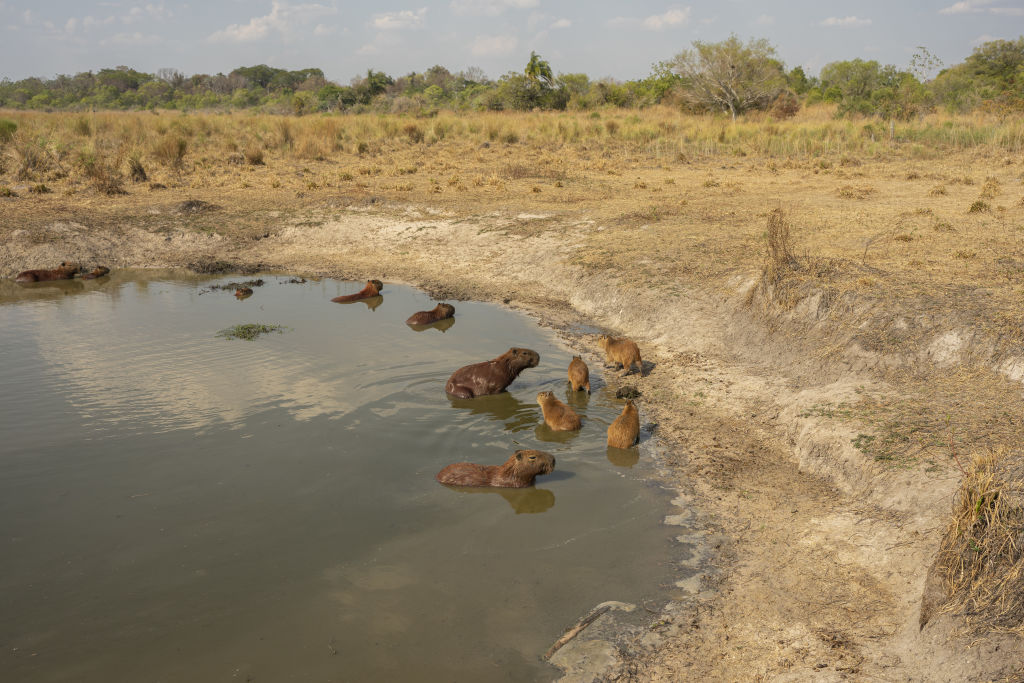
Capybaras in one of the few remaining places with water following wildfires in the Ibera Wetlands, Corrientes province, Argentina,.Sebastian Lopez Brach—Bloomberg/ Getty Images

Capodoglio was “furious” when she read news stories about the capybara “invasion” in Nordelta. And again, in January 2022, when similar stories popped up about an invasion of tegus—black-and-white lizards native to the region—in gated communities near the Pilar reserve. “The word invasion drives me crazy! They were here first,” she says.


In pre-pandemic times, people concerned about tegus on their properties would contact animal rescue shelters to take them away “I try to explain to them that the poor tegu is an inoffensive animal,” she says, noting that the lizards, will cut off their own tails to run away from dogs or larger animals that catch them. “And it helps you keep rats out of your house! Why do we need to look at all animals as attackers? It’s such an anthropocentric view. It pisses me off.”

Over in Nordelta, Canton, of the residents association, says that the group that wanted to remove all capybaras from the neighborhood was a minority of about a hundred out of some 45,000. After the media firestorm, he says, a second group of “environmentalist residents” spoke up, opposing any measures that could affect the capybaras or their urban habitat. “Then finally, a third group in the middle came up, who said ‘okay we have to respect the animals, but what are we going to do?’”

In August 2021, that group made their case for some kind of intervention to the wildlife department of Buenos Aires province and in an open letter in the national press. They pointed out that capybaras had been driven almost to extinction by poachers in Tigre, the municipality where Nordelta is located, by the 1990s, and that the creation of the gated community—where hunters don’t venture—had saved the animals. But, they argued, the area “could no longer feed or sustain” today’s numbers. The province agreed, based on their observations from a visit in June, that there was an “overpopulation” problem. They then began to work with the municipal government and the Nordelta residents association—which acts almost like a local government because of Nordelta’s private status—on a plan to restore “harmonious coexistence” between capybaras and humans, according to Canton, consulting with capybara experts at Argentina’s national scientific research council, and a team of biologists hired by Nordelta.


Limiting capybara numbers is part of the plan. Officials have ruled out the idea of moving some capybaras to nearby nature reserves—suggested by the residents to bring the population back to the level it stood at five years ago—on the grounds that they had not learned to fear their natural predators and wouldn’t last in the wild, Canton says. And there will, “of course,” be no culling of the animals in Nordelta, he adds. But capybara vasectomies are on the table. The province is consulting with vets before giving the greenlight for a trial, which would follow a few dominant males and monitor them for several years. A deer vasectomy program with similar goals in Staten Island has resulted in a “sizable decrease” in the deer population since 2016, but proved controversial among residents and conservationists. “That is a mid- to long-term solution,” Canton says, “and it’s the only less natural measure that’s under consideration.”

For now, the focus has been on softer measures. First there was an awareness campaign, using newsletters, social media, and outreach to local press to remind residents that capybaras are generally harmless and ideally are dealt with by simply ignoring them.