Translate

Posts tonen met het label Humane World for Animals. Alle posts tonen

woensdag 11 maart 2026

Humane World for Animals: Two years ago South Korea officially passed a ban on dog meat: of the 17000 dog meat farms 1,204 have closed but with heavy hearts we know we cannot save all the dogs


Today marks two years since the ban on dog meat officially passed in South Korea. Since enforcement began, 1,204 dog farms—or about 78% of all dog farms in the country—have closed. When we started advocating for an end to the industry, about a decade ago, government estimates indicated that there were more than 17,000 dog meat farms.


The phase-out of this industry—from 17,000 dog meat farms to now just over 330—represents a huge achievement. For decades, these facilities had been sites of suffering and death for millions of dogs and would have gone on to torment and kill countless more had the ban not been passed. And this progress is possible because of continued efforts from Humane World for Animals Korea and other Korean animal welfare groups during the phase-out period of the dog meat industry. We’re working to ensure that awareness of and support for the ban remains high so full implementation can be smoothly achieved.


We are also continuing our efforts to rescue dogs from dog meat farms, giving them the chance to live full, loving lives. Later this month, we will be flying 16 dogs we rescued last year from meat farms to Canada for adoption. Additionally, in the spring, we plan to conduct another rescue as part of a farm closure operation.


Because the dog meat ban has no specific directive related to rescuing dogs, our rescues have become even more meaningful. With heavy hearts, we know we cannot save them all, but every life matters. In total, we have rescued nearly 2,800 dogs from dog meat farms in South Korea since our Models for Change program began over a decade ago.


Meanwhile, our teams are working across Asia to end the dog and cat meat trade:

In China, we’ve been partnering and supporting Vshine in its efforts to end the dog and cat meat trade. A survey in Dalian, a major city in Northeastern China, found that 95% of citizens support legislation to protect companion animals and 99% support Dalian banning dog and cat meat; these results boost support for a companion animal protection law, which would include provisions prohibiting the sale and consumption of dog and cat meat in this city. A legislative proposal has been submitted by Vshine and if approved this would make Dalian the third city in China to ban the dog and cat meat trade. And in Yulin, infamous for the dog meat “festival,” which is held each summer, Vshine produced a comprehensive report showing that most residents in Yulin don’t support this notorious event. A petition, endorsed and signed by over 180,000 animal welfare advocates worldwide, called upon the Guangxi and Yulin authorities to shut down the dog and cat meat trade within the province and the city of Yulin.

In India, we are working closely with authorities in the northeast of the country to address the illegal cross-border dog meat trade, in which thousands of dogs are sourced from the state of Assam and transported to neighboring states. We have also launched a livelihood conversion program—this program supports vulnerable women who work in the dog meat markets in transitioning out of the trade and into humane, sustainable livelihoods—and are engaging with authorities to stop the dog meat trade.

In Indonesia, a bill that proposes an explicit ban on the dog and cat meat trade, which is backed by four major political parties, including the ruling party, will be debated this year. This milestone was possible because of continued advocacy by the Dog Meat Free Indonesia coalition, of which Humane World for Animals is a founding member.

In Viet Nam’s Dong Nai province, we’re working on disrupting cross-border transportation of dogs and cats for the meat trade. In Thai Nguyen we are advancing public awareness raising programs to alert people to the dangers of rabies linked to the dog and cat meat trade and deter consumers, and in Ho Chi Minh City—the country’s second largest metropolis—we are in discussion regarding a potential three-year partnership to address the dog and cat meat trade in this city.

It is thanks to advocates all over the world that public perceptions of animals are changing. More people are welcoming companion animals into their lives, and there seems to be a wider acknowledgment that animals deserve to be treated with care and respect. In Asia, the younger generation has been at the forefront of the paradigm shift, demanding action to end the dog and cat meat trade.

When we first began our efforts to close dog meat farms in South Korea, we were told that achieving a ban on the dog meat industry in the country would be impossible. But we put our idealism into action: As our program shut down dog meat farms and transitioned farmers to more humane ways of earning a living, this work ultimately served as a model for the implementation of the nationwide ban. Now, the dog meat ban in South Korea will come into full effect next year, in February 2027.

As part of our mission to end the trade across Asia, we issued a report last year, Ending the Dog Meat Industry in South Korea: Building a more compassionate society toward dogs, which captures how animal advocates, policymakers and citizens came together to end dog meat cruelty. This is a story of how political will, shifting cultural values and strong partnerships can create lasting change for animals. And we will continue to work toward the kinder, more compassionate world at the center of our vision by advocating for a permanent end of the dog and cat meat trade wherever it exists.

Kitty Block is president and CEO of Humane World for Animals. Follow Kitty Block.
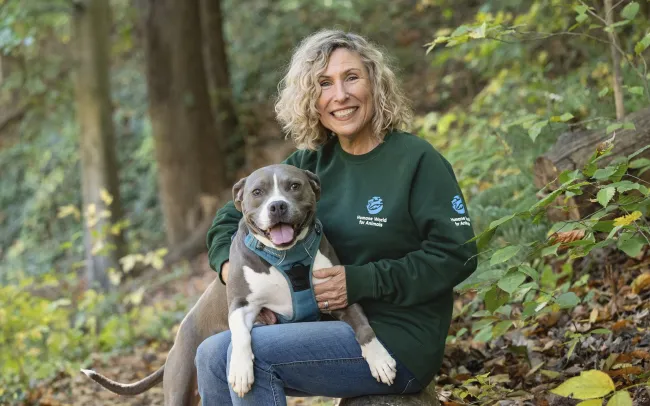
Kitty Block, President and CEO of the Humane World for Animals, poses with Mini

About the Author

Kitty Block is the chief executive officer and president of Humane World for Animals, as well as the chief executive officer of Humane World Action Fund.


woensdag 12 november 2025

Humane World for Animals US assisted in saving 47 dogs and puppies from unimaginable cruelty: scarred, injured, emaciated and abused due to dogfighting


In some hopeful news, 47 dogs and puppies were saved from three properties suspected of dogfighting in Chester and Lancaster counties, South Carolina. Humane World for Animals assisted the South Carolina Law Enforcement Division (SLED) in the operation, alongside the Chester County Sheriff’s Office, Chester County Animal Control, and the Lancaster County Sheriff’s Office.


Authorities executed search and seizure warrants early on November 5, uncovering scenes of unimaginable cruelty. Responders found scarred, injured, and emaciated dogs, many wagging their tails despite their suffering. Most were chained to heavy metal links, with plastic barrels or makeshift boxes serving as their only shelter.


Veterinarians confirmed that multiple dogs had infected puncture wounds consistent with dogfighting injuries. Many were severely underweight, flea-infested, and suffering from painful dental disease. On the properties, officials discovered treadmills, heavy chains, and what appeared to be a dismantled dog fighting pit, grim evidence of the abuse these animals endured.


One especially heartbreaking scene involved a starving mother dog and her three nursing puppies, who were confined in a filthy, feces-caked hutch. Though initially fearful, she quickly warmed up to the rescuers, seeking chin scratches and affection. Nearby, a limping dog strained against his chain, his swollen leg marked by recent bite wounds. Despite his pain, he still wagged his tail as he greeted his rescuers with trust.


“It’s haunting to see so many dogs—injured, covered in scars and clearly in need of veterinary attention—just stuck on the end of a heavy chain. They looked hurt and alone,” said Janell Gregory, South Carolina state director of Humane World for Animals. “It’s rewarding to see them start to wiggle and give kisses as we got them to safety. We are deeply grateful to SLED for initiating this rescue operation.”

Dogfighting is one of the most brutal forms of animal cruelty imaginable. The dogs suffer deep puncture wounds, broken bones, and severe bruising, often dying from blood loss, infection, or shock. Those who survive are forced to fight again, trapped in a cycle of violence and neglect. These operations are not just acts of animal cruelty but are often tied to other crimes involving weapons, drugs, and illegal gambling.


Enjoying her first cuddle ever

Dogfighting is a felony offense in the U.S., punishable by up to five years in prison for fighting, training, or transporting dogs for fighting purposes. Humane World for Animals has worked with SLED on multiple investigations this year alone, rescuing nearly 90 dogs from seven South Carolina properties since June.

These efforts are supported by South Carolina’s 2024 cost-of-care law, which requires owners of seized animals to either pay for their care or relinquish them for adoption. This law allows abused animals to begin new lives without being held in limbo for months or years as cases move through the courts. Humane World for Animals continues to champion such legislation nationwide to strengthen animal protection laws and enforcement.

All of the rescued dogs are now safe at a confidential location, receiving the medical care and love they deserve. Though their bodies bear scars of cruelty, their spirits are already beginning to heal.


maandag 19 mei 2025

Breaking News: 67 dogs saved from South Korea's dog meat trade living in filthy cages with wire flooring, find sanctuary in the US (5 photos of the rescue)


All photos from Humane World for Animals

Over the weekend, 50 dogs rescued from a South Korean dog meat farm began a new life in the U.S., thanks to Humane World for Animals. Once confined to cramped, filthy cages with wire flooring, deprived of basic care, affection, or even the chance to run, these dogs have now stepped onto solid ground, felt soft bedding, and received gentle hands instead of fear.


Their journey took them from South Korea to JFK Airport in New York. From there, they travelled to the Humane World for Animals’ care and rehab center in Maryland, where they will receive veterinary care and emotional rehabilitation before finding adoptive families. An additional 17 dogs, mothers and puppies, will follow once they’re old enough to travel, bringing the total number of dogs rescued from the dog meat farm to 67.


The rescue operation was part of a broader effort to end South Korea’s dog meat industry, which is in its final chapter. With a government ban set to take full effect in 2027, nearly 40% of farms have already closed. Humane World for Animals has been instrumental in this progress, shutting down 18 farms and rescuing over 2,700 dogs since 2015.


One such farm, operated by Mr. Yu in Cheongju, was recently shut down for cruelty violations. For 40 years, Mr. Yu bred dogs for slaughter, serving their meat in his restaurant and selling them to markets. Now, he’s transitioning to chili farming, proof that alternative livelihoods are possible and necessary.


Joining the rescue was Korean American actor Daniel Henney, a longtime advocate against the dog meat trade. On-site in Cheongju, he helped remove terrified dogs from their cages and also adopted a golden retriever named Juliette, herself a survivor of the dog meat trade.

“As a huge dog lover, and dad to a dog meat farm survivor, it was incredibly challenging to see the suffering of these dogs who have endured so much. It makes me all the prouder to have supported Humane World for Animals’ successful campaign to achieve a ban because it means no more dogs like these will suffer like this again,” said Henney. “South Korea is embracing a new chapter where dogs are our friends not food, and that couldn’t make me more thrilled. I’m looking forward to following the journey of these dogs as they find their forever homes in the United States and put the dog meat industry behind them.”  

The rescued dogs, mostly Jindo mixes, now face a future filled with love and stability. But for too many still trapped in this cruel system, time is running out. Humane World for Animals’ campaign not only offers a second chance for individual dogs, but also challenges the cultural stigma that still surrounds meat farm survivors in South Korea.

“While the law is successfully dismantling the dog meat industry, we are happy to be able to provide a bright future for the dogs on this farm. For them the dog meat industry is over, and they have nothing but soft beds, full bellies and lots of love ahead of them,” said Sangkyung Lee, campaign manager for Humane World for Animals Korea.

donderdag 20 februari 2025

Humane World for Animals : Cockfighting is illegal in all 50 states US but still flourishing across the country where in Kansas City 400 roosters were rescued and euthanized


You don’t need to see a cockfight in progress to comprehend the misery, suffering and death that animal fighting causes. All you need to do is look at the breeding operations that service the cockfighting industry—barren, dismal and hopeless places, every one of them—and there are thousands across the country, even though cockfighting is illegal in all 50 states and under federal law.  

But in Kansas, it appears, there’s now one fewer site of such cruelty, because, on Jan. 25, law enforcement officials from the Sumner County Sheriff’s Office served a search and seizure warrant and took action at a property in Mulvane, near Wichita. With responders from Humane World for Animals and Humane Society of Greater Kansas City there to assist, officials found more than 400 roosters and hens in small wire or wooden structures with little protection from freezing temperatures. Some of the birds were afflicted with eye and nasal discharge—the signs of apparent respiratory illness, particularly concerning right now—and two roosters were covered in dried blood, with open wounds.  

The response teams found cockfighting paraphernalia too, including transport boxes, scales and gaffs—sharp blades attached to roosters’ legs during fights. Our experts identified the birds on site as gamefowl, a term for birds selectively bred and raised for aggression and fighting.  

A detective working the case credited previous training with our teams as indispensable to her work at the scene. This was encouraging because educating humane and law enforcement agents is a priority for us. This week, our Humane World for Animals Law Enforcement Training Center co-hosted a cockfighting investigations webinar with the National Sheriffs’ Association, an active partner in the campaign to end cockfighting. Nearly 400 officers registered, many from states in which cockfighting is a major law enforcement concern.  

In addition to such training activities, we support prosecutors and other law enforcement personnel with their assessment and handling of complex cases. We’re also pursuing a comprehensive agenda to fortify state-level laws in key states, including Kentucky, Georgia, California, Maryland, Florida and Texas. We’re particularly committed to working in the 11 states that do not prohibit breeding and trafficking gamefowl for fighting. 

In a cynical play, cockfighters and their allies in a few state capitals have organized faked-up civic organizations that exist for a single, dishonorable purpose: to reduce or eliminate penalties for cockfighting. These “gamefowl commissions” host rallies, raise funds and make political contributions in support of attempts to decriminalize cockfighting. Known cockfighters have even surfaced as “expert witnesses” in these efforts. In Oklahoma last year, this nearly Orwellian approach resulted in a dangerous proposal to reduce penalties for cockfighting and dogfighting to a misdemeanor—which, we’re glad to report, stalled out in the legislature.  

In the 21st century, of course, cockfighting is not merely a criminal industry but an incubation system for dangerous diseases, including the highly pathogenic avian influenza H5N1 now ravaging commercial flocks of chickens and plaguing big cats and other animals at wildlife rescue centers, to name just several of the most prominent instances of zoonotic transmission. Together, the real risk of disease spread and the poor prospects for placement of roosters trained to be aggressive mean that animals from situations like the one in Mulvane are generally not adopted out; in this case, all the animals had to be euthanized at the scene. 

Cockfighting is a serious crime. That's no radical position. It is the law in all 50 states, and multiple polls through the years have helped to make it clear that people from coast to coast—in states red, blue and purple—disapprove of cockfighting. Most recently, a July 2024 poll we commissioned found that 90% of Democrats, 88% of Republicans and 87% of independents support stronger laws on the issue.  

Recognizing the severity of the problem, the National Sheriffs’ Association has formally declared animal fighting a crime of violence, urging all levels of government to uphold and strengthen penalties.   

At the federal level, we have successfully pressed for animal fighting upgrades to the Animal Welfare Act on five occasions. At this time, our focus is on enforcement and most recently, we’ve encouraged the government to maintain strong sentencing guidelines for animal fighting offenses because of our understanding that cockfighting and dogfighting are malicious crimes and frequently connected to other serious criminal activities.  

With animal fighting classified as a felony crime under the AWA, we’ve also sought to encourage better collaboration between the U.S. Department of Agriculture and the Department of Justice (along with other partners) through appropriations requests and other means. This is challenging at present, as potential agency cuts could result in fewer staff positions, smaller budgets, weaker cross-reporting and less funding for state, local and tribal law enforcement efforts. 

We’ll keep pushing. Time and again, our team members hear from legislators and others surprised that cockfighting continues after all the negative publicity it has received and all the laws that have passed. Not enough people understand that cockfighting is a multi-million dollar industry in which participants are willing to take their chances of discovery and arrest in situations where the financial rewards of participation far outweigh the risks. 

That’s why we push lawmakers and government agencies to step up their efforts to make anti-cockfighting laws tougher and to see that they are better enforced. Not just in this country, either. We are increasingly focused on the global dimensions of this problem, because cockfighters are shipping animals all over the world for profit. Beyond causing massive animal suffering, what they’re doing threatens to exacerbate the spread of avian diseases. We’ve done some important work to curb animal fighting in Costa Rica, India and the EU, for example. In Costa Rica, where cockfighting is illegal, we helped to turn back a legal challenge from cockfighters who tried to argue they had a cultural right to fight roosters under the constitution.  

Cockfighting’s cruelty is not a matter of opinion. It’s an objective fact, and the same is true for its obvious public health and safety risks. We can’t afford to be complacent about it, and we can’t afford to let policymakers be complacent either. The massive suffering the birds endure propels our efforts to get at the root causes of cockfighting, in order to stop it for good. 

Sara Amundson is president of Humane World Action Fund. 

Category