Mini, a long-tailed macaque, was rescued after the BBC Eye investigation, The Monkey Haters, that exposed a global online monkey-torture ring. Now Free Mini, a new short documentary from the BBC World Service, traces her release into the wild.

As a baby, Mini was taken from the forest, her mother killed. Mini was sold to a YouTuber. Her owner tortured her and filmed it for sadistic customers mainly in the US and the UK. In private Telegram groups they were brainstorming and crowdfunding the torture videos. According to the man who ran one of the groups and called himself the Torture King, Mini was a “sadistic trophy”: “Mini was so popular in this hatred world… [when] you think old movie stars, female Marilyn Monroes, in this little demented circle of ours, that was Mini.”
Rebecca Henschke – who had spent over a year tracking down Mini and her torturers uncovered in the BBC Eye investigation, The Monkey Haters – went along for Mini’s release back to the wild. “When I first saw tiny vulnerable baby Mini being abused in videos online, I became obsessed with finding her and seeing her go free. It was amazing and emotional to see her go boldly and curiously into the wild with an adopted family that will look after her in the wild.”
Femke De Haas, the founder of the Jakarta Animal Aid Network (JAAN), who has successfully released hundreds of ex-captive and abused long-tail macaques, says: “If we would have any doubts about her being ready to be released – Mini or any of her family members – we would not bring them to the forest. They underwent… a very long process of rehabilitation, different stages. We observe every detail of this process, and they are ready to be an independent long-tailed macaque back in the forest where they belong.”
In the US, nine of the key players of the online torture ring have pleaded guilty or been sentenced. Two women, who were key players in the UK, have pleaded guilty and are due to be sentenced in the UK.
The BBC Eye investigation also lead to legal changes in the UK, obliging social-media firms to remove online animal cruelty content from their platforms.
The short documentary, Free Mini, is available for viewing on BBC iPlayer in the UK and internationally via the BBC World Service YouTube channel. The content is available on the BBC News website – via bbc.co.uk in the UK, and internationally – on BBC.com, BBC Studios global digital news platform; and in Indonesian via BBC News Indonesia.
To watch the BBC Eye investigation, The Monkey Haters, follow this link - https://
A year-long BBC investigation has uncovered a sadistic global monkey torture ring stretching from Indonesia to the United States.
The World Service found hundreds of customers in the US, UK and elsewhere paying Indonesians to torture and kill baby long-tailed macaques on film.
The torture ring began life on YouTube, before moving to private groups on the encrypted messaging app Telegram.
Police are now pursuing the buyers and several arrests have already been made.
BBC journalists went undercover in one of the main Telegram torture groups, where hundreds of people gathered to come up with extreme torture ideas and commission people in Indonesia and other Asian countries to carry them out.
The sadists’ goal was to create bespoke films in which baby long-tailed macaque monkeys were abused, tortured and sometimes then killed on film.
- Read the full story: Hunting the monkey torturers
The BBC tracked down both the torturers in Indonesia, and distributors and buyers in the US, and gained access to an international law enforcement effort to bring them to justice.
At least 20 people are now under investigation globally, including three women living in the UK who were arrested by police last year and released under investigation, and one man in the US state of Oregon who was indicted last week.
Mike McCartney, a key video distributor in the US known by his screen name, “The Torture King”, agreed to speak to the BBC – and described the moment he joined his first Telegram monkey torture group.
“They had a poll set up,” McCartney said. “Do you want a hammer involved? Do you want pliers involved? Do you want a screwdriver?” The resulting video was “the most grotesque thing I have ever seen,” he said.

IMAGE SOURCE,JOEL GUNTER/BBC
Image caption,

"The Torture King" at home in Virginia. "It went from baby bottle teasing to fingers being snipped off," he said
McCartney, a former motorcycle gang member who spent time in prison before entering the monkey torture world, ended up running several Telegram groups in which hardcore torture enthusiasts distributed videos.
“It’s no different than drug money,” he said. “Drug money comes from dirty hands, this money comes from bloody hands.”
The BBC also identified two other key suspects who are now being investigated by the US Department of Homeland Security (DHS) – Stacey Storey, a grandmother in her 40s from Alabama who was known in the community as “Sadistic”, and a ringleader known as “Mr Ape” – whose real name we cannot reveal for safety reasons.
“Mr Ape” confessed in an interview with the BBC that he had been responsible for the deaths of at least four monkeys and the torture of many more. He had commissioned “extremely brutal” videos, he said.
Storey’s phone was seized by Department of Homeland Security agents, who found nearly 100 torture videos, as well as evidence that she had paid for the creation of some of the most extreme videos produced.
According to police sources, Storey was active in a torture group as recently as earlier this month. Approached by the BBC in Alabama in January, Storey claimed that she had been hacked and declined to comment on the allegations in detail.
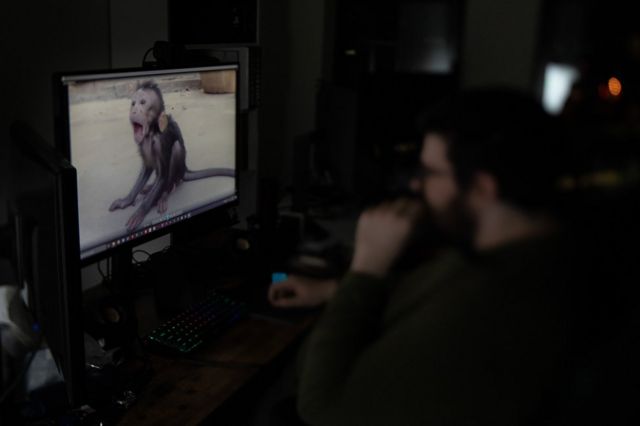
IMAGE SOURCE,ED OU/BBC
Image caption,

"I remember the face of every monkey and how they died," said Mr Ape
“Mr Ape”, Stacey Storey and Mike McCartney are three of five key targets in the ongoing Homeland Security investigation. They have yet to be charged, but could face up to seven years in prison if prosecuted based on evidence gathered by the DHS.
Special Agent Paul Wolpert, who is leading the DHS investigation, said everyone involved from law enforcement had been deeply shocked by the nature of the alleged crimes.
“I don’t know if anybody would ever be ready for a crime like this,” he said. “The same with the attorneys and the juries, and anybody who reads that this is going on. It is going to be a shocker I think.”
Anybody involved in buying or distributing the monkey torture videos should “expect a knock on the door at some point”, Agent Wolpert said. “You are not going to get away with it.”
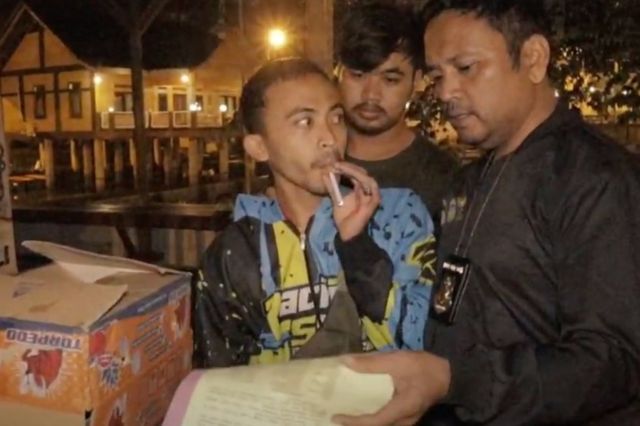
Police in Indonesia have arrested two torture suspects. Asep Yadi Nurul Hikmah was charged with animal torture and the sale of a protected species, and sentenced to three years in prison. M Ajis Rasjana was sentenced to eight months – the maximum sentence available for torturing an animal.
Monkey torture videos are still easily accessible on Telegram and now Facebook, where the BBC recently found dozens of groups sharing extreme content, some with more than 1,000 members.
“We’ve seen an escalation in this extreme, graphic content, which used to be hidden but is now circulating openly on platforms like Facebook,” said Sarah Kite, co-founder of animal charity Action for Primates.
Facebook told the BBC it had removed the groups we brought to the company’s attention. “We don’t allow the promotion of animal abuse on our platforms and we remove this content when we become aware of it, like we did in this case,” a spokesperson said.
Ms Kite also called for UK laws to be updated to make it easier to prosecute individuals who pay for torture videos to be made. “If someone is proactively involved in inflicting that pain by paying for it and providing a list of things they want done to the animal, there should be stronger laws to hold them to account,” she said.
YouTube told the BBC in a statement that animal abuse had “no place” on the platform and the company was “working hard to quickly remove violative content”.
“Just this year alone, we’ve removed hundreds of thousands of videos and terminated thousands of channels for violating our violent and graphic policies,” the statement said.
Telegram said it was “committed to protecting user privacy and human rights such as freedom of speech”, adding that its moderators “cannot proactively patrol private groups”.
Need help to report? email me and I can send you information
eevanderploeg@gmail.com

.jpg)