
Karen travels to Ukrainian cities to rescue dogs: 'You come all the way here for the animals?'
On her way to the dog shelter adopted by her foundation in bombed-out Dnipro, Karen Soeters stops in a parking lot. A Ukrainian woman nearly bursts into tears when she hears why the Dutch are there. "You're coming all the way here for the animals?" A hug follows. On Tuesday, House of Animals will open a "Christmas Village": one hundred insulated wooden houses where displaced animals can survive the winter.
.jpg)
Together with emergency aid coordinator Helma van de Vondevoort and filmmaker Sanne Vermaas, the founder of House of Animals is once again traveling to war zones. In cities like Dnipro, Mykolaiv, and Zaporizhia, Soeters is assessing the most urgently needed emergency aid for four-legged war victims. She is in daily contact with local animal rights activists about how the donations will be spent.
She knows things are not going well, but what she finds is shocking: many animals have been killed, abandoned, or are wandering. Dogs are startled by every loud noise, traumatized by impacts from Russian missiles and drones.
"That's so incredibly sad," says Soeters from the car. "Our people have horses that have been rescued from the line of fire and are barely horses anymore. When you look into their eyes, you see nothing but fear."
A hospital for Lucy
That's why House of Animals built an emergency hospital in 2024 with Dutch and Flemish support. A crisis kitchen and a dog village will open there on Tuesday. The latter consists of wooden houses furnished with hay and a blanket.
Key to Soeters' work with displaced animals in Ukraine was the story of Lucy, a German Shepherd injured in an explosion. Lucy appeared to recover but died due to lack of hygiene and medical care in an overcrowded shelter. To prevent this, House of Animals opened Lucy's emergency hospital in Dnipro, complete with an operating room and fifteen beds. Local veterinarians can operate and neuter animals there.
Two thousand animals in one shelter
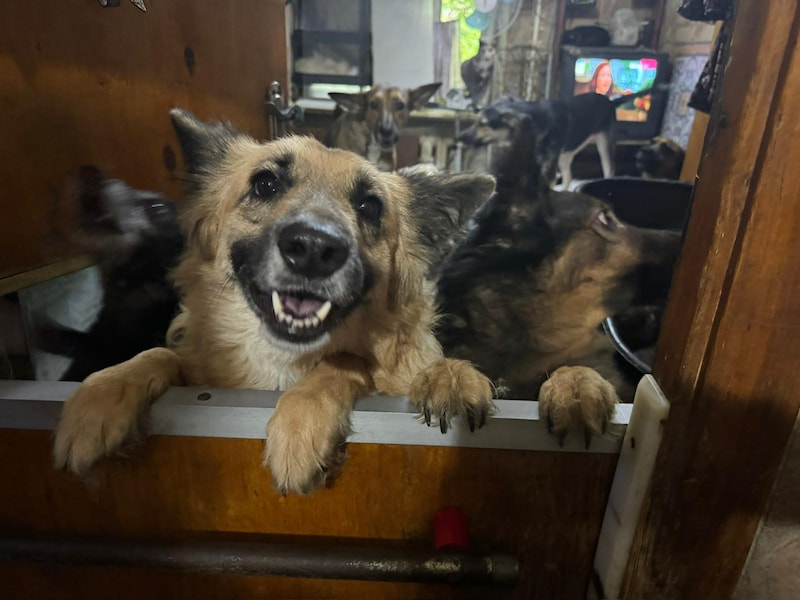
Ukrainian shelters are completely full. Before the war, the Pegasus shelter, supported by House of Animals, housed five hundred animals; now there are two thousand. Dogs, cats, horses, pigs, and even a camel.
As the front line draws ever closer, Ukrainian soldiers are also regularly bringing in wounded animals. The shelter staff are becoming exhausted, says Soeters. They stay with their animals and often sleep in bathrooms with their families at home because there are no bomb shelters.
Animal food is hard to come by. Dog food is barely being delivered anymore, as supplies are depleted by the war. Therefore, House of Animals has set up a crisis kitchen where the remaining kibble is mixed with muesli and grains to make a porridge.
In Zaporizhia, Soeters met Angel, a woman who cared for all the pets abandoned in an apartment building from which the residents had fled. "It's wartime; you can't take everything with you," Soeters says sympathetically. "Many residents thought they had to leave temporarily and often left food and water behind. But they never came back. We're helping her too."

Monika and the Christmas Village
In Kramatorsk, the dog Monika was found next to her dead puppies, with mud in her stomach. She recovered in the emergency hospital.
For dogs like Monika, House of Animals is opening a Christmas village on Tuesday. A drop in the bucket, but still: a hundred insulated wooden houses filled with straw and blankets. "It's a safe place where animals can survive the coming winter," says Soeters.

They found Monica lying next to het dead puppies. She had eaten mus to keep her babies alive......unfortunately it was not to be.
Despite sleepless nights in bomb shelters, she keeps returning. Even now, things are tense again, and the team has received training on how to respond to Russian drone attacks. "Every time I've been there, I think: it can't get any worse. And then I come back and think: it can definitely get worse. I just want to hold on to hope that it will stop eventually. I don't actually want to say I'm hopeless. But I also see Christmas trees everywhere, Christmas decorations everywhere. It's like: we're not going to let this get us down, this is our country, we're going for it."
Soeters has often said that a society's treatment of animals reflects its civility. The more than two million euros in emergency aid she has raised from the Netherlands and Belgium, she says, demonstrates that many people here share this sentiment.
War in Ukraine hits animals hard
We don't know exactly how many animals were killed in the war in Ukraine. The figures we do have indicate that it's in the millions. Millions of chickens and tens of thousands of cows and pigs alone have perished. Hundreds of thousands of animals died last winter at large chicken farms that lost power and feed.
Before the war, there were millions of cats and dogs. Many animals fled with their owners, but many others were abandoned, died, or became strays. The total number is unknown.
Many wild animals in Ukraine are dying from bombs, fires, pollution, and natural disasters. Thousands of dead dolphins, for example, have been found. Natural areas have also been severely damaged.
Animals are also psychologically damaged. They panic at sirens and bombs, and some die from sheer fright.
Organizations like the Dutch House of Animals try to help local organizations in various ways, but the almost daily danger of Russian bombing makes that work difficult.

Geen opmerkingen:
Een reactie posten