In the decades since the Chernobyl disaster, the abandoned exclusion zone has seen a remarkable recovery of local megafauna. Herds of grazing ungulates and the large predators that feed on them have repopulated the landscape in the total absence of human beings, along with countless small animals.

Telling the story of Chernobyl in numbers 40 years later involves dauntingly large figures and others that are even more vexing because they’re still unknown. A look at numbers that hint at the scope of the world’s worst nuclear accident, the explosion and fire at the Chernobyl nuclear power plant on April 26, 1986:

On April 26, 1986, a routine safety check gone wrong led to one of the worst nuclear disasters in history. While the Ukrainian people mourned the loss of human life and the necessary abandonment of their homes, the earth mourned the loss of over 600 hectares of pine trees and the destruction of an entire ecosystem. The only living things that remained were the animals left behind. The forgotten ones, the abandoned ones, the ones who now had to learn how to survive in a nuclear wasteland. The wild dogs of Chernobyl.
When the canine population grew to a point that was uncontrollable, something had to be done—humanely. The solution was an animal-first project that involved mass sterilization of the dogs living on the site carried out by the Dogs of Chernobyl program, part of the Clean Futures Fund (CFF).
.jpg)
In the aftermath of the nuclear disaster, the surrounding 30-kilometer area now known as the Chernobyl Exclusion Zone saw the evacuation of around 300,000 including the entire population of the nearby worker town of Pripyat. Those who didn’t evacuate, though, were the dogs. To dog owners, fleeing your hometown without your beloved four-legged friends may seem unthinkable, but the panic that followed the explosion, alongside authorities’ instructions to leave everything behind, including pets, meant that many furry friends became homeless and familyless overnight.

With no vets, families, or even people left in the exclusion zone, the dogs of Chernobyl were left to fend for themselves, all while radioactive matter from the explosion seeped into their bones. The radioactivity can cause major health issues, and fear of animal-human contamination also prevents the dogs from being released into society.
Fast-forward to 2017 and there were an estimated 1,000 stray dogs living throughout the exclusion zone. Somehow, despite countless hardships and grueling living conditions, these dogs survived, reproduced, and continued to live on the abandoned site of the Chernobyl Nuclear Power Plant.
The sheer number of dogs was becoming a problem, and efforts by Soviet authorities to cull the dogs were far from well-received by the Ukrainian population. Workers at the plant—who are now working on the decommissioning process—had taken an interest in building shelters and feeding the dogs and wanted to enlist help to care for them as breeding spiraled out of control. That’s where Erik Kambarian and Lucas Hixson came in. The two met in 2015 on visitor trips to the power plant with a group of professionals with backgrounds in nuclear energy and emergency response, and quickly saw the need for some sort of intervention to help both the humans and the animals affected by the disaster.
Building the program
In 2016, Kambarian and Hixson established the Clean Futures Fund (CFF)—an organization that provides support to communities affected by industrial accidents—and subsequently launched human and animal healthcare programs in 2017, including the Dogs of Chernobyl initiative. Portland-based Jennifer Betz, Veterinary Medical Director and Board Member at the program, explains that the initial goal of the project was to “do some sort of spay-neuter program and just keep them from reproducing, but allow them to live as happy as they possibly can.” Betz was contacted by the founders to join the program as she’d worked with organisations worldwide on similar projects: “We go into areas where they can’t afford veterinary care or there isn’t veterinary care, like Chernobyl, and we provide free spaying and neutering to help control the population, veterinary care, vaccinations, deworming, and wellness care.”
The first project was launched in 2017 when the CFF team and volunteers flew from the US to Ukraine to start the spay and neuter program. Despite the fearful nature of the dogs, Betz and her team were able to capture and treat 300 dogs during the first mission. Why not more? These dogs aren’t like your childhood pup—they’re feral. “They are not aggressive, but they’re very fearful,” Betz explains. “You can get close to them, but a lot of times you can’t touch them. So capturing them is very difficult.” During each mission on the site, a lot of time is spent building a trust that will enable the CFF team to provide medical care and help the dogs understand that these are good people.
Projects like these don’t come cheap, and while the travel expenses for the trip are covered by each individual volunteer, the organization still forks out around $20,000 per Chernobyl mission in order to bring all the supplies they need, and provide food, transportation, and accommodation on the ground. However, some crucial equipment was kindly donated by SPCA International, a huge help for the Dogs of Chernobyl project. “They had purchased all of our surgical instruments, surgery tables, and drapes,” Betz recalls.
Successes, but unexpected roadblocks
After effective programs in 2017, 2018, and 2019, the Dogs of Chernobyl team had successfully sterilized between 85-90% of the dog population, Betz explains. And then, the unthinkable happened: a pandemic and global lockdown, halting international travel and thus, temporarily suspending the organization’s spay-neuter project. During this time and without the presence of the CFF team, the non-sterilized dogs reproduced and new litters of pups were born. The new dogs came from, Betz suspected, a particular pack living on the site that was even more fearful than the others. “When you would try to catch them, they would take off and go into areas that you can’t access, like under fences. This population of dogs has been a problem for us ever since 2017,” Betz says. It wasn’t until the 2022 mission that Betz and her team were able to resume their on-site work.
Working with the dogs of Chernobyl is a physically demanding job. From setting up surgical clinics to building shelters, installing automatic feeders, and training feral dogs, this type of work isn’t for everyone. But Betz and her team are determined to help these dogs. Even with the many obstacles they’ve faced, this project is one close to their hearts: “Yes, Covid stopped us for a little while, but we’re here. We’re here to help,” she says.
A seemingly simple solution would of course be to screen the dogs for contamination risk, and then let them be adopted into warm, loving homes. But Betz explains that the process is harder and riskier than you might think. In an initial trip to the exclusion zone, the CFF team found an abandoned litter of puppies, and then a second litter after that. With about 34 small, vulnerable dogs on their hands, the team went through a taxing process to get the puppies off the site. “We had to get special permission from the exclusion zone, from the power plant, from all of the authorities—about 100 signatures to allow us to remove these dogs from the zone because you cannot legally remove anything from the exclusion zone due to radioactive contaminants,” Betz says. “So we petitioned them and said we will take care of them, vaccinate them, monitor them, and house them as long as we can to determine that there isn’t anything that’s coming out in their feces—which takes about three months—to assure that they were not going to pose a threat to the humans.” Add to that a six-month quarantine and about $4,000 to get the pups into the US or Canada and the whole process is expensive, exhausting, and—especially—it can be traumatizing for the dog.
So while 34 radioactive dogs were successfully adopted, the organization decided “they would act as ambassadors of our program so we could follow them and continue to see how they’re doing, find out if they’re developing any cancers later on in life,” Betz says. Their goal isn’t to disrupt the dogs’ lives by removing them from their home, but “to make them as comfortable as they possibly can be where they live. Yes, I’d love for all of them to have a great home, but their home isn’t so bad where they are.”
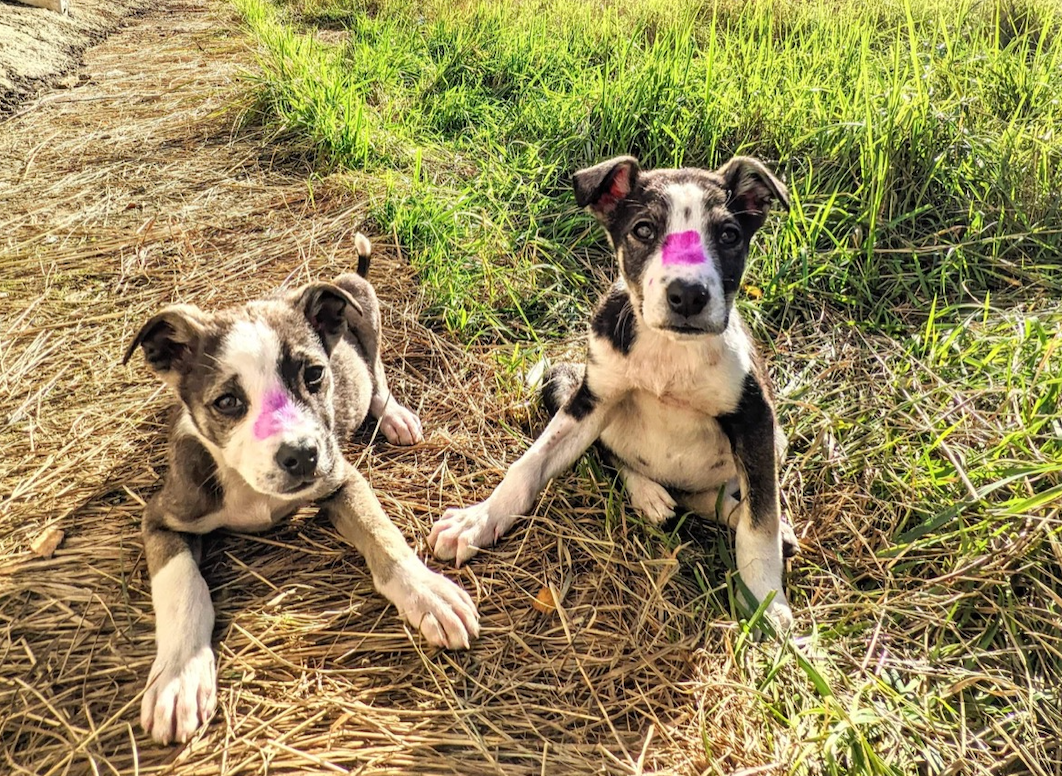
Sterilized dogs with temporary ink marks to ensure they don’t get rcaught by the CFF team. Photo credit: CFF
Working on radioactive grounds
While the radiation levels on the Chernobyl site were deemed safe for workers in recent years, the dugouts and trenches created during the Russian invasion of the site in March 2022 have potentially released new masses of radioactive matter previously buried in the soil. A research project currently being carried out by Greenpeace Germany, with the approval of the Ukrainian government and in cooperation with scientists from the State Agency of Ukraine on the Exclusion Zone Management (SAUEZM) to determine the current levels of radioactivity in the area.
Working on a radioactive wasteland comes with droves of precautionary measures and stringent safety procedures. Betz explains that a typical day starts out with radiation control: “They do a whole body count of you and take measurements to see what you have as far as radiation contaminants. And then we are issued dosimeters that we are to wear for basically 24 hours.” In terms of clothing, anyone who enters the site has to be fully covered in protective gear. “When we’re there we have to wear long sleeves, special long coats, special long pants, and special boots that stay in the area,” Betz says. After a long day of treating and feeding the dogs, the team “turn in our dosimeters and then go back to radiation control our whole body, count our measurements and everything once more.”
The impact of the war
When Betz and the team planned to perform a “scouting mission” in May of this year, their goal was to figure out how to catch the uncatchable dogs. However, Russia’s invasion of Ukraine in February put an abrupt halt to the organization’s campaign. With the Russian Armed Forces controlling the Chernobyl exclusion zone, the dogs were left without the food and care they had come to know from the workers at the plant. While some workers managed to occasionally sneak out and feed the pups, many of the dogs were starving to death.
Once the Ukrainians regained control of the exclusion zone and power plant site, the workers on the ground were able to go back out to the dogs and feed them. While recovering health and strength is a huge positive, Betz says this also created problems: “These dogs were fattened back up and got healthy and then started breeding,” and with breeding come puppies, and with puppies come risks. Betz says she knew she and her team had to do something: “We were going to have a bunch of new litters before winter. They were going to freeze to death. They were going to suffer.”
Betz and the Dogs of Chernobyl team assembled a small group of volunteers and took a risk: they were to sneak into Ukraine in the middle of a war and resume their efforts to help the dogs. In June 2022, after a flight from the US and a train from Poland, along with permission from Ukrainian authorities to enter the Chernobyl site, Betz and her crew set out on a five-month mission to spay and neuter the remaining, until now uncatchable dogs. Instead of embarking with a big group of volunteers, Betz says the strategy this time was different, “We only took specialized people that we’ve had in the past. We only brought basically six people and then [we worked with] the Ukrainians.”
Among the medical supplies, food, and outdoor sleeping equipment (because hotels weren’t an option this time around) the team also brought care packages for the Ukrainian soldiers they met along the way to the site. “Each one of us brought little goodie bags that we made, with little things for the military at the checkpoints. They had socks and hand warmers, beef jerky, and things for them to have. Those were purchased by the volunteers themselves,” Betz explains. The CFF organization as a whole has been supporting the Ukrainian population since the invasion began: “We’ve provided over $100,000 since the beginning of the war in assistance to the people of Ukraine,” Betz says.
The power of social media
The Dogs of Chernobyl project has gained a lot of traction on social media, particularly trough Tik Tok, where the CFF team shares videos of the dogs on the site to raise awareness of their efforts. Betz explains that a lot of what they do on social media is educational, especially for the younger generations. “There’s a lot of people that don’t know [what happened]. Younger people weren’t around in 1986, so they don’t know anything about Chernobyl so we try to educate as best we can.”
The organization’s presence online has also led to a lot of adoption requests. Unfortunately, it can’t be done. Betz says people all over the world want a Chernobyl puppy, “I get 10 or 15 emails a day asking ‘can I adopt a dog?’” But she encourages people to instead adopt locally and “go next door to your shelter,” as there are plenty of dogs that need homes without traveling across the world.
Because of the sensitive situation of the organization’s most recent mission, social media campaigns for funding were halted. Betz explains how broadcasting that a group of Americans would be traveling to Chernobyl in the middle of a war wouldn’t have been safe. However, this affected the number of donations they were able to collect for this mission. “We usually get a lot of donations beforehand in preparation for our campaign, so we weren’t able to do that [this time]. We didn’t post anything until everybody was safely back home, so we are getting some donations from there now but nowhere near what we normally do for a campaign, but that’s just the nature of the beast for right now, it’s the way things are.”
Cover photo: ChNPP
Feature photos: Clean Futures Fund

.jpg)