3 lions in a small cage in the former Zoo- Lujan Argentina
Amsterdam / Buenos Aires
Global animal welfare organization FOUR PAWS has launched the first phase of a large-scale emergency relief mission in Argentina. At the former Zoo Luján—closed in 2020 due to serious animal welfare concerns—our team is providing urgent medical care to more than 60 big cats and two bears.
One of the 2 bears rescued by Four Paws
It's the largest veterinary mission we've ever conducted on big cats in such a short period – the medical mission is scheduled to run from October 23rd to the end of November. Conditions on site are difficult: the enclosures are too small, there are too many animals, and the lions and tigers are kept together in cages. The two bears are also living in precarious conditions, but are separated from the big cats.
Cooperation with the Argentine government
Our main short-term goal is to improve the welfare of the lions, tigers, and two brown bears and provide them with urgent medical care. Our team of veterinarians and wildlife experts is currently working on this. This is the first step of the Memorandum of Understanding (MoU) we signed with the Argentine government in July. In the longer term, we aim to work with the government to find suitable solutions for the animals in the former zoo and to ban the commercial trade and private ownership of big cats in Argentina.
A wild orca can cruise some 40 miles of coastline in a single day an aquatic marathon that knits together hunting grounds, family calls, and deep-water dives. But on the French Riviera, Wikie and her calf Keijo trace a weary oval of chlorinated water no longer than a sprinting track, the paint flaking off the concrete like dried salt on skin. Their world shrank overnight when Marineland Antibes shut its gates on 5 January 2025, forced closed by France’s ban on dolphin and whale shows. Now the country’s last two captive orcas circle a tank gone green with spring algae spectators gone, music off, future uncertain.
For decades, Marineland Antibes was a fixture of the French Riviera an ocean-themed amusement park promising close-up encounters with marine life. At its peak, the park drew hundreds of thousands of visitors annually, most of them coming to see the orcas and dolphins perform in tightly choreographed shows. But beneath the surface appeal, criticism was mounting. Growing awareness of marine mammal intelligence, stress-related behaviors in captivity, and shifting public ethics eventually crystallized into political action.
12 dolphins and 2 orcas are left behind in this small basin
Twelve dolphins and two orcas Wikie, a 23-year-old female, and her 11-year-old son Keijo remained behind. Rehoming plans, initially promised as part of the transition, stalled almost immediately. Despite legal and ethical responsibility falling to the park’s owner, Parque Reunidos, no clear exit strategy materialized. A small maintenance crew stayed behind to provide basic care, but the orcas’ environment began to deteriorate. Footage released by the advocacy group TideBreakers showed tanks lined with green algae, installations in disrepair, and the orcas swimming aimlessly. and that roughly 50 employees continue to care for the animals’ basic needs. Still, what was once a choreographed marine show has become a haunting daily loop two apex predators pacing the perimeter of a life they can’t escape.
Why Relocation Has Stalled
Initially, Marineland proposed relocating the two orcas and twelve dolphins to facilities in Japan and Spain. Both efforts were blocked. French authorities rejected the transfer to Japan, citing welfare standards that didn’t meet European expectations. Meanwhile, the proposed move to Loro Parque in Tenerife one of the few marine parks in Europe equipped to house orcas was vetoed by a scientific panel in Spain. Their reasoning: the facility already housed four orcas, including a newborn, and could not ensure optimal conditions for additional animals.
At the heart of this movement is Tide Breakers, a Canada-based NGO whose drone footage of the algae-lined tanks brought global attention back to the closed park. Their co-founder, Marketa Schusterova, has described the situation as an “emergency,” arguing that leaving the orcas in a crumbling facility risks illness, psychological deterioration, or even premature death. “After entertaining the public for years, we should still provide them with a clean and safe environment to live out their remaining years,” she said in a public plea. Their advocacy has galvanized a growing online campaign, bolstered by a petition and social media traction that spans countries and languages.
Honestly, there’s no single villain to blame for this situation. It’s something much more frustrating: a system that has ground to a halt. It’s a mess of red tape, buck-passing, and official inertia, where everyone seems to be waiting for someone else to make the first move. And this isn’t just happening in France. All over the world, we’re looking at concrete tanks and asking ourselves some hard questions about whether this is right, especially for animals this intelligent and social. We’re finally challenging the very idea of it.
So, what happens now? It all comes down to a simple shift in how we see them. We have to stop looking at Wikie and Keijo as property to be managed or a problem to be solved. They are individuals, with memories and relationships, who have spent their entire lives in our service. We can’t give them back the wild ocean, but we can—and should—give them something better than this. Surely, after all this time, the very least we owe them is a final chapter with some dignity, space, and peace.
Thousands of orcas and dolphins worldwide are suffering as tourist attraction. Stolen from the oceans.
16 July 2025: Woman calling herself "Sadistic Queen" given jail sentence in US baby monkey torture case
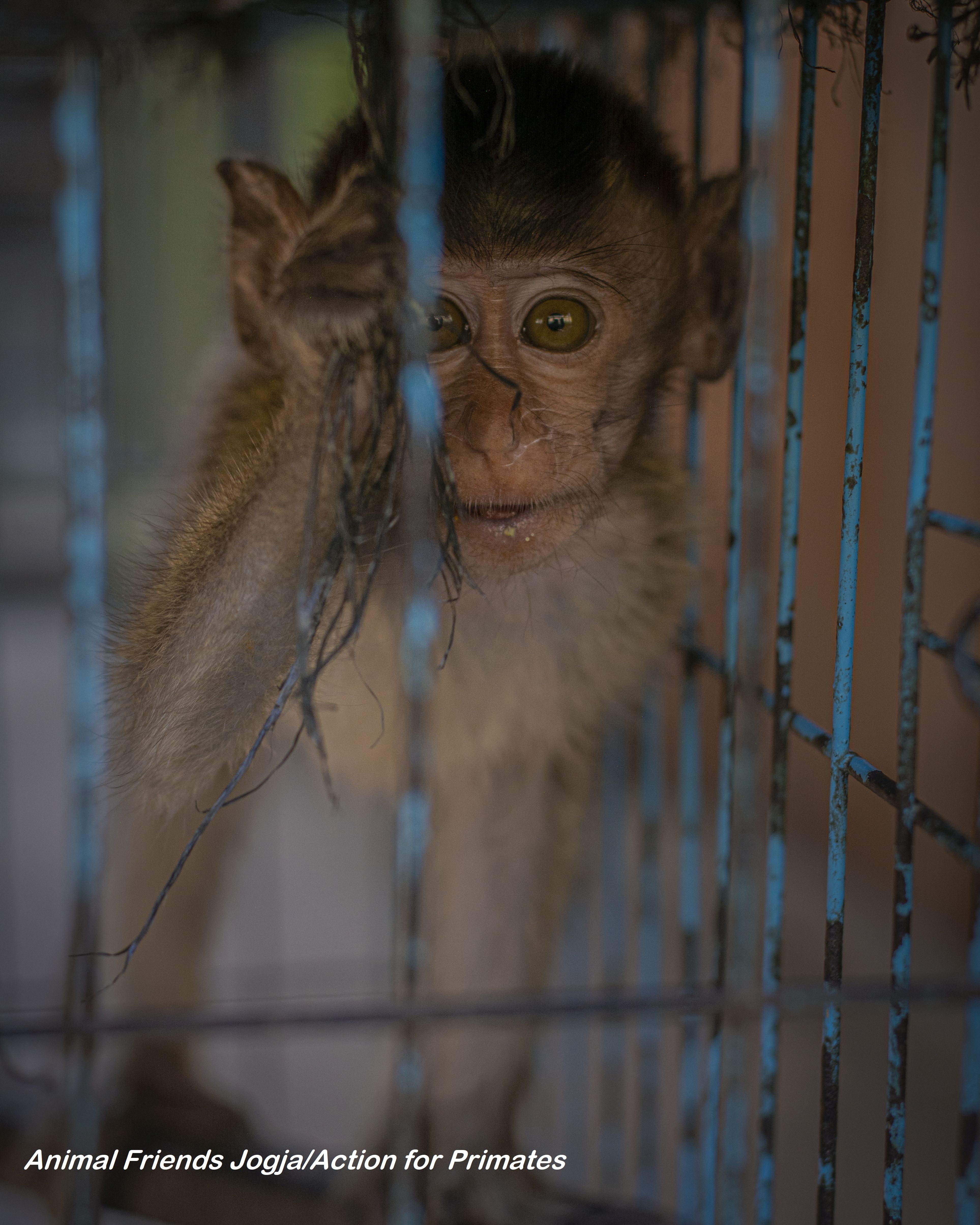
Infant long-tailed macaque, in captivity, Indonesia Animal Friends Jogja/Action for Primates
Action for Primates and Lady Freethinker applaud the jail sentence handed down to a US woman convicted of Conspiracy to Create and Distribute Animal Crushing Videos. Stacey Storey, of Alabama, has received a three-year prison sentence and three years supervised release, in the US District Court, Eastern District of Virginia, after pleading guilty to conspiracy to create and distribute 'animal crush' videos.
Storey, who called herself "Sadistic Queen" and "Sadistic Mind", was a member of an online monkey torture group that facilitated the torture, murder and sexually sadistic mutilation of baby long-tailed macaques in Indonesia. She sent payments and instructions on how to torture the monkeys and then distributed the videos within the group. In June 2022, with the words Enjoy this one ladies and gents, Storey circulated a horrifying video depicting the brutal torture and killing of a baby monkey who was sealed inside a jar of red ants before being sodomised with an object.
In June 2023, law enforcement seized Storey's electronic devices, which contained over 675 videos and 11,000 images depicting animal crushing. Three of her co-conspirators in the US have also received jail sentences: Michael Macartney, who used the name "Torture King", was jailed for three years and six months; Jeffrey Radtke received a 21-month prison sentence, followed by three years of supervised probation, and Drexel Venero, who used the name "Mr Ape", was given an 18 month prison sentence with three years supervised release.
Action for Primates and Lady Freethinker first exposed the sadistic world of online monkey torture groups in 2021, and since then have continued to investigate as various other groups sprung up dedicated to the torture, mutilation and killing of infant monkeys. We are extremely grateful to US law enforcement agencies for tracking down and prosecuting these depraved and perverted individuals responsible for the most unimaginable pain and terror inflicted upon baby monkeys.
This sentence is the latest in a global spike in arrests and charges for crimes in which sadistic individuals purchase torture videos from "filmmakers" in Indonesia through encrypted chats on Telegram, using cryptocurrency and other online payment methods. The videos have often been re-posted on major social media sites such as Facebook and YouTube.
Creating and distributing 'animal crush' videos is a federal crime in the US, punishable by up to seven years in prison under the Preventing Animal Cruelty and Torture Act (PACT Act).
Nina Jackel, founder, Lady Freethinker, stated: Such brutal and horrific crimes against monkeys or any other animal must not be tolerated. The torture inflicted on young macaques for these videos is more disturbing than any other abuse I've come across in more than a decade of animal advocacy work. I'm grateful to law enforcement for their diligence in investigating these unthinkable acts and seeking justice.
Sarah Kite, co-founder, Action for Primates, stated: We welcome the prison sentence given to Stacey Storey for her involvement in facilitating the violent, sadistic torture and killing of baby monkeys. We are extremely grateful to US law enforcement for tracking down and prosecuting these depraved individuals. These people need to know that there are legal consequences to their vile activities. We fervently hope this prosecution and punishment will act as an important deterrent to others.