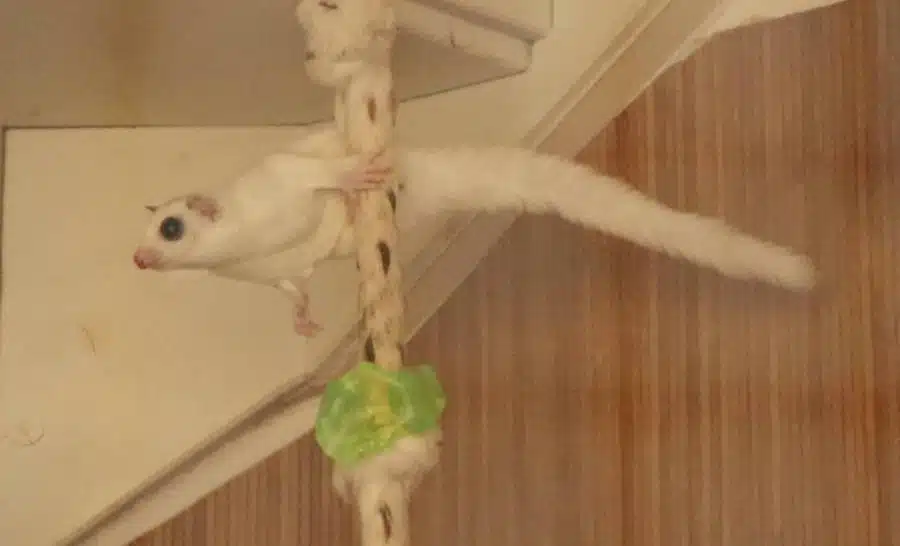
Onlangs zijn maar liefst negen suikereekhoorns naar ons opvangcentrum in Almere gebracht. De dieren leefden bij een gezin in Nederland onder het trappenhuis.
Gekocht op Marktplaats
Drie jaar geleden kocht het gezin twee suikereekhoorns nadat ze een advertentie op Marktplaats hadden gezien, waar de dieren werden aangeboden. Daarna zijn nieuwe dieren geboren en uiteindelijk mondde het uit in een groep van negen suikereekhoorns. Daarna besloten ze contact op te nemen met AAP.
Een van de suikereekhoorns in het trappenhuis.
Ongeschikt als huisdier
Suikereekhoorns, ook wel sugar gliders genoemd omdat ze een stukje kunnen zweven, zien er lief en schattig uit. Toch zijn het allesbehalve geschikte huisdieren. Ze markeren hun territorium met een enorm penetrante geur. Daarnaast zijn ze alleen ’s nachts actief.
Ook voor suikereekhoorns zelf is een leven als huisdier geen pretje. De dieren hebben veel ruimte nodig om te kunnen zweven. Daarnaast is specifieke verzorging een vereiste. Veel eigenaren kunnen hier niet aan voldoen, zelfs al is die kennis in huis.
Met de nieuwe Nederlandse positieflijst is het in Nederland niet meer toegestaan een suikereekhoorn als huisdier te houden. Gelukkig maar, want dit voorkomt een hoop dierenleed! Lees hier meer over de positieflijst in Nederland.
Alles over suikereekhoorns
Suikereekhoorns zijn nachtdieren en worden tegen de avond pas actief. Ze zijn erg sociaal en leven in groepen van ongeveer zeven dieren die allemaal familie van elkaar zijn.
Cultivated meat products are set to go on sale in Australia as the government has now issued its approval to a food company which produces cell-cultivated quail.
Also known as cellular agriculture or lab-grown meat, cultivated meat is cultivated - grown - in a controlled setting using cells extracted from an animal. The production process crucially does not require the farming or slaughter of animals.
Following a two-year-long approval process, Sydney-based company Vow received regulatory approval from Food Standards Australia New Zealand (FSANZ) for three products made from cultured quail cells.
The regulatory approval means Vow can now sell its cultivated meat in restaurants and supermarkets across both countries. The decision follows the startup’s launch of its Japanese-inspired quail in Singapore in 2024, where demand reportedly grew by 200% a month.
“We’ve worked closely with FSANZ over the past two years, and we’re proud to have earned their approval,” said George Peppou, Vow CEO and founder. It’s a rigorous process, and rightly so. This is an important milestone for cultured meat in Australia and around the globe – to have the stamp of approval from a trusted global regulator such as FSANZ – and we’re excited to bring safe, high-quality products to local diners through some of the country’s most talented chefs.”
Vow’s whipped parfait, foie gras, and a tallow candle developed from cultured Japanese quail cells will soon be served at high-end restaurants under their premium brand, Forged, starting with Bottarga in Melbourne and Nel in Sydney.
“This isn’t about replacing the meats we know and love. It’s about trying something entirely new – something that can only exist because of how it’s made,” said Mike McEnearney, owner and executive chef at Kitchen by Mike in Sydney. “For chefs, that’s incredibly exciting. But for all of us, it’s a huge opportunity.
“The future always lies in bold ideas that seem impossible at first but are rooted in real innovation – the kind that drives culture forward,” McEnearney added.
Also known as cellular agriculture or lab-grown meat, cultivated meat is cultivated - grown - in a controlled setting using cells extracted from an animal. The production process crucially does not require the farming or slaughter of animals.
Cultivated meat has already generated a huge amount of buzz in the food sector, where it is being seen as having the potential to create a more sustainable food system that can produce meat with significantly less environmental, ethical, and sourcing issues.
Vow’s approval in Australia marks a positive step forward for an emerging industry that continues to weather a political storm, as cultivated meat becomes a target for politicians who view the innovation as a threat to traditional animal agriculture.
“Australia has always punched above its weight when it comes to food – we’re a country of curious, creative, and deeply thoughtful chefs and diners” said Peppou. “To now be able to offer something completely new – not an imitation, but a new category of food that complements local farming – is something we’re incredibly excited about.”
In the United States, four companies have now been approved to sell cultivated products. Mission Barns received approval for its cell-based pork in products earlier this year, following previous government approval back in 2022 for cultivated-chicken from Upside Foods and Good Meat.
Wildtype met the US Food and Drug Administration’s (FDA) requirements for its cell-cultured seafood product just this week. The company’s cultivated salmon is now on the menu at Kann, an award-winning Haitian restaurant in Portland, Oregon.
This marks the first time a cultivated seafood product is available for sale anywhere in the world, according to the alternative protein think tank Good Food Institute (GFI) and signals the FDA isn’t blocking cultivated meat under Trump, despite political pushback.
Our practical but ambitious five-year plan to make the world a kinder place
Our six ‘superstars’,the iconic species we’ll focus on to maximise our impact
An update on Blue, the cheetah cub you helped rescued last year in Ethiopia
The latest news about new lion cubs, born in our charity’s heartland of Kenya
But that’s just for starters. The mag is brimming with success stories, from pangolins to gorillas, hippos to leopards. AND find out how one of the world’s smallest species is helping save one of the largest!
But, as you turn the pages, don’t forget all this good news is only possible because of incredible YOU. Thank you for caring for wildlife as much as we do!
Er komt een verbod op dolfijnenshows in Mexico. Bovendien wordt het fokken van dolfijnen in gevangenschap verboden |
Het wetsvoorstel was een initiatie een verbod op dolfijnenshows en het fokken van dolfijnen in gevangenschap
Het ongeluk van dolfijn Mincho is destijds op beeld vastgelegd en ging al snel daarna viraal. Dit leidde tot een heftige publieke reactie, waarop de federale procureur voor milieubescherming (Profepa) een inspectie uitvoerde. Volgens Animal Heroes kwamen daar meerdere onregelmatigheden aan het licht, waaronder ongeoorloofde acrobatiek, deelname van dolfijnen die een medische behandeling ondergingen aan activiteiten zonder dat daarvoor veterinaire goedkeuring was gegeven, en overmatige interacties van mensen met dolfijnen. Profepa sloot definitief de deuren van het dolfinarium en legde deze een boete op van 7,5 miljoen Mexicaanse pesos (ongeveer 340 duizend euro).
Dolfijn Plata sterft tijdens liveshow in Mexico
Dolfijn Plata overleed eerder deze maand na een fatale sprong tijdens een liveshow in het Barceló Riviera Maya-hotel in Mexico. Plata sprong uit haar kleine tank en kwam op het beton terecht, ze bezweek aan haar verwondingen. Dit tragische incident roept opnieuw vragen op over
Mexicaanse dolfijnenshow in luxe hotel voorlopig verboden
Begin dit jaar stierf dolfijn Plata op tragische wijze in het Mexicaanse Barceló Maya Grand Resort. Plata sprong tijdens een show op de rand van het zwembad en stierf voor de ogen van een tribune vol publiek. De Mexicaanse milieu autoriteit Profepa stelde een onderzoek in.
An anonymous source for the Empty the Tanks campaign in Mexico has informed our team that another dolphin has died at the Dolphinaris Riviera Maya location. A female dolphin named Ashin reportedly died nearly one month ago in her tank. Our source says that Ashin died due to medical malpractice and that she suffered from ailments due to her life in captivity. We have been told that Ashin had regular infections on her tongue due to poor water quality which resulted in staff having to cut away pieces of her tongue on a regular basis. We are told another dolphin named Vairon has the same medical problem and goes through the same procedures for his tongue infections as well.
Ashin the dolphin has allegedly died at Dolphinaris Riviera Maya. Credit: Anonymous
Ashin, reportedly a wild caught dolphin, was mother to Aqua and Kalla. Her death is just one more in a string of dolphin deaths in Mexico, particularly at Dolphinaris facilities. It is our understanding that employees of these facilities are told not to share information about any dolphin deaths that occur.
Dolphinaris was responsible for the four dolphin deaths that occurred at their facility in Arizona. The Riviera Maya location is also the same location that had a dolphin calf death which we reported on earlier this year. Dolphinaris never reported the calf’s death to the government according to our records. Former employees have told us that many of the dolphins at Dolphinaris suffer from eye and respiratory damage due to the harsh sun in their unshaded tanks, as well as from the strong chemicals used in the water. You can read more about our investigation about Dolphinaris here.
Four dolphins died at Dolphinaris Arizona. The facility closed in 2019. Credit: Empty the Tanks
We called Dolphinaris to ask them about Ashin’s death. After a marked silence, we were informed nobody was there that could confirm the information. We have also emailed Arturo Dominguez, General Manager of Dolphinaris Riviera Maya and we are still awaiting his response
Empty the Tanks will be requesting that PROFEPA investigate this most recent dolphin death allegation. PROFEPA is the agency in Mexico tasked with regulating and overseeing the dolphinaria in the country.
We are asking that PROFEPA do a full investigation into the dolphin deaths at Dolphinaris. PROFEPA has a history of not fully investigating dolphin deaths in Mexico and we are asking that they also be held accountable for lack of proper oversight at Dolphinaris.
Another disturbing allegation made by our sources in Mexico is that Dolphinaris is incorrectly reporting the number of guests that interact with the dolphins during the busy season. PROFEPA regulates the number of interactions each dolphin has with tourists per day, to prevent stress and exhaustion. Our source revealed to us that Dolphinaris allegedly doubles the interactions allowed during the high season. It would appear that employees are instructed to change the numbers on the reports before they are submitted to the government. We are requesting that PROFEPA investigate this allegation as well.
Empty the Tanks is working to create more accountability within the captivity industry in Mexico. Our end goal is of course to bring an end to this industry overall, but until that day comes, these companies must be held responsible for the welfare of the dolphins in their tanks. We will continue requesting information from Dolphinaris explaining the allegations against them, as well as pressuring the Mexican government to uphold their own policies for the welfare of captive dolphins.
We ask that you please never buy a ticket to a dolphin show or swim-with-dolphins program.
Dear Readers, I know and I see that the zoo where Tamy lived is not what we want a zoo to be. I want to be fair. The zoo has had many problems and many bad reviews. Nevertheless Tamy was saved from a far worse situation in a very cruel circus Animal welfare organisations are helping zoos to improve animal life and most are doing their best. The staff loved him and that is a comforting thought.
It is with the heaviest of hearts that we must announce that Tamy, the male Asian elephant that lived at Ecoparque Mendoza, passed away last night. Tamy was over 50 years old and had been dealing with some of the physical difficulties that come with age and extreme confinement. His body had been slowly facing more and more challenges, so though this is a shocking development, it’s also a sad representation of what captivity can do to an individual, especially over the course of decades. We don’t yet know the cause of death, but a necropsy will be performed soon that will hopefully provide more details.
Tamy was a former circus elephant who had lived at the ecoparque for over 30 years. His past in the circus meant that most, if not all, of his training was dominance based, so he had a deep distrust of humans. Over the past three months, our team of caregivers had been working to build a relationship with him, and he was beginning to respond positively to the time they were spending with him. While his path to sanctuary would not have been a simple one, we were committed to making sure he had the chance at a life of autonomy that it provides.
We know that all of you were invested in Tamy’s journey and that you gave generously toward the preparations needed for his relocation. We thank you for your commitment to Tamy and to the other captive elephants around the world. Tamy will be remembered for the sweet disposition that would sometimes shine through the rougher exterior in moments he felt safe enough to let his guard down. While his passing speaks to the legacy of captivity, his life was more than his situation and surroundings. He was a sweet boy who was trying to trust in himself and those around him and start his emotional journey to freedom before taking the steps in his physical one. We will cherish the little glimpses he shared of the version of him that he hid deep inside decades ago, but that we all knew was the beautiful true him.
Samen versnellen naar een dierwaardigere veehouderij
Vandaag is het convenant ‘Stappen naar een Dierwaardige Veehouderij’ officieel ondertekend. Een belangrijke mijlpaal, want hiermee leggen wij samen met sectoren, overheid en markt- en ketenpartijen de basis voor een versnelde transitie naar een veehouderij waarin het welzijn van dieren centraal staat. Ook minister Wiersma van Landbouw, Visserij, Voedselzekerheid en Natuur (LVVN) heeft haar handtekening onder het convenant gezet.
Na intensieve en langdurige onderhandelingen is de Dierenbescherming met de varkens- en pluimveesector, en de jonge boeren van het Nederlands Agrarisch Jongeren Kontakt (NAJK), tot belangrijke afspraken gekomen waarmee dieren een aantoonbaar beter leven gaan krijgen. Eerder al was met de melkveesector en het NAJK overeenstemming bereikt over een ‘Routekaart naar een dierwaardiger en toekomstbestendige melkveehouderij’. Deze plannen, zijn net als het Koploperplan van Caring Farmers, opgenomen in het convenant.
Concrete stappen naar verbetering
De afspraken die gemaakt zijn, zijn essentieel en maken uiteindelijk het leven van miljoenen dieren ingrijpend beter. Een aantal voorbeelden per sector zijn:
Varkenshouderij: een einde aan het couperen van varkensstaarten, invoeren van vrijloopkraamhokken en het inrichten van varkenshokken met functiegebieden zoals een varkenstoilet. Zodat de stallucht gezonder wordt en de rest van het hok beter door het varken kan worden gebruikt.
Pluimveehouderij: minder dieren per vierkante meter, inrichting van stallen die beter aansluit bij de behoeften van de dieren (functiegebieden) en een einde aan kooihuisvesting.
Melkveehouderij: het stimuleren van vrijloopstallen, meer weidegang, experimenteren met het houden van het kalf bij de koe en stoppen met onthoornen.
Geen volledig dierwaardige veehouderij, wel belangrijke stappen naar
De ondertekening van het convenant door Ellen Bien, directeur van de Dierenbescherming
“Het convenant leidt nog niet tot een volledig dierwaardige veehouderij zoals beschreven in ons Deltaplan Veehouderij.” aldus Ellen Bien directeur van de Dierenbescherming. “Wel bevat het belangrijke, concrete stappen, waar het dierenwelzijn significant door zal verbeteren. De Dierenbescherming staat klaar om met veehouders, verwerkers, retailers, foodservice en overheid aan de slag te gaan om de plannen uit te voeren. Daarbij zullen in de komende jaren de nodige barrières en onvoorziene gebeurtenissen overwonnen moeten worden. Maar door daar flexibel op in te spelen en vast te houden aan de doelen, wordt de veehouderij stap voor stap steeds dierwaardiger.”
Minister Wiersma tekent het convenant ‘Stappen naar een Dierwaardige Veehouderij’
Minister Wiersma van van Landbouw, Visserij, Voedselzekerheid en Natuur (LVVN): "Het is een ontzettend intensief traject geweest. Ik kan de verantwoordelijkheid niet verder voor me uitschuiven door de bal weer verder vooruit te schoppen. Sectoren steken hun nek uit om hier te komen, maar ook de organisaties die voor dierenwelzijn opkomen zoals de Dierenbescherming en Caring Farmers. Het zijn toch twee uitersten die hier samen zijn gekomen.”
Volgende fase en vervolgafspraken
Om de ambities uit het convenant waar te maken, willen wij samen met de betrokken partijen snel aan de slag in zogeheten werkplaatsen per sector. In deze samenwerkingsverbanden wordt onder andere onderzoek gedaan naar best practices die vervolgens snel uitgerold kunnen worden. Ook is het nodig dat over fokkerij, transport en slacht afspraken worden gemaakt, en voor de andere diersectoren. Het convenant laat ruimte om hier in de toekomst naar te kijken en als Dierenbescherming vinden we het belangrijk dat dit daadwerkelijk gebeurt.
Autoriteit Dierwaardige Veehouderij
Stappen voor dierenwelzijn blijken in de praktijk niet makkelijk. Het is belangrijk om inzicht te hebben in de voortgang van de convenantafspraken. Daarom komt er een onafhankelijke Autoriteit Dierwaardige Veehouderij, die meet, monitort en rapporteert of de gezamenlijke doelen die convenantspartijen zich hebben gesteld ook daadwerkelijk worden gerealiseerd. De autoriteit moet ieder van de convenantspartijen aanspreken om binnen hun vermogen de noodzakelijke stappen te nemen om een dierwaardige veehouderij in Nederland te realiseren.
Naast het convenant start vandaag ook de consultatie van nieuw voorgestelde wetgeving voor een dierwaardige veehouderij. Dit is de invulling van een vorig jaar aangenomen amendement op de Wet Dieren, wat ervoor had moeten zorgen dat de veehouderij in 2040 dierwaardig is. Dat is met de nu voorgestelde wetgeving helaas nog niet het geval. Op sommige punten is er overlap tussen de wetgeving en het convenant, maar in het convenant wordt juist ook gefocust op wat er bovenwettelijk gedaan kan worden om dierenwelzijn te verbeteren.



.jpg)


