
Ayed watches over the animals in the Gaza Strip: 'They are defenseless, just like us'
Ayed Mahmoud Abu Nejem (26) is the youngest veterinarian in Gaza. Every day, he searches for food for himself, his family, and the animals. Donkeys and horses, in particular, suffer greatly, Ayed says. They are emaciated and suffer from open wounds or stomach problems. "If I leave, who will be left?"
Ayed was seriously injured in a bombing in January, just before the ceasefire. He could no longer care for people or animals. But he's now back on the road.
"Despite my own problems, we can't turn a blind eye to the animals in Gaza," Ayed explains at the beginning of the conversation. He's calling this site from his pop-up clinic in Deir al-Balah, in the heart of the Gaza Strip. "We're thinking outside the box, because doing nothing means animals die."
Because that's happening on a massive scale. According to Ayed, an estimated 80 percent of the animals have died from starvation, bombing, and exhaustion. Donkeys and horses, in particular, are suffering immensely. They are emaciated to the bone, have open wounds from chafing harnesses, and stomach problems from dirty water. Chickens are usually eaten.
Worldwide animal aid
Ayed Mahmoud Abu Nejem (26) recently obtained his veterinary diploma. Since then, he has been working as the youngest veterinarian in the Gaza Strip.
During the war, he started working for Animal Heroes, a global animal aid organization. In Gaza, that means working in an environment where food is scarce, medicine is almost impossible to obtain, and safety is never guaranteed. "We don't look at the political situation in a country, but only at the aid for the animals," says Dutch founder Esther Kef.
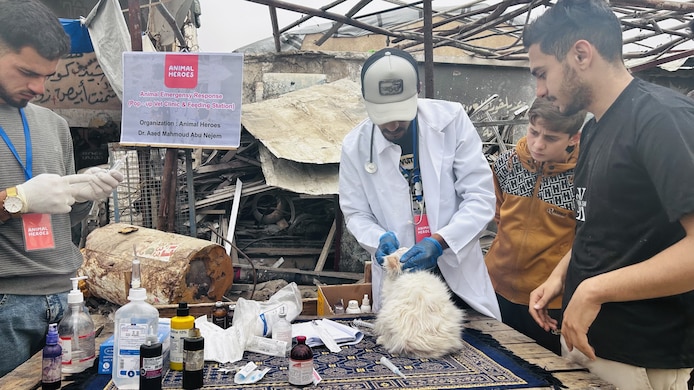
Pens in his left leg
A day before the ceasefire began, on January 19, 2025, Ayed was seriously injured in his left leg. At the hospital, surgeons inserted metal pins into his leg. His animal care seems to be over, but despite his pain and hunger, Ayed rose from his sickbed.
"We call him a miracle kid ," says Kef. "He's incredibly brave and resourceful; despite his own problems, he always manages to buy medicine and continue treating animals."
Yet, since the aid blockade in March, Ayed has had to primarily help his family members. Every day begins with finding food and water for them. "We used to have three meals a day, but that's changed now. I have to walk long distances to find tiny portions of lentils or pasta."
Ayed says four of his family members were killed at a food aid distribution center. Others were shot or crushed while trying to get food. "It's safer to go hungry than to stand in line."
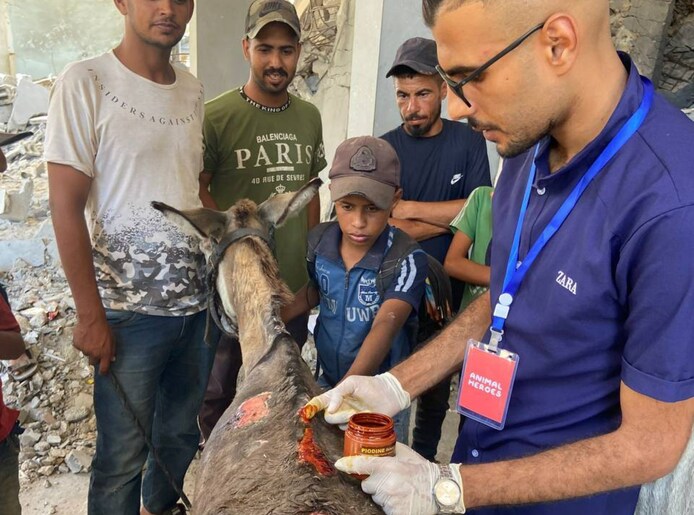
Emaciated dogs and donkeys
Meanwhile, Ayed continues to treat injured cats, emaciated dogs, and donkeys with bomb shrapnel in their bodies at the Animal Heroes pop-up clinic. Since the beginning of the war, his clinic has been destroyed several times, and he has had to evacuate six times.
This is the most difficult time for people and animals, Ayed observes. "We have serious shortages of animal feed and medicine."
In Gaza, animals are vital to the population. The thousands of working donkeys, in particular, are among the most important means of transport in the hard-hit region.
The Israeli news channel Kan reported last month that Israel evacuated some of these donkeys to France for rehabilitation. While Israel sees this as a rescue operation, many Palestinians see it as theft of an animal that kept them alive.
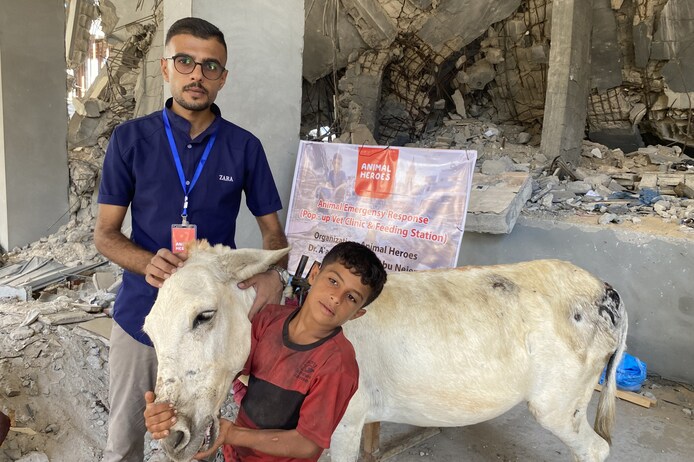
He's not thinking about quitting
For Ayed, his work is more than just a job. It feels like a moral obligation, rooted in a childhood spent always surrounded by animals. His father worked for the Ministry of Agriculture, and several family members were veterinarians.
When a scholarship offered him the choice between human and veterinary medicine, he chose the latter. "There are many people who help people, but few who stand up for animals," he says.
"Animals are defenseless, just like us," says Ayed, who certainly isn't thinking about quitting. "There are only a few veterinarians left in northern Gaza, where more than a million people live. If I leave, who will be left?"

Geen opmerkingen:
Een reactie posten