
From a distance, they stir the heart. Heads high and manes flowing, brumbies can be a magnificent sight — a symbol of pioneering spirit and the wildness within us all. Yet there’s another side to their story. The hard hooves of feral horses churn riverbanks to slop and trample delicate ecosystems into extinction.
Standing by the Snowy — Australia’s “river of dreams” — you can still glimpse paradise. A platypus will duckdive nearby and flocks of flame robins swarm and swirl. Red-necked wallabies watch furtively from the bush while a kestrel wheels on high. A towering Kurrajong rises like an apparition from a matchstick forest of Cypress Pine.
On the other side are the environmentalists, First Nations custodians and scientists. They see feral horses as a scourge on a once pristine landscape, a pest totem for invaders, subjugators of soil and destroyers of native life. They fight to protect the fauna and flora that’s been here for more than 5000 generations.
“Feral horses do terrible damage to our native wildlife, fragile wetlands and streams,” says Invasive Species Council Advocacy Director Jack Gough. “Australia is an ancient landscape not made to cope with thousands of heavy, hard-hoofed beasts trampling and trashing sensitive environments. Aerial culling is a humane and effective way to reduce their numbers. Feral horses or thriving national parks? We can’t have both.”
Although the horse debate has only really exploded in the past 25 years, the issue of feral animals destroying native ecology is old and ongoing. Two bulls, four cows, 44 sheep and nine horses arrived via the Cape of Good Hope with the First Fleet. And as early as 1788, the punishment for any convict herdsman who allowed them to stray was death.
Yet stray they did, and on a land of creatures no bigger than a male red kangaroo (90kg), the hard-hooved behemoths unleashed chaos.
Today, the war on ferals is waged on every inch of our wide, increasingly brown land. Cats alone kill an estimated 75 million native animals every night. Foxes are implicated in the extinction of 19 of 21 marsupials on the mainland. And then there’s the estimated 400,000 brumbies around Australia.
“Wild horses are a great nuisance,” The Australasian newspaper wrote in 1867, “and we can suggest no means for their destruction …”
Back then, brumby culling was common. Only when a poem by a 26-year-old lawyer from Orange was published in 1890 did brumbies transform from a pest into an icon. Banjo Paterson’s The Man from Snowy River — based on the rugged exploits of high-country stockmen in what is now Kosciuszko National Park — fast became a legend and today is the central tenet of arguments that brumbies belong in the mountains.
“The Man from Snowy River is an iconic part of our history,” says former Nationals MP and cattleman Peter Cochran, who runs brumby-spotting tours through the High Country. “At the 2000 Olympics, we used that image to promote Australia to the world, proudly so. But there is a cult within political fields where they do what they can to destroy our cultural history and The Man from Snowy River is an image they don’t like.”


After: Australian Brumbies cause degeneration of vegetation and soil stability.
Paterson’s poem hit with patriotism at a fever pitch. Federation followed 11 years later. Yet not often cited is that even Paterson saw feral horses as a scourge on Australian land. “The wild horses [have] got to be as big a plague as the wallabies and rabbits,” he said, and while culling by settlers was “a terrible thing”, horse numbers were such that “it had to be done, for if they didn’t get rid of the horses, the horses would get rid of them”.
Science bears that out. Ecologist Renée Hartley loves horses but not ferals. “There are other ways to celebrate Australia than protecting horses,” she says. “Feral impacts on our ecology are considerable and cumulative. It’s time to take responsibility for actions and inactions in our history and act. My solution would be total eradication — and that’s driven by horse welfare. Culling brumbies is an investment in our future.”
That future is unfolding now, with a cull underway of the high-country herd that Paterson made famous — a herd that environmentalists say has reached almost 25,000 but which pro-horse lobbyists say numbers as few as 900. With the bullets flying and protests raging onto the lawns of Parliament House in nearby Canberra, it’s time to go where the fighting is fiercest, and where past and present, poetry and science collide.
Driving to the Snowy River in the dim dawn of winter, I watch the temperature gauge slide south. Canberra’s chilly seven degrees has hit -2 by the time I arrive in Cooma 75 minutes later. This is a gold rush town, established in 1849, but the Ngarigo clan have lived hereabouts for more than 15,000 years.
I’m here to meet a real man from Snowy River. Richard Swain is a river guide and local elder known as “Uncle Cooma” to his mob. Richard has paid, and still pays, a high price for his anti-brumby stance. Some of the pro-brumby lobby have slashed his tyres, threatened his wife and kids, and concocted lies to discredit him — all to warn him off his sacred duty to protect this land.
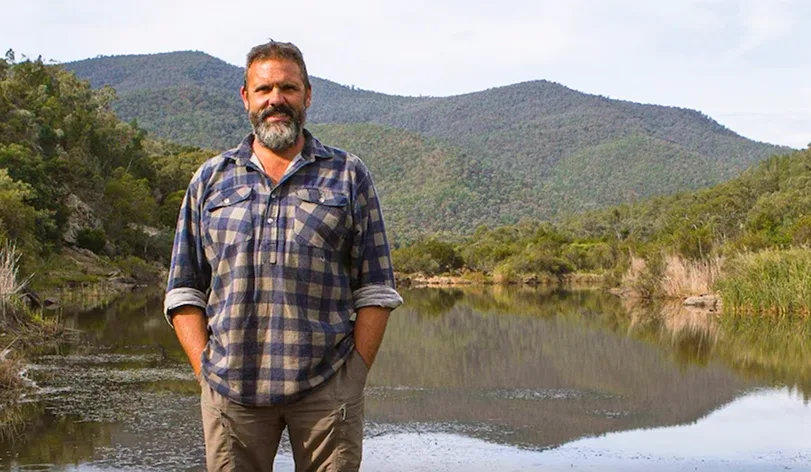
Today, Richard shakes my hand warmly but doesn’t smile. It’s serious business we’re here to discuss. I want to know how a shy bloke — one of eight born to a mountain man who moved the rocks that hikers still use crossing Charlotte Pass — found his voice.
“We were reared not to buck the system,” he tells me in his gentle burr. “But I don’t think there’s a patch of Australia that got better after the white man stepped on it.”
To explain, Richard drives me to the Snowy. In Jindabyne, we pass a statue of Polish geologist Paul Strzelecki, whose 1840 expedition saw him name Australia’s highest peak after Tadeusz Kościuszko, hero of the American Revolutionary War. When he saw the rich topsoil had been stripped to dust by overgrazing, he warned Governor Gipps that squatters “were not improvers but spoilers of the land”, but he was ignored.
“So much damage had been done by then, but if we’d only listened to Strzelecki, this problem wouldn’t be anywhere near as bad,” says Richard sadly. “The lower Monaro was natural grassland. For millennia the biggest grazers here were insects. This was frog song land. These bogs held more carbon than the forests in the high country. The air would’ve been singing with butterflies and pollinating bugs. All the mountain men did was bleed the water dry and erode the soil around it.”
We descend a rutted road of ochre, past deep gorges surrounded by sheer mountains. It’s a landscape Australia recognises:
He hails from Snowy River, up by Kosciuszko’s side, Where the hills are twice as steep and twice as rough, Where a horse’s hoofs strike firelight from the flint stones every stride …
The Man from Snowy River, A.B. Paterson, 1895.
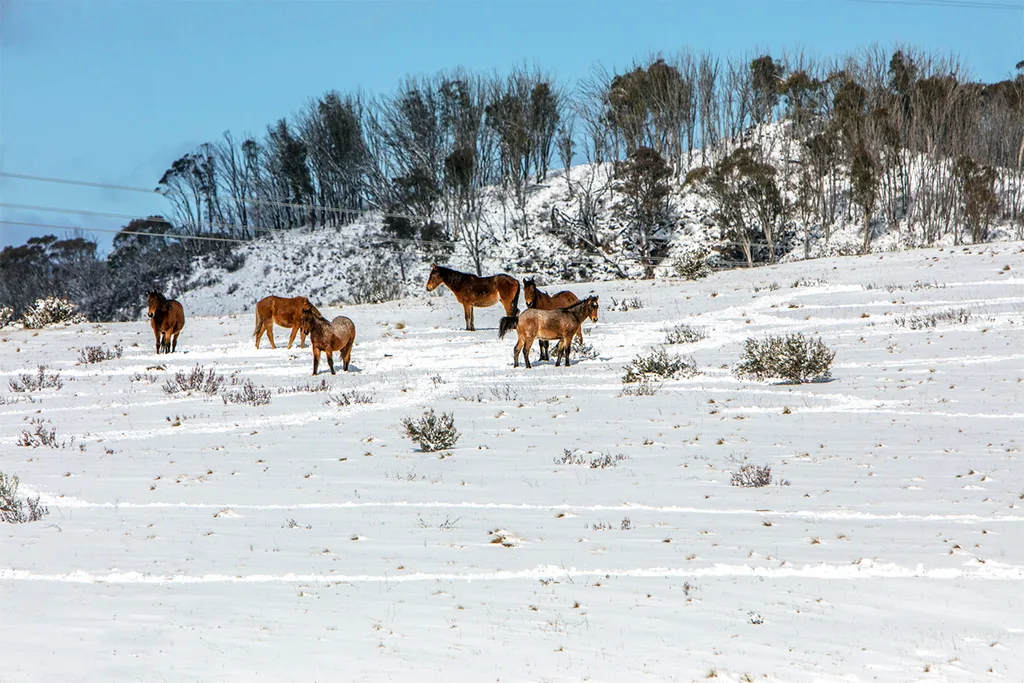
And there they are. A herd of seven horses, ragged-looking beasts with thistles in their manes and no sheen to their coats. These are survivors of the current aerial cull by the NSW National Parks and Wildlife Service (NPWS) that, since November 2021, has removed 8944 horses. The NSW Government has committed to further reducing numbers to 3000 surviving animals by mid-2027.
“If we do not succeed in reducing the population, one of Australia’s most fragile natural areas will be irreparably damaged and iconic species will be pushed closer to extinction,” NPWS Deputy Secretary Atticus Fleming tells The Weekly.
“The Australian Alps cover one per cent of the Murray-Darling Basin catchment but contribute 30 per cent of its water,” adds environmental scientist Jess Ward-Jones. “It’s one of the few regions in Australia where snow falls and sticks, and that’s why 40 per cent of our annual agricultural production comes from [the water that flows from] here — $3 billion per annum’s worth.”
The destruction that horses wreak on these waterways, she insists, risks agricultural land, too.
Leisa Caldwell, a leading brumby advocate, will tell you something else is being extinguished: “An integral part of our heritage and its folklore [that] reflects the history of our ancestors.” All that, she says, is gone, or going. “What is there left but the brumbies to demonstrate that our history even existed?”
Leisa, Sydney-born but now a mountain resident for almost 50 years, found her voice after the last significant horse cull (Leisa refers to it as a “massacre”) in 2000. On that occasion, NPWS culled 606 horses. However, the public wasn’t informed before or after, so when leaked visions of dead horses went global, it detonated claims of animal cruelty. Indeed, the RSPCA initiated prosecution but the matter was settled out of court.
The RSPCA has been consulted on the “repeat shooting” technique which NPWS employed in its most recent cull. Animals were shot from the air (as many as 15 times each) to ensure a quick death. Information from trial culling indicated most horses were unconscious within five seconds.
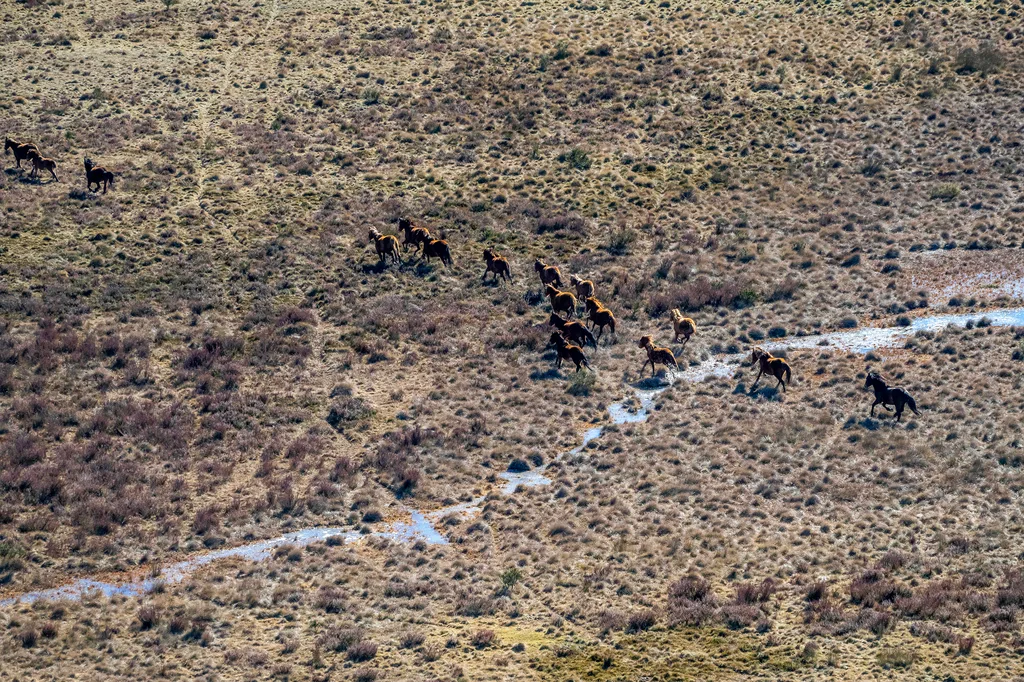
According to an NPWS spokesperson, the pilot and shooter confirm each animal is dead before the helicopter moves on, a process that is consistent with advice from an independent vet. Most carcasses are left to decompose in place, a standard practice that applies to a wide range of feral animals in national parks, while a management plan is in place to ensure none are left near waterways or visitor facilities.
“This is probably the most scrutinised feral animal control program in Australia,” Atticus claims. “No one enjoys doing it, but it is necessary to protect the park and our unique animals and plants. And to date, the program has been delivered without any adverse welfare incidents.”
Ballistics expert Andrew Mallen disagrees. He told a NSW Government inquiry that the number of shots required to fell each animal was “deplorable”, and that the weapon used (the .308 Winchester rifle) was not an efficient or humane way to cull horses.
During the most recent aerial cull, Leisa tells The Weekly, she received reports of “several orphaned foals in the north and the south of the park which had been left to fend for themselves. Some survived with rehoming. Friends of mine have also seen mares, aborting foals, and some who had been shot in the gut and neck, who would have died slow deaths. In the past, there were restrictions on shooting in the spring, during foaling, in forested areas where the shooters couldn’t get a clear line of sight. Now they can shoot anywhere, anytime. It’s open slather and it’s cruel.” The Weekly has seen still and video images of slowly dying horses and aborted foals but has not been able to verify if they are from the NPWS cull.
One alternative that has been employed in the past is “trapping and trucking” — capturing wild horses and transporting them either to an abattoir to be killed or to volunteers to be domesticated, cared for and rehomed. However, at present, there are too few volunteers to rehome the number of horses involved, and the logistical challenges in capturing and transporting thousands of horses are immense.
It was around the time of the 2000 cull that the brumby wars — and culture wars — really kicked up a gear. Mountain families, angry at being stripped of the right to graze in the high country, were outspoken with their objections to what Peter Cochran calls “the complete annihilation of the horses [and] our cultural history”. It triggered the social media slander and abuse that still exists, and which Richard and National Parks continue to wear.
NSW National Parks says this recent cull has been “very challenging” with sources claiming over $1 million has been spent on security to protect aerial shooters and NPWS staff from anonymous “threats and intimidation”.
“They include a threat to firebomb an NPWS office, threats to shoot at helicopters, threats to assault the children of NPWS staff, dumping a severed horse head at an NPWS office, abuse on social media and other threats of violence,” a spokesperson said.
“We need balance and co-operation in this debate,” says Sue Bulger, former mayor of Tumut, “and leaders on both sides willing to give ground.” But the thing about common ground is that, like common sense, it’s not that common.
Even the retention of 3000 feral horses in one-third of Kosciuszko is problematic. For Jill Pickering “It’s not enough. We need 4000 at least in case of fire or disease”. While for Jack Gough, it “locks in damage” to ecologically fragile land.
When the cull ends in October, what remains of that herd will be subject to a reproductive control trial.
For Richard Swain, healing this broken wilderness will last a lifetime and beyond. He sees disrespect everywhere: when he steps into a river and sediment plumes; when he visits an old ceremonial ground of striking stones and shale torn up by 4WD tyres; when he sees pre-settlement trees chopped down for a brumby corral.
“This was once a sea of orchids and 16 varieties of yam, with bettong, potoroo, bandicoot and thylacine,” Richard says. He is determined to help what little is left of this ancient landscape to survive.


.jpeg)

