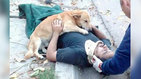
Ayesha Chundrigar was twenty-four- years old when she established the Ayesha Chundrigar Foundation (ACF) in Karachi. The formation of ACF in July 2014 was simply an extension of Ayesha’s lifelong empathy and concern for all living beings, especially the be-zeban: animals. According to ACF’s website, “Compassion for the underdog is central to Ayesha’s vision. Since a young age, she has always felt a connection to those who were usually ignored and neglected.
Ayesha has been rescuing animals since the age of five, from coloured baby chicks to birds sold in claustrophobic, tiny cages to set them free, to abused and injured dogs, cats, goats, cows and donkeys.”
ACF, located on almost one acre and staffed with fifty fabulous people who rescue, look after, and love unwanted animals, has, so far, rescued over eighty-five hundred animals, and helped over fifteen thousand through its outreach programmes.
As Ayesha says, “For many of us, it has become and will always be the way of life. And we cannot be more grateful to all those who have united to make this possible.”
What Ayesha and her team does is nothing less than pure heroism, courage and nobility that changes—with every broken animal they rescue, heal and love—our society to be kinder, better, more inclusive.
Good morning! Today we have an animal who was found miles out at sea, a dog who’s obsessed with stuffed hedgehogs and a cat who looks like he has two noses.
1. People Notice Someone Strange Stranded On An Iceberg Miles Out At Sea
Photo Credit: Mallory Harrigan
Last week, while aboard a crab-fishing boat off the coast of Labrador, Canada, Mallory Harrigan and her colleagues noticed something unusual. There, about 4 miles from shore, was a rather sizable mushroom-shaped iceberg — and it had an unwitting passenger stranded atop it.
"We thought it was a baby seal," Harrigan told The Dodo.
But then they got a closer look.
Turns out, the animal riding the iceberg was not exactly a seafaring species.
It was an Arctic fox — and he was in real trouble.
Rather than leave the fox to face the grim fate that awaited him, Harrigan and her colleagues decided to try to help. They pulled up alongside the iceberg in their boat, and wrangled the frightened castaway to safety.
"We were able to get him aboard even though he fought it," Harrigan said. "We knew we were his only chance for survival, as the winds had changed and were driving all the ice farther out to sea."
While the fox had good reason to have given up all hope, hope was now restored.
Photo Credit: Mallory Harrigan
Harrigan and the other unlikely fox rescuers quickly cobbled together a little bed aboard their boat and offered food to the exhausted animal so he could regain his warmth and strength.
Then they began the journey back to dry land together.
Once back to the harbor, Harrigan and the crew gave the fox a few more morsels — and then they set him free.
"We dropped him off in an old doghouse," she said. "He shook himself off and that was it!"
It may have only taken a few minutes for Harrigan and the others to go out of their way to rescue the fox, but that simple act of kindness changed everything for him.
Photo Credit: Mallory Harrigan
"We're glad to have saved an animal," Harrigan said, noting the fox seems to be doing well, and appears occasionally to remind his rescuers of the life they saved. "We can still see him from time to time!"
2. Dog Is Still Obsessed With The First Toy She Ever Got
Photo Credit: Alexa Ferguson
Luna is obsessed with hedgehog toys. Big ones, small ones, old ones, new ones — the 1-year-old pit bull mix loves them all.
“We couldn’t really figure out ‘why hedgehogs,’” Alexa Ferguson, Luna’s mom, told The Dodo. “She has a variety of different sizes and colors, but I’d say she’s probably got like 10 hedgehogs.”
Before Luna became the proud owner of 10 hedgehog toys, she was a stray, wandering around the streets of San Bernardino, California.
“[Animal control] found her roaming the streets alone,” Ferguson said. “She was really skinny, and they felt that maybe someone wasn’t treating her right and just let her go. She was ... taken to one of the kill shelters in San Bernardino. They waited to see if someone claimed her or adopted her … but no one wanted her, so she was put on the euthanasia list.”
Thankfully, a Canadian rescue group, RainCoast Dog Rescue Society, got her out of the shelter and set her up with a foster family in Vancouver, Canada. Then in June 2017, Ferguson and her fiancé, who live in Victoria, Canada, agreed to foster Luna with the possibility of adopting her.
“We had been wanting a dog for a very long time,” Ferguson said. “We saw a picture of her and were like, ‘Yeah, she’s pretty cute.’”
Luna did have some “quirks,” Ferguson and her fiancé noticed.
“We have a feeling that whoever she did live with before … probably kept her in a crate for most of the time,” Ferguson said. “Her paws were so fresh — it was like she’d never walked on pavement before, and after going for a couple of walks, her paws started to bleed — they were so tender.”
In general, Luna didn’t seem to like the outdoors — at least, not at first.
“We live right across from the ocean, and we took her down there when we got her, and she was absolutely terrified of the ocean,” Ferguson said.
Then Ferguson and her fiancé bought Luna her first stuffed hedgehog.
“Maybe she never had other toys ... but she was obsessed with it from the beginning,” Ferguson said. “We got her other toys, but she didn’t care about them — just the hedgehog.”
Luna played a bit with her hedgehog, but she mainly wanted to cuddle with it, Ferguson explained.
Photo Credit: Alexa Ferguson
“She’s very lazy, and has always been very sleepy from the day that we got her … and she’d climb up on the couch with her hedgehog and fall asleep,” Ferguson said.
While Luna fell in love with her hedgehog toy, Ferguson and her fiancé fell in love with Luna — and they officially adopted her.
Luna eventually grew to love the outdoors, and she now takes frequent trips to the beach and forest, and enjoys playdates with other dogs. But nothing has changed for Luna when it comes to hedgehogs. She doesn’t only like the original hedgehog toy — Luna adores every new one her parents buy for her.
“We subscribe to BarkBox, and so we have tons and tons of toys,” Ferguson said. “She destroys the other ones, but not the hedgehogs. It puzzles me so much.”
“She loves to sit out in the sundeck ... and she brings them out there and sucks on them and falls asleep with them,” Ferguson added. “She has pretty bad separation anxiety, and she has this habit of bringing toys to the door while we’re gone. So we come home, and there’s just a pile of toys at the front door. And there’s always hedgehogs.”
“We just don’t know why she loves them, but my best guess is that it’s some sort of comfort for her,” Ferguson added. “The first toy that she had was some kind of representation of safety for her, but just the fact that she carries it around with her and takes it outside, falls asleep with it — it’s adorable.”
Whatever the reason is for Luna’s obsession, Ferguson and her fiancé think they’re the luckiest people in the world for having Luna in their lives. Hedgehogs included.
“I’ve never had a dog that appreciates things so much,” Ferguson said. “She’s just so expressive, so thankful and she has such a personality. She’s just the happiest dog.”
3. This Rescue Cat Looks Like He Has Two Noses And He's Perfect
Photo Credit: Instagram/dobythehousecat
Doby was taken in by The Cat House on the Kings sanctuary in California when he was just a kitten. No one is sure where he came from or how he ended up on his own, but before long it became clear that Doby was a little different from the other cats. He suffered from cerebellar hypoplasia (CH), which makes him a little wobbly, as well as a cleft nose — which makes him look like he has two noses.
Despite his differences, Doby didn’t seem to have any idea that he was different from any other cat at the sanctuary. He became particularly close with a blind cat while he was there, but when she got adopted without him, he suddenly became very anxious and reserved. When a member of Friends for Life Rescue Network (FFLR), Jacqueline Santiago, went to the sanctuary to take some cats into the rescue, she noticed little Doby and decided to take him, too.
As soon as Doby arrived in the care of FFLR, Santiago made a post about him on Instagram — and that’s how his new family found out about him and fell in love.
Photo Credit: Instagram/dobythehousecat
“I had stayed in touch to send her photos of my two polydactyl bobtail sisters that were adopted through [the ]rescue about a year before,” Jeanne, Doby’s new mom, told The Dodo. “I saw his little bat face and that was it. We didn’t know a lot about him at first, so we did our research on cerebellar hypoplasia and cleft palates to make sure our home was safe and accessible for him.”
Since Doby was small for his age and had some special needs, he had to be fostered for a few months before he could be adopted, but once he was finally declared healthy, his new parents welcomed him into their home with open arms. His foster family did a great job of helping him come out of his shell, and by the time he came to his forever family, he had grown into a spunky, playful little cat.
“His foster mom is the absolute best and we are so thankful that she took a scared and anxious little kitten and taught him to love and trust people,” Jeanne said.
Doby adjusted to his new home right away, and his new parents fell even more in love with him. He’s a very curious cat and will chew pretty much anything he comes across, just to check if it’s tasty or not. He loves to follow his parents around the house, and needs to be around a member of his family at all times.
“Doby is a happy, chirpy sweetheart,” Jeanne said. “He has so much love in his tiny little body. He sings to us in the morning when we wake up and chatters at us all the way to the food bowl. The bowl is always full, but he likes for one of us to stand with him while he eats.”
Photo Credit: Instagram/dobythehousecat
While Doby still suffers from CH, he has a very mild case — it just makes him a bit unsteady as he bounces around the house. His most unique feature is definitely his cute cleft nose — and his parents wouldn’t have him any other way.
“We joke that Doby has a double snoot, so there is more snoot to boop,” Jeanne said. “His cleft nose means that he gets winded really easily while he is playing. He huffs and puffs while he goes after feather toys, but otherwise breathes normally. He can still eat without too much difficulty, but he is really messy.”
Doby’s parents also have to keep an eye on his health to make sure he doesn’t catch any upper respiratory infections, as they will affect him much faster and more severely because of his nose.
Other than that, besides wobbling a little and being an incredibly messy eater, Doby is just like any other cat. He loves playing with his two cat sisters, and he seems to have absolutely no clue that he looks any different from them. He’s just a little cat enjoying life, and his parents are so happy that he’s theirs.
Elephant populations are under threat from habitat loss and ivory poaching — but some people are doing everything they can to save them from extinction.
And what the people at the David Sheldrick Wildlife Trust (DSWT) Orphans' Project in Kenya are doing is saving lives and helping to ensure a future for these majestic and intelligent animals.
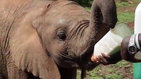
Orphaned baby elephants who have lost their families are being raised by keepers who spend day and night by their side, helping them grow up strong. They even tuck the elephants in at night and sleep nearby so they can wake up for the elephants' feedings.
The David Sheldrick Wildlife Trust
“It feels the same to me as having my own babies in the same room,” one keeper, who's also a father of a 4-year-old and 15-year-old, told The Dodo. “It felt very similar as to when they were babies, waking up at all hours to feed and change them.”
Most of the elephant keepers are parents themselves, so the experience of raising the baby elephants feels oddly familiar.
“The elephant babies call out in the night, especially the very young ones,” another keeper said. “The young ones are very restless as well, just like human babies, and wake up often. Sometimes they are crying for milk — you have to wake up for them just like a mother with a newborn baby.”
The David Sheldrick Wildlife Trust
The David Sheldrick Wildlife Trust
When there’s a chill in the air, the keepers make sure the babies are covered with blankets — and the keepers become accustomed to losing theirs when a baby wants milk. “Every three hours, you feel a trunk reach up and pull your blankets off!” one said.
“When the keepers used to sleep on a mattress on the floor, a few years ago now, the elephant would pull the blanket off the keeper to wake them up for milk, and touch their face with a wet trunk,” another added.
The David Sheldrick Wildlife Trust
But the keepers who have been raising elephants for a long time know when to wake up for the babies, and just do it automatically. “It’s like their minds are set to wake up every three hours,” one keeper said.
The David Sheldrick Wildlife Trust
The David Sheldrick Wildlife Trust
The keepers also watch over the babies as they fall back to sleep. These keepers are just a handful of people in the whole world who get to see — and hear — the little animals as they’re dreaming. “They do snore sometimes,” a keeper said. “They trumpet and stay fast asleep, and kick their legs while they dream, too.”
The David Sheldrick Wildlife Trust
The David Sheldrick Wildlife Trust
The elephants also tend to be, well, a little bit gassy. The smell in their sleeping quarters is definitely something the keepers have to get used to. “Back when we used to sleep on a mattress on the hay, one elephant very nearly dropped dung on my face as I was sleeping,” one keeper remembered. “I woke up and it was right in front of me!”
But the keepers stay by the elephants no matter what. And it isn’t just tenderness that keeps them close. In the wild, a baby elephant is never more than a few feet away from his mother. The keepers believe that staying with the babies through the night actually helps the vulnerable babies stay strong. “It makes the babies feel very secure,” a keeper explained. “You are like a mother to them and being there enables them to sleep very comfortably. When they sleep comfortably it allows them to grow healthily.”
The David Sheldrick Wildlife Trust
The David Sheldrick Wildlife Trust
But sometimes, tenderness and devotion just isn't enough for the weakest of the orphans, and it’s heartbreaking for the keepers.
“Sometimes we do lose babies, and when this happens it is often at night and not during the day,” one keeper said. “Maybe they have been sick or they have arrived in bad condition and it is too late to save them ... In the end we want them all to survive.”
The David Sheldrick Wildlife Trust
To help DSWT save as many baby elephants as possible, you can make a donation.
On the 15th of March a Tsavo Trust vehicle was driving in Tsavo East National park in an area known as the Triangle, a sector of the Park between the Athi River and the Mombasa Nairobi highway, their mission to retrieve ivory from a carcass sighted from the air earlier in the day.
On their way back they found a tiny baby elephant wandering around on its own near the road. It is difficult to know if the carcass was that of the mother, but it would appear likely given the proximity of the two, despite the fact that the carcass looked a few weeks old. The calf was in an emaciated condition indicating she had been on her own for quite some time before being rescued having been restrained and captured, and then loaded into the landcruiser and brought to the Trust’s Field Headquarters at Kaluku adjacent to the Triangle. (Kaluku is where our aerial support operates from, and where the Trust Pilots live).
It was well after dark by the time the team arrived at Kaluku, and it required many able bodies to off- load the calf, get her back to her feet, and ensure she received some water. The only place available to keep her restrained for the night was in Humpty the hippo’s recently constructed stable. Humpty is an adorable baby hippo who was rescued just before Christmas day, and has since made Kaluku her home. She has a customized pool and fortunately that evening had chosen to remain in her pool for the night, relinquishing her stable for the newcomer. Despite being very thin, the baby elephant still had fight, no doubt bolstered by adrenaline, so not much else could be done for her that night.
In the meantime the Nairobi HQ had been alerted about the baby and a rescue plane and a team of Keepers were coordinated by Angela Sheldrick, set to depart first thing in the morning in order to head down to Tsavo. A further report received first thing on the 16th confirmed that the calf was alive and well, and so the team departed, arriving at Kaluku at around 10 am in the morning. They were greeted by a curious Humpy aware that the usual routines had been turned upside down. The stable door was opened and the team was able to encourage the calf to drink before preparing her for the flight to Nairobi. All the while this was going on, Humpty was mooching around surveying the scene, extremely interested in the unusual proceedings. The men were grappling with a young elephant calf, while the tiny pint-sized hippo circled curiously, and some of the Trust’s other orphaned animals at Kaluku which included a duiker and kudu, watched from a safe distance. We estimated the elephant calf to be around 10 months old, very much still milk dependent, and without such timely intervention would have died of starvation.
One could not help but reflect on the terrifying days and nights she had spent out there before help arrived, alone and vulnerable, fearing for her life, and just how fortunate she was to be sighted. And at first the help she was about to receive must have been terrifying, but elephants are incredibly intelligent animals, and so it would not be long before she would understand that, in fact, she was being helped.
The elephant calf was loaded onto a Cessna Caravan on the Trust’s Kaluku airfield, and without much delay she was on her way to Nairobi where she could receive the intensive care she needed given her precarious state. Upon arrival at the Nursery at midday she remained aggressive, charging at the Stockade Gate, but with freshly cut greens available and fresh water, she settled down to feed, clearly desperate for food. Tsavo in March was tinder dry after a lengthy drought, so for her to suddenly have so much vegetation at her disposal was, indeed, a treat. At one year old, however, greens alone could not sustain her life so it was important that she got hooked on her milk rapidly, the Keepers persevering with this. We brought the other orphans around to meet her in her Stockade in the afternoon, as this is the best balm of all for new arrivals, the Nursery orphans able to impart positive vibes and communicate with a newcomer that there was nothing to fear.
By evening, the new calf was visibly calmer, her next door neighbor being KARISA at the time. Soon she began taking her milk from a hand-held bottle, tolerating the presence of a Keeper in her Stockade and as the days passed she would come to the Keepers and gain comfort sucking their fingers. In a very short time our little calf was calm enough to head out into the Nairobi National Park with the other elephant orphans to browse and wander around at will doing what elephants do all day, free from the confines of the stockade. We called her MTETO, after the Mtito Andei village, not far from where she was found.
The day she joined the others in the forest was a happy day for this friendly little calf, calm and relishing the companionship she appeared to learn the ropes from the outset. Seamlessly she slotted into the herd, even heading off to the public viewing one hour between 11a.m. and 12 noon, such was the confidence the rest of the orphans were able to impart. Since then MTETO has thrived, has gained condition, and is now totally settled and happy having made a number of very special friends within the fold.
No one can say for certain if it was a tragic accident, or some wanton act of cruelty, that led to this poor pup being covered from head to tail in thick, sticky tar — but there is no doubt that it was love and patience that finally got him clean.
With little they could for the dog themselves, the men asked for help from a police officer, and together they transported the tar-covered animal to a veterinary clinic. From there, volunteers from the animal rescue group Zoonosis Lanus were called in to assist.
Though the dog might have seemed like a lost cause for some, his rescuers refused to give up hope.
By the end of the day, the dog was all but free of the tar that had nearly killed him. It was around this time that his rescuers christened him with a name reflecting that substance he overcame: Petro (that's petrol in Spanish).
Still, Petro would require a bit more cleaning the following day.
Petro's brown fur still shows some staining from the tar, but he is nevertheless unrecognizable compared to the sorry state he'd been found in. Best of all, his sweet personality has begun to shine through, too.
"Each day he's better and happier," rescuer Myriam Otellado wrote online.
The story of Petro's rescue has since gone viral in Argentina with countless well-wishers lavishing praise upon those who helped him.
And though he'll likely need a little more time to recover completely from the trauma he experienced before he can be adopted, thanks to the love and patience of all involved his future is brighter than ever.