Translate

Posts tonen met het label illegal. Alle posts tonen

zondag 15 februari 2026

The Battle Continues providing safe shelter for Lissy a female sloth bear rescued by the Forest Department India a 'dancing bear' illegal since 2009

 www.wildlifesos.org  India

On the last day of the year 2025, our team arrived in the scenic town of Sahibganj in the state of Jharkhand. We were alerted to a sloth bear which was rescued by the forest department. With unspoken concern in our hearts we wondered about the grave injustice that has happened to this yet unknown ursine.

A ripple of shock went through the entire team as they entered the premises of the forest department. They saw what was last seen in the year 2009. A female sloth bear was crouched in a trap cage with a rope around her neck. Her muzzle was pierced, leading the team to believe that this was done to pass a tugging rope. All four of her canines were found to be smashed. That was the moment they knew very well that they had in fact come across a ‘dancing’ bear.
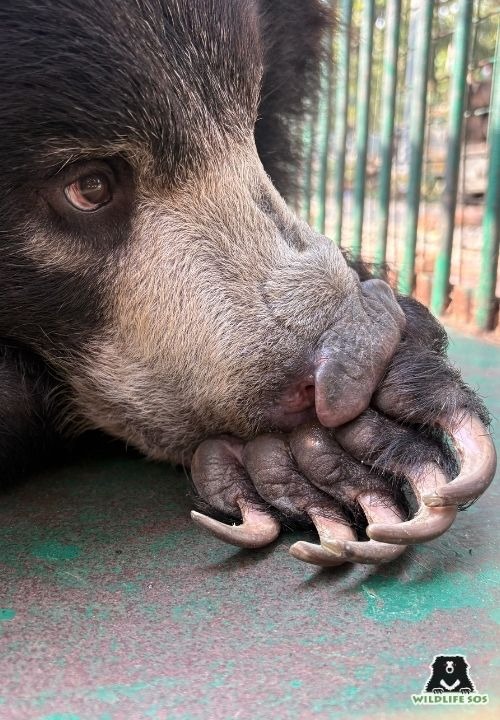
Wildlife SOS team immediately noted that the rescued sloth bear had a pierced muzzle, indicating how her future was being directed towards the cruel ‘dancing’ bear practice. [Photo (c) Wildlife SOS/ Vineet Singh]

Forest officials have previously reported poaching incidents near the Indo-Nepal border, and Wildlife SOS have also rescued a few bears that were being poached across borders to facilitate this practice in our border countries, but retrieving a ‘dancing’ bear had come in as a rare rescue.
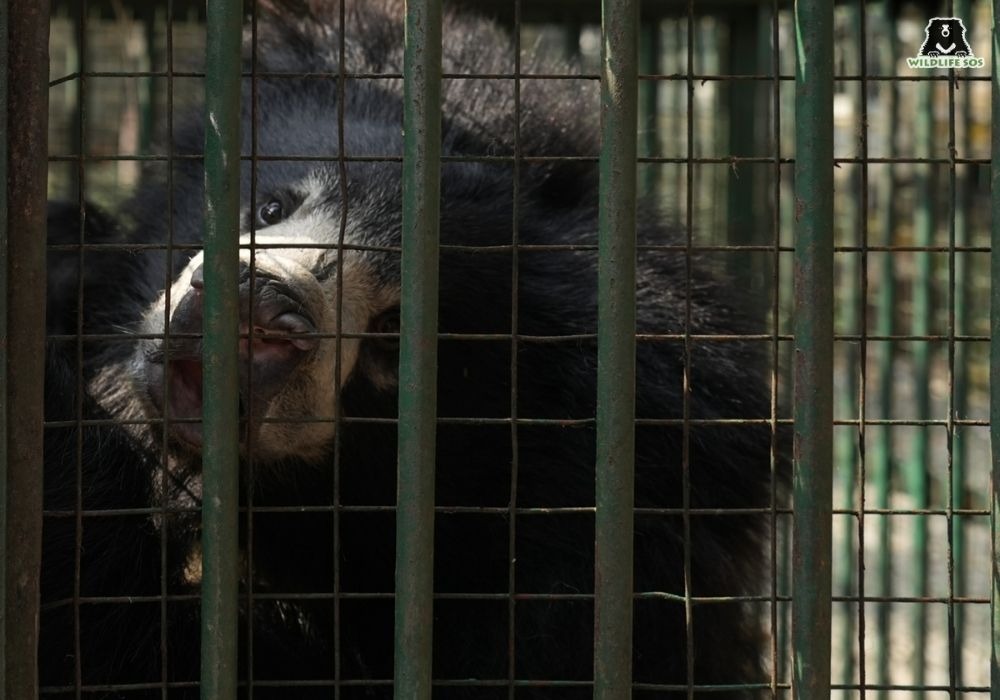
There were no visible signs of infection at the time of assessment, however, she was suffering from diarrhoea and required immediate medical attention. [Photo (c) Wildlife SOS/ Vineet Singh]

Wildlife SOS had put in committed efforts to bring an end to this gruesome practice with the rescue of over 628 sloth bears, the last of which being Raju (Adit) 17 years ago. Through years of conducting rescue operations, ensuring legal action, providing rehabilitation care to the rescued bears, and alternative opportunities for livelihood to the Kalandar community reliant on the practice, the illegal trade was brought to a halt in India. However, we kept a lookout for bears being poached, especially near the Indo-Nepal border, from where Ron, Molly and three more bears were rescued from being smuggled for this very trade in 2019.
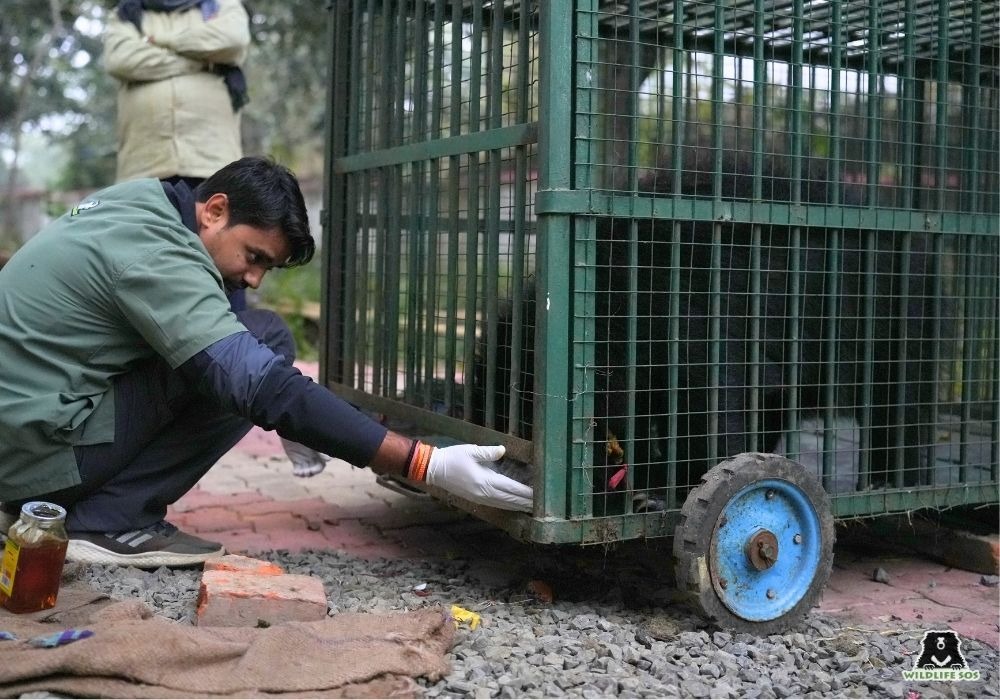
Our proficient veterinarians ensured the ursine was well enough to start her journey to the sanctuary. [Photo (c) Wildlife SOS/ Vineet Singh]

The years of experience and studying sloth bear trade closely led to the understood conclusion that the bear rescued in Jharkhand was separated from her mother at a tender age.

Without maternal guidance for survival skills, releasing the rescued bear back into the unknown wild posed a great threat to her life. Considering our expertise with rehabilitating sloth bears, the forest department of Jharkhand handed over this young sloth bear’s safe and long-term care to Wildlife SOS.
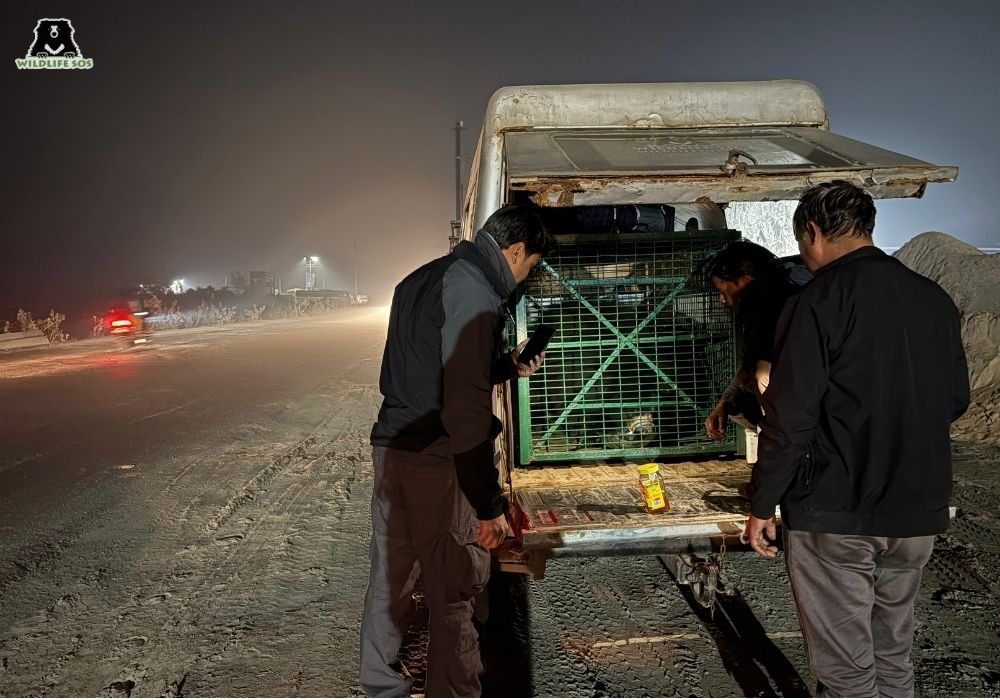
The young bear’s journey from Jharkhand to our centre in Agra took place over two days, covering over 1,250 km with frequent pitstops to ensure she was well fed and in good health. [Photo (c) Wildlife SOS/ Vineet Singh]

Wildlife SOS has four rehabilitation centres specifically for the care of sloth bears, the first of which being the Agra Bear Rescue Facility (ABRF) that was established in 1999 in Uttar Pradesh in collaboration with the Uttar Pradesh Forest Department,. When this bear arrived at ABRF, we helped her turn over a new leaf in her life. This new beginning came with a new name as well. She was introduced to the entire family of Wildlife SOS and our benevolent supporters as Lissy — a name in remembrance to one of Wildlife SOS’s long-time friend and supporter, Lis Key. Lis worked tirelessly with International Animal Rescue (IAR), a UK-based conservation organisation that has been instrumental in helping us end the brutal ‘dancing’ bear practice since the very beginning. Her everlasting compassion for wildlife now lives on with Lissy.
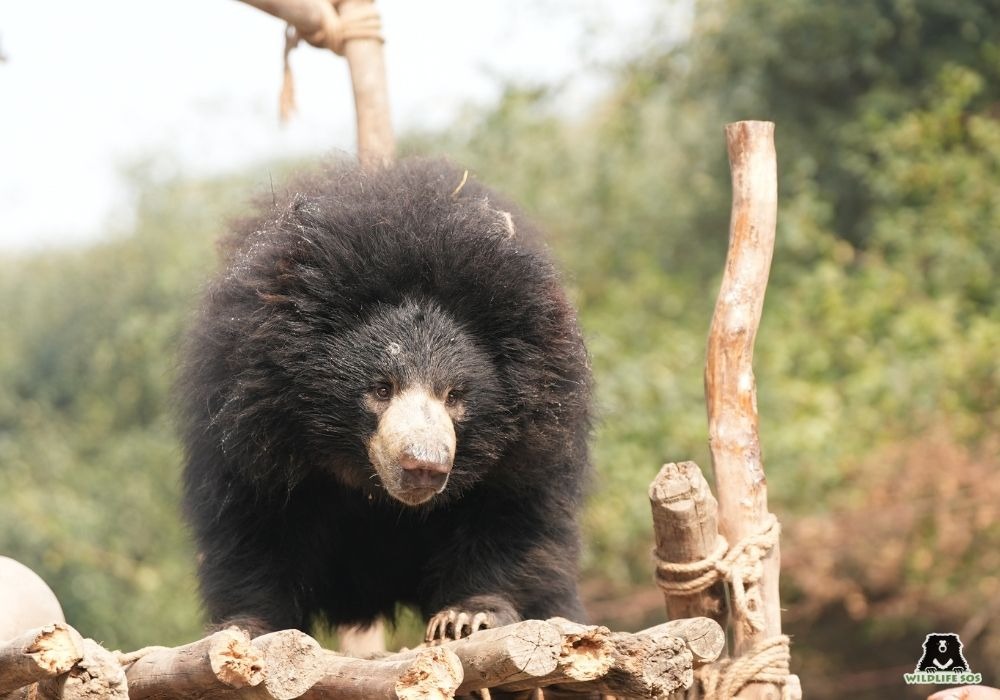
Lissy’s frizzy fur and her immaculate eyes reveal what she has suffered. [Photo (c) Wildlife SOS/ Mradul Pathak]

Care and Comfort

Currently, Lissy is under careful observation in a three month quarantine that is part of the rehabilitation protocol we consistently follow. This period allows the veterinary team to understand medical issues the bear is facing, conduct health assessments, and curb any possibility of infection or disease. In turn, the calm environment reduces stress levels of the rescued bear, and even gives the bear time to adjust into its surroundings and develop trust in the care being given.

Lissy was undergoing digestive discomfort and faecal inconsistency. Upon further investigation, endoparasites were detected and our team quickly provided Lissy with her first deworming dose and essential vaccinations. Medical assessments are crucial as they will serve as a bedrock for her well-being. To supplement these, our dedicated team is also monitoring Lissy’s behaviour, understanding her needs and her preferences.

Healthy meals are an essential part of Lissy’s care. She receives multi-millet porridge blended with fresh vegetables twice a day. Vitamin and mineral supplements are mixed in her food for easy consumption. Lissy quickens her pace towards her full feeding bowl everyday. And a peculiar yet endearing habit of hers reveals itself when she lowers her head into it — Lissy likes to make bubbles with her nose while slurping her porridge!

Lissy has been introduced to enrichment balls that are covered with peanut butter and filled with dates. Her fascination in exploring them each day shows how playful and enthusiastic she is. She is finally surrounded by earth, nature’s gift to sloth bears and their insectivorous appetite, and has begun to dig pits in search of ants and termites, reclaiming an inherent habit of sloth bears that had so far remained subdued.
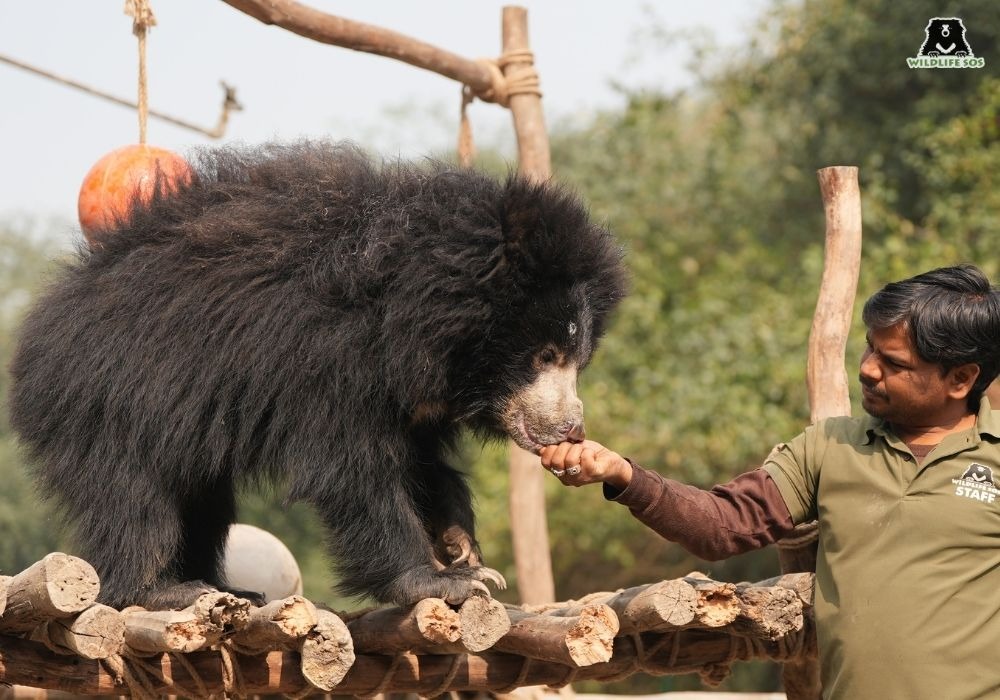
For the very first time, Lissy is exploring her ability to climb and has been doing so on the wooden platform created by the staff, who have been present to help her feel secure since her arrival. [Photo (c) Wildlife SOS/ Mradul Pathak]

While she is a lively bear, Lissy is cautious around human beings. This comes as a natural reaction for a bear who has so far only witnessed insensitive treatment by her former captors. However, she is gradually building trust with her caregivers, and their soft interactions with her are laying out this friendly bridge. As she takes her steps forward on it, Lissy is slowly being introduced to operant conditioning as well that involves responding to cues for comfortable medical examinations. Gentle gestures are helping Lissy gain confidence in this process, which is visible in Lissy’s willingness to participate. There’s another reason behind why Lissy remains highly active during this time. She is now well aware that every session comes with a sweet, rewarding promise of receiving dollops of honey!
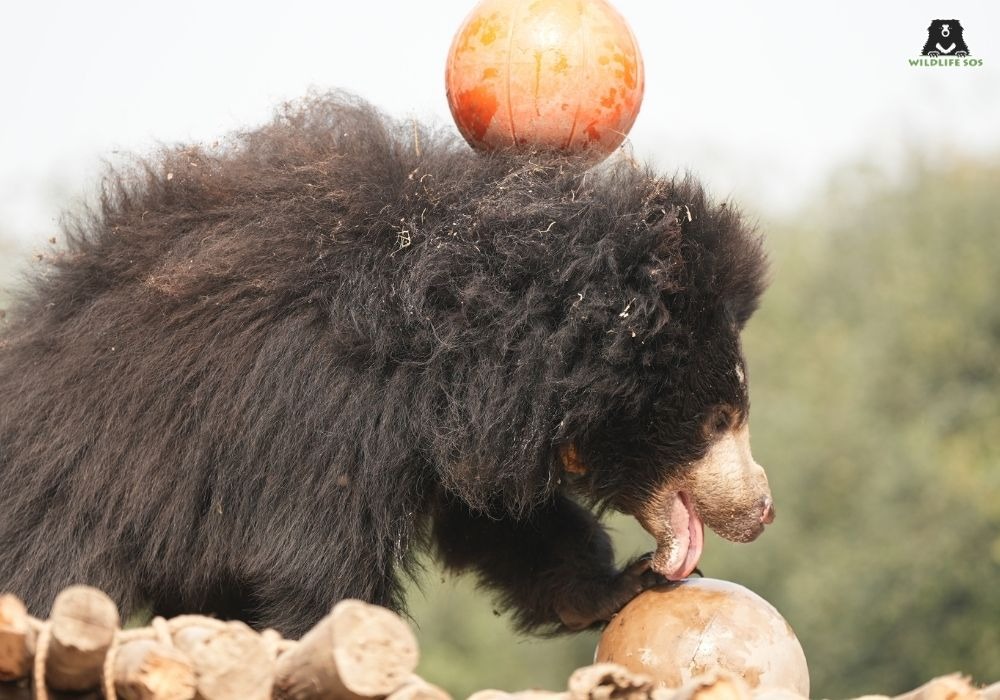
The smell of peanut butter on enrichments is undoubtedly captivating for Lissy and the sloth bears at ABRF, serving as a major attraction to follow and remain physically engrossed for hours. [Photo (c) Wildlife SOS/ Mradul Pathak]

Join Lissy in her journey of healing by becoming a monthly donor for Wildlife SOS and stay up to date on how she is settling into her new home!

Lissy will continue to remind us of our deep and steadfast alliance with International Animal Rescue that has played a vital role in Wildlife SOS’s mission to free bears from exploitation and, preventing cubs from being poached from the wild to feed this cruel practice. Wildlife SOS has fought the injustice of the ‘dancing’ bear practice once before, and we will not hesitate to do so again. If you witness a sloth bear being abused, exploited, or forced to perform, please email us directly at info@wildlifesos.org or use this hotline for an immediate response: +91 9971699727.

Feature Image: Mradul Pathak/Wildlife SOS

vrijdag 26 september 2025

Wildlife detection dogs in Indonesia and South Africa ( K9 sniffers ) have saved thousands of animals which were destined for illegal wildlife trade


Link :Stories of the dogs that didn't survive :

https://www.scentimprintconservationdogs.com/in-memoriam/


 Stopping and prosecuting smugglers is a first important step in stopping illegal wildlife trade.

Sniffer Dog Bailey The first trained dog in Indonesia

We currently have 10 wildlife detection dogs, who have been specially trained to detect wildlife hidden in cargo and transport. Each dog has two handlers, working in pairs for safety reasons and working alongside the National Police of Indonesia.


The love between the sniffer dog and the trainer , both having a rest

Together with their trained handlers, the dogs patrol several harbors and airports which are known for being main smuggling routes between islands. Over the years, they have saved thousands of animals which were destined for the illegal wildlife trade.


Their jobs are not without risks, as the sniffer dogs have earned the reputation of being very successful during raids at the Indonesian harbors and airports. The illegal wildlife trade continues to thrive in Indonesia…


Baily at work. 

Regular exchange of knowledge to discuss new K9 sniffer methods with their Dutch partners, Scent Imprint Conservation Dogs, has made this small and committed Indonesian team a force to be reckoned with.


They have the full assistance of the different local authorities in Indonesia. Together we continue to rescue smuggled wildlife at several of the most trafficked routes in Asia - every single week!

A short summary of this program's activities

Training Bailey and other K9 dogs

Bailey is our first wildlife detection dog and a pure superpower. She has proven that the patrols produce great results: with her on board we are able to find many smuggled animals.

That is why we have extended the team with five more K9 dogs. Just like Bailey, they were trained by the Dutch Scent Imprint Conservation Dogs. Puppies learn detection and follow-up work in their training center. Dutch zoos donated scent prints so that they can track not only monkeys, but also bears, gibbons, sloths, reptiles and birds.

Patrolling boat routes

The boat routes between the islands are ideal for smugglers for trading young wild animals that have recently been caught in the jungle. We can release animals found on this route directly on Sumatra. Once they have arrived in Java, a lot of bureaucracy is involved. For example, it could take months before an animal is able to return to nature. Moreover, the suffering at the end of the journey is much greater: the animals are sick, their teeth are pulled out and their eyes are damaged.

Local K9 officers

In Indonesia the dogs are accompanied by locals who have been trained by JAAN Wildlife. They recognize the dogs’ signals and the ways smugglers use to hide odors. Before the 5 new dogs can get started, we first take the time to let them get used their handlers. A bond of trust must be established before they tackle the smugglers together.

donderdag 20 februari 2025

Humane World for Animals : Cockfighting is illegal in all 50 states US but still flourishing across the country where in Kansas City 400 roosters were rescued and euthanized


You don’t need to see a cockfight in progress to comprehend the misery, suffering and death that animal fighting causes. All you need to do is look at the breeding operations that service the cockfighting industry—barren, dismal and hopeless places, every one of them—and there are thousands across the country, even though cockfighting is illegal in all 50 states and under federal law.  

But in Kansas, it appears, there’s now one fewer site of such cruelty, because, on Jan. 25, law enforcement officials from the Sumner County Sheriff’s Office served a search and seizure warrant and took action at a property in Mulvane, near Wichita. With responders from Humane World for Animals and Humane Society of Greater Kansas City there to assist, officials found more than 400 roosters and hens in small wire or wooden structures with little protection from freezing temperatures. Some of the birds were afflicted with eye and nasal discharge—the signs of apparent respiratory illness, particularly concerning right now—and two roosters were covered in dried blood, with open wounds.  

The response teams found cockfighting paraphernalia too, including transport boxes, scales and gaffs—sharp blades attached to roosters’ legs during fights. Our experts identified the birds on site as gamefowl, a term for birds selectively bred and raised for aggression and fighting.  

A detective working the case credited previous training with our teams as indispensable to her work at the scene. This was encouraging because educating humane and law enforcement agents is a priority for us. This week, our Humane World for Animals Law Enforcement Training Center co-hosted a cockfighting investigations webinar with the National Sheriffs’ Association, an active partner in the campaign to end cockfighting. Nearly 400 officers registered, many from states in which cockfighting is a major law enforcement concern.  

In addition to such training activities, we support prosecutors and other law enforcement personnel with their assessment and handling of complex cases. We’re also pursuing a comprehensive agenda to fortify state-level laws in key states, including Kentucky, Georgia, California, Maryland, Florida and Texas. We’re particularly committed to working in the 11 states that do not prohibit breeding and trafficking gamefowl for fighting. 

In a cynical play, cockfighters and their allies in a few state capitals have organized faked-up civic organizations that exist for a single, dishonorable purpose: to reduce or eliminate penalties for cockfighting. These “gamefowl commissions” host rallies, raise funds and make political contributions in support of attempts to decriminalize cockfighting. Known cockfighters have even surfaced as “expert witnesses” in these efforts. In Oklahoma last year, this nearly Orwellian approach resulted in a dangerous proposal to reduce penalties for cockfighting and dogfighting to a misdemeanor—which, we’re glad to report, stalled out in the legislature.  

In the 21st century, of course, cockfighting is not merely a criminal industry but an incubation system for dangerous diseases, including the highly pathogenic avian influenza H5N1 now ravaging commercial flocks of chickens and plaguing big cats and other animals at wildlife rescue centers, to name just several of the most prominent instances of zoonotic transmission. Together, the real risk of disease spread and the poor prospects for placement of roosters trained to be aggressive mean that animals from situations like the one in Mulvane are generally not adopted out; in this case, all the animals had to be euthanized at the scene. 

Cockfighting is a serious crime. That's no radical position. It is the law in all 50 states, and multiple polls through the years have helped to make it clear that people from coast to coast—in states red, blue and purple—disapprove of cockfighting. Most recently, a July 2024 poll we commissioned found that 90% of Democrats, 88% of Republicans and 87% of independents support stronger laws on the issue.  

Recognizing the severity of the problem, the National Sheriffs’ Association has formally declared animal fighting a crime of violence, urging all levels of government to uphold and strengthen penalties.   

At the federal level, we have successfully pressed for animal fighting upgrades to the Animal Welfare Act on five occasions. At this time, our focus is on enforcement and most recently, we’ve encouraged the government to maintain strong sentencing guidelines for animal fighting offenses because of our understanding that cockfighting and dogfighting are malicious crimes and frequently connected to other serious criminal activities.  

With animal fighting classified as a felony crime under the AWA, we’ve also sought to encourage better collaboration between the U.S. Department of Agriculture and the Department of Justice (along with other partners) through appropriations requests and other means. This is challenging at present, as potential agency cuts could result in fewer staff positions, smaller budgets, weaker cross-reporting and less funding for state, local and tribal law enforcement efforts. 

We’ll keep pushing. Time and again, our team members hear from legislators and others surprised that cockfighting continues after all the negative publicity it has received and all the laws that have passed. Not enough people understand that cockfighting is a multi-million dollar industry in which participants are willing to take their chances of discovery and arrest in situations where the financial rewards of participation far outweigh the risks. 

That’s why we push lawmakers and government agencies to step up their efforts to make anti-cockfighting laws tougher and to see that they are better enforced. Not just in this country, either. We are increasingly focused on the global dimensions of this problem, because cockfighters are shipping animals all over the world for profit. Beyond causing massive animal suffering, what they’re doing threatens to exacerbate the spread of avian diseases. We’ve done some important work to curb animal fighting in Costa Rica, India and the EU, for example. In Costa Rica, where cockfighting is illegal, we helped to turn back a legal challenge from cockfighters who tried to argue they had a cultural right to fight roosters under the constitution.  

Cockfighting’s cruelty is not a matter of opinion. It’s an objective fact, and the same is true for its obvious public health and safety risks. We can’t afford to be complacent about it, and we can’t afford to let policymakers be complacent either. The massive suffering the birds endure propels our efforts to get at the root causes of cockfighting, in order to stop it for good. 

Sara Amundson is president of Humane World Action Fund. 

Category