Translate

Posts tonen met het label online. Alle posts tonen

zondag 4 januari 2026

Free Mini: Rescued baby monkey escapes exploitation and returns to the wild: What is the truth behind baby monkey torture online? How to report it


How to report animal cruelty | SMACC  Please report if you see any online monkey torture

Mini, a long-tailed macaque, was rescued after the BBC Eye investigation, The Monkey Haters, that exposed a global online monkey-torture ring. Now Free Mini, a new short documentary from the BBC World Service, traces her release into the wild.


As a baby, Mini was taken from the forest, her mother killed. Mini was sold to a YouTuber. Her owner tortured her and filmed it for sadistic customers mainly in the US and the UK. In private Telegram groups they were brainstorming and crowdfunding the torture videos. According to the man who ran one of the groups and called himself the Torture King, Mini was a “sadistic trophy”: “Mini was so popular in this hatred world… [when] you think old movie stars, female Marilyn Monroes, in this little demented circle of ours, that was Mini.”

Rebecca Henschke – who had spent over a year tracking down Mini and her torturers uncovered in the BBC Eye investigation, The Monkey Haters – went along for Mini’s release back to the wild. “When I first saw tiny vulnerable baby Mini being abused in videos online, I became obsessed with finding her and seeing her go free. It was amazing and emotional to see her go boldly and curiously into the wild with an adopted family that will look after her in the wild.”

Femke De Haas, the founder of the Jakarta Animal Aid Network (JAAN), who has successfully released hundreds of ex-captive and abused long-tail macaques, says: “If we would have any doubts about her being ready to be released – Mini or any of her family members – we would not bring them to the forest. They underwent… a very long process of rehabilitation, different stages. We observe every detail of this process, and they are ready to be an independent long-tailed macaque back in the forest where they belong.”

In the US, nine of the key players of the online torture ring have pleaded guilty or been sentenced. Two women, who were key players in the UK, have pleaded guilty and are due to be sentenced in the UK.

The BBC Eye investigation also lead to legal changes in the UK, obliging social-media firms to remove online animal cruelty content from their platforms.

The short documentary, Free Mini, is available for viewing on BBC iPlayer in the UK and internationally via the BBC World Service YouTube channel. The content is available on the BBC News website – via bbc.co.uk in the UK, and internationally – on BBC.com, BBC Studios global digital news platform; and in Indonesian via BBC News Indonesia.

To watch the BBC Eye investigation, The Monkey Haters, follow this link - https://www.bbc.co.uk/programmes/w3ct5j1p.

A year-long BBC investigation has uncovered a sadistic global monkey torture ring stretching from Indonesia to the United States.

The World Service found hundreds of customers in the US, UK and elsewhere paying Indonesians to torture and kill baby long-tailed macaques on film.

The torture ring began life on YouTube, before moving to private groups on the encrypted messaging app Telegram.

Police are now pursuing the buyers and several arrests have already been made.

BBC journalists went undercover in one of the main Telegram torture groups, where hundreds of people gathered to come up with extreme torture ideas and commission people in Indonesia and other Asian countries to carry them out.

The sadists’ goal was to create bespoke films in which baby long-tailed macaque monkeys were abused, tortured and sometimes then killed on film.

The BBC tracked down both the torturers in Indonesia, and distributors and buyers in the US, and gained access to an international law enforcement effort to bring them to justice.

At least 20 people are now under investigation globally, including three women living in the UK who were arrested by police last year and released under investigation, and one man in the US state of Oregon who was indicted last week.

Mike McCartney, a key video distributor in the US known by his screen name, “The Torture King”, agreed to speak to the BBC – and described the moment he joined his first Telegram monkey torture group.

“They had a poll set up,” McCartney said. “Do you want a hammer involved? Do you want pliers involved? Do you want a screwdriver?” The resulting video was “the most grotesque thing I have ever seen,” he said.

The Torture King at home in Virginia. "It went from baby bottle teasing to fingers being snipped off," he said.

IMAGE SOURCE,JOEL GUNTER/BBC

Image caption,

"The Torture King" at home in Virginia. "It went from baby bottle teasing to fingers being snipped off," he said

McCartney, a former motorcycle gang member who spent time in prison before entering the monkey torture world, ended up running several Telegram groups in which hardcore torture enthusiasts distributed videos.

“It’s no different than drug money,” he said. “Drug money comes from dirty hands, this money comes from bloody hands.”

The BBC also identified two other key suspects who are now being investigated by the US Department of Homeland Security (DHS) – Stacey Storey, a grandmother in her 40s from Alabama who was known in the community as “Sadistic”, and a ringleader known as “Mr Ape” – whose real name we cannot reveal for safety reasons.

“Mr Ape” confessed in an interview with the BBC that he had been responsible for the deaths of at least four monkeys and the torture of many more. He had commissioned “extremely brutal” videos, he said.

Storey’s phone was seized by Department of Homeland Security agents, who found nearly 100 torture videos, as well as evidence that she had paid for the creation of some of the most extreme videos produced.

According to police sources, Storey was active in a torture group as recently as earlier this month. Approached by the BBC in Alabama in January, Storey claimed that she had been hacked and declined to comment on the allegations in detail.
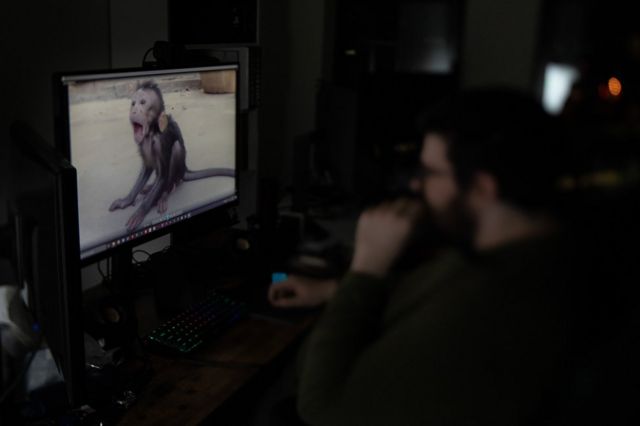
"I remember the face of every monkey and how they died," said Mr Ape

IMAGE SOURCE,ED OU/BBC

Image caption,

"I remember the face of every monkey and how they died," said Mr Ape

“Mr Ape”, Stacey Storey and Mike McCartney are three of five key targets in the ongoing Homeland Security investigation. They have yet to be charged, but could face up to seven years in prison if prosecuted based on evidence gathered by the DHS.

Special Agent Paul Wolpert, who is leading the DHS investigation, said everyone involved from law enforcement had been deeply shocked by the nature of the alleged crimes.

“I don’t know if anybody would ever be ready for a crime like this,” he said. “The same with the attorneys and the juries, and anybody who reads that this is going on. It is going to be a shocker I think.”

Anybody involved in buying or distributing the monkey torture videos should “expect a knock on the door at some point”, Agent Wolpert said. “You are not going to get away with it.”

Police in Indonesia have arrested two torture suspects. Asep Yadi Nurul Hikmah was charged with animal torture and the sale of a protected species, and sentenced to three years in prison. M Ajis Rasjana was sentenced to eight months – the maximum sentence available for torturing an animal.
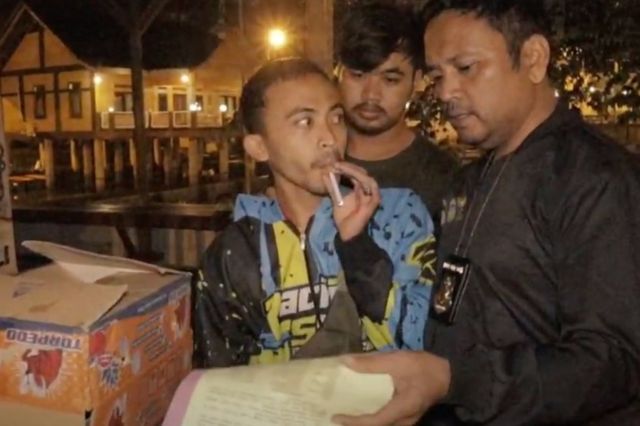
Police in Indonesia detain Asep Yadi Nurul Hikmah, who was among the most brutal torturers.
Image caption,Police in Indonesia detain Asep Yadi Nurul Hikmah, who was among the most brutal torturers.

Monkey torture videos are still easily accessible on Telegram and now Facebook, where the BBC recently found dozens of groups sharing extreme content, some with more than 1,000 members.

“We’ve seen an escalation in this extreme, graphic content, which used to be hidden but is now circulating openly on platforms like Facebook,” said Sarah Kite, co-founder of animal charity Action for Primates.

Facebook told the BBC it had removed the groups we brought to the company’s attention. “We don’t allow the promotion of animal abuse on our platforms and we remove this content when we become aware of it, like we did in this case,” a spokesperson said.

Ms Kite also called for UK laws to be updated to make it easier to prosecute individuals who pay for torture videos to be made. “If someone is proactively involved in inflicting that pain by paying for it and providing a list of things they want done to the animal, there should be stronger laws to hold them to account,” she said.

YouTube told the BBC in a statement that animal abuse had “no place” on the platform and the company was “working hard to quickly remove violative content”.

“Just this year alone, we’ve removed hundreds of thousands of videos and terminated thousands of channels for violating our violent and graphic policies,” the statement said.

Telegram said it was “committed to protecting user privacy and human rights such as freedom of speech”, adding that its moderators “cannot proactively patrol private groups”.

Need help to report? email me and I can send you information

eevanderploeg@gmail.com


woensdag 22 oktober 2025

Four years cell for selling videos, which were shared online on Telegram showed baby monkeys being crushed, burned, drowned, suffocated, impaled and mutilated.


A still image of a baby long-tailed macaque, which prosecutors say is from a torture video.  

Man sentenced for 'animal crush' videos of baby monkeys he bought, shared on Telegram


The videos, which were shared online, showed baby monkeys being crushed, burned, drowned, suffocated, impaled and mutilated.

A federal judge in Cincinnati on Sept. 30 said the videos were among the most horrific things she had heard about in three decades on the bench.

“I'm sorry I even know what they are,” US District Judge Susan Dlott said at a sentencing for a man who paid more than $1,200 for multiple videos – and even made requests about what acts of torture he wanted to see.

The man, 39-year-old Giancarlo Morelli, a car salesman from New Jersey, was one of  multiple people charged locally  last year in connection with the videos.

Dlott sentenced Morelli, who was accused of conspiracy to distribute animal crush videos, to four years in prison and ordered him to pay a $25,000 fine.

The videos are illegal under a 2010 federal law that criminalizes so-called animal crush videos.

A second defendant, 28-year-old Nicholas Dryden of Cincinnati's English Woods neighborhood, attempted to plead guilty on Sept. 30, but Dlott rejected the plea.

Dlott didn't fully explain her decision. Dryden faced a maximum of 12 years in prison, but the plea agreement called for a seven-year sentence. Dlott indicated that she wanted to impose a sentence longer than seven years.

Prosecutors say Dryden paid a 17-year-old boy in Indonesia to create videos showing the torture. The monkeys in the videos were baby or juvenile long-tailed macaques.

Best customer of animal crush videos

Prosecutors described Morelli – who on the messaging app Telegram called himself “Lord CmdrGC” – as Dryden's best customer.

Morelli participated in numerous Telegram chats in which people shared videos and talked about acts of torture they wanted to see. One group had more than 400 members, court documents say.

Morelli's requests, according to prosecutors, led Dryden to ask the Indonesian boy to find a baby monkey and create a video that is described in court documents.

In that 30-minute video, the baby monkey is first fed pieces of a banana. The person recording the video eventually kicks the monkey, then bends and twists its arms, “appearing to break them,” the documents say. The monkey can be seen trying to crawl across the floor “in obvious pain.”

The monkey's genitals are burned with a candle, and it is placed in a cage with a mongoose, which attacks it. The videographer then breaks the monkey's legs before throwing it against a wall and the floor.

Prosecutors say Morelli paid for that video and only stopped buying videos from Dryden after Dryden was arrested.

He beats it to death

In one Telegram exchange about a video, Dryden says, “He beats it to death and cuts its (genitals) off.”

Morelli's response: “Yes finally!”

Prosecutors noted that Morelli also funneled money to others, who would then obtain videos for the Telegram group.

At the Sept. 30 sentencing, Morelli, wearing a gray suit, read a statement, apologizing for what he did. Although sober now, Morelli said a heroin addiction that he hid from his wife and child was at least partly to blame.

“All God's creatures should be respected and cared for,” he told Dlott, adding: “I am extremely sorry for my actions, and the harm brought to these animals.”

In a statement, a spokesperson for Telegram said: "Any content that encourages violence is explicitly forbidden by Telegram's terms of service and is removed whenever discovered. Moderators empowered with custom AI tools proactively monitor public parts of the platform and accept reports in order to remove millions of pieces of harmful content each day, including animal abuse content."

zondag 21 augustus 2016

7 bedrijven waar onder eBay gaan dieren beschermen tegen illegale online handel ( helpt u ook mee? )


Zeven bedrijven, bestaande uit eBay, Etsy, Gumtree, Microsoft, Pinterest, Tencent and Yahoo!, hebben vandaag op World Elephant Day gezamenlijk nieuw beleid geïmplementeerd dat dieren zal helpen beschermen tegen de illegale online handel. 
Het International Fund for Animal Welfare (IFAW) bestrijdt al sinds 2004 online-criminaliteit rond wilde dieren, en ik heb zelf de afgelopen vijf jaar voorop gelopen in die strijd. In die periode heeft bedrijf na bedrijf zich uitgesproken en zijn beleid veranderd.

Maar nu staan we op een cruciaal kantelpunt, en is het tijd om samen actie te ondernemen. Dit beleidskader is een soort stevige, standvastige muur die wildcriminelen buiten de grote online-platforms houdt, en die voorkomt dat de illegale handel zich verplaatst naar andere sites.
Waarom is het zo belangrijk dat online-technologiebedrijven een beleid hebben dat mogelijke wildcriminelen afschrikt? Omdat bijvoorbeeld uit onze enquête onder 280 online-marktplaatsen blijkt dat er daar in zes weken tijd meer dan 30.000 (delen van) bedreigde wilde dieren zijn verhandeld. En dit zijn nog maar de cijfers voor 16 landen. Met deze producten is volgens een voorzichtige schatting meer dan 10 miljoen Amerikaanse dollar gemoeid.


Deze aantallen kunnen wat overweldigend en abstract lijken, maar bedenk bijvoorbeeld dat het bij 32% van de advertenties ging om ivoor, of zeer waarschijnlijk ging om ivoor (waarbij handelaars codewoorden gebruikten om te versluieren dat het hier om ivoor ging). Dat zijn duizenden stukken ivoor. En dat in een tijd waarin er elk kwartier een olifant wordt gedood om de illegale handel in ivoren prullaria te kunnen laten doorgaan. 

Niet al deze online-handel in wild is illegaal - je kunt bepaalde bedreigde soorten verhandelen als je daar de juiste vergunningen voor hebt - maar het internet geeft criminelen toegang tot enorme markten, waar de kansen om gepakt te worden veel te laag zijn.
Daarom hebben we de hulp nodig van grote internationale bedrijven. De online-marktplaats is zo groot dat iedereen zijn steentje moet bijdragen om de toegangswegen te kunnen afsluiten voor cybercriminelen die handelen in wilde dieren.

Er zijn ook consumenten die misschien niet beseffen dat ze door het kopen van dit soort producten de wildpopulaties in gevaar brengen, of dat ze door deze illegale wildhandel een risico lopen op zware straffen. Het bericht van deze online-techbedrijven zal helpen om het bewustzijn en de kennis over de illegale online handel in wilde dieren te vergroten. Dit is cruciaal omdat veel kopers niet weten dat ze met hun aankoop het voortbestaan van wilde dieren bedreigen of dat ze (onwetend) bijdragen aan de illegale handel en een boete of celstraf riskeren.

We hebben bij het ondersteunen van deze grote onlinebedrijven samengewerkt met TRAFFIC en het Wereldnatuurfonds (WNF), omdat we weten dat een beleidswijziging zelf niet het wondermiddel is dat het probleem oplost. We zullen hen samen helpen om hun beleid te handhaven, maar we hebben jou, als consument of natuurbeschermer, ook nodig. Jij moet onze ogen en oren zijn, en verdachte artikelen op dit soort websites melden.

De online-techbedrijven zijn een belangrijk deel van de oplossing voor dit probleem, maar het IFAW blijft ook samenwerken met de autoriteiten om te zorgen dat personen die de wet overtreden worden berecht. Het IFAW verzoekt overheden ook om hun wetgeving tegen het licht te houden en sterker te maken, om zo specifiek de cybercrime in wilde dieren aan te pakken. En alleen al de laatste paar maanden hebben we gezien dat China en Frankrijk in hun wetten nieuwe bepalingen hebben opgenomen om deze illegale handel de kop in te drukken.
Ik heb een ruimte gezien die door een online-handelaar helemaal was volgestapeld met lichaamsdelen van bedreigde wilde diersoorten. Van boven tot onder, van muur tot muur. Deze beelden blijven me achtervolgen.
Als we blijven samenwerken met online-techbedrijven, ngo's, handhavingsautoriteiten en overheden, kunnen we zorgen dat dit soort walgelijkheden tot het verleden gaat behoren.

--TM  www.ifaw.org