Translate

Posts tonen met het label rhino. Alle posts tonen

dinsdag 5 augustus 2025

Rhino horns injected with radioactive isotopes which can be detected by customes in South Africa and is harmless for the animals

Rhino horns made radioactive to foil traffickers in South African project

Isotopes can be detected at airports and borders even in large containers and are harmless to the animals

A South African university has launched an anti-poaching campaign to inject the horns of rhinoceroses with radioactive isotopes that it says are harmless for the animals but can be detected by customs agents.


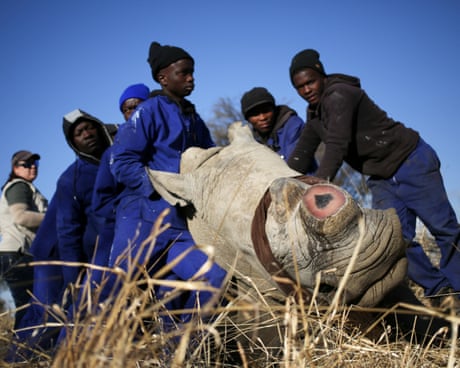
Under the collaborative project involving the University of the Witwatersrand, nuclear energy officials and conservationists, five rhinos were injected in what the university hopes will be the start of a mass injection of the declining rhino population, which they are calling the Rhisotope Project.

Last year, about 20 rhinos at a sanctuary were injected with isotopes in trials that paved the way for Thursday’s launch. The radioactive isotopes even at low levels can be recognised by radiation detectors at airports and borders, leading to the arrest of poachers and traffickers.

Researchers at Witwatersrand’s Radiation and Health Physics Unit said tests conducted in the pilot study confirmed that the radioactive material was not harmful to the rhinos.

“We have demonstrated, beyond scientific doubt, that the process is completely safe for the animal and effective in making the horn detectable through international customs nuclear security systems,” said James Larkin, chief scientific officer at the Rhisotope Project.
“Even a single horn with significantly lower levels of radioactivity than what will be used in practice successfully triggered alarms in radiation detectors,” said Larkin.

The tests also found that horns could be detected inside full 40-foot shipping containers, he said.

The International Union for Conservation of Nature estimates that the global rhino population was about 500,000 at the beginning of the 20th century but has now declined to approximately 27,000 because of demand for rhino horns on the hidden market.

South Africa has the largest population of rhinos with an estimated 16,000 but has high levels of poaching and about 500 rhinos are killed for their horns every year.

The university has urged private wildlife park owners and national conservation authorities to have their rhinos injected.


https://www.theguardian.com/

maandag 28 juli 2025

In the first 6 months of this year,195 rhinos were killed by poachers: Rhino horn trafficking is linked to money laundering, corruption, and violent organized crime.

 https://www.ifaw.org/journal/rhino-faq  Detailed information about the rhino


Dogs are being trained to find the poachers K9 projects 

South Africa’s Environmental Minister, Dr. Dion George, has announced rhino poaching figures for the first half of 2025. This marks the first high-level report of its kind under South Africa’s G20 Presidency.

A rhino

Between January 1 and June 30, 195 rhinos were killed by poachers, 35 fewer than during the same period in 2024. While this decline is encouraging, the scale of the problem remains critical. The announcement coincided with the launch of a new government initiative, Rhino Renaissance, which aims to restore Kruger National Park’s rhino population to 12,000 within the next decade.

June recorded the fewest rhinos killed this year, with 22 lost across the country. Still, Kruger National Park remains the hardest hit. Half of those June losses happened in the park, although poaching numbers there have steadily declined, from 17 rhinos in January, and 30 in February, to 11 in both May and June. Could this be an inside job?

K9 projects to train dogs

As part of the Rhino Renaissance initiative, the South African government has pledged to train and deploy 90 dedicated Rhino Monitors each year in Kruger National Park. While this is a promising step in the right direction, the numbers still reflect a disturbing reality: rhino poaching continues almost daily.

White rhinos were once nearly extinct, with their numbers dropping below 100 in the early 1900s. Thankfully, South Africa turned the tide with bold conservation measures, protected areas, community efforts, and ranger-led protection. By 2010, more than 20,000 white rhinos roamed the country.


Kruger National Park became a conservation triumph, with over 12,000 rhinos, more than anywhere else in the world. Sadly, that momentum has reversed. As of 2024, South Africa’s white rhino population has dropped to 14,389. In Kruger, just over 2,000 remain.

The decline in rhino populations is primarily due to poaching, fueled by international criminal syndicates, greed, and the illegal rhino horn trade. Additionally, drought and shifting climates have had an impact on rhinos. Improved monitoring can provide a more accurate count of the species.

This crisis extends far beyond conservation; it impacts national security, economic stability, and the rule of law. Rhino horn trafficking is linked to money laundering, corruption, and violent organized crime.

“Bringing rhino conservation to the global stage through the G20 is a powerful move by South Africa’s leadership and a necessary one. Political backing and international focus are key to shifting the tide for rhino populations that have been pushed to the edge. The launch of the ‘Rhino Renaissance’ initiative is encouraging, especially the plan to deploy 90 new Rhino Monitors in Kruger each year. That kind of investment in boots-on-the-ground protection matters.

“But let’s be honest, 195 rhinos lost in six months is still devastating. That’s more than one rhino killed every single day. We can’t allow those numbers to feel like ‘less bad’ is good enough. Yes, some ranger teams are operating as strongholds, but far too many are still stretched thin, underfunded, and fighting this war without the tools they need. At the same time, we’re seeing too many court cases stall or fall flat, allowing traffickers and syndicates to slip through the cracks.

“Rhino conservation can’t rest on one plan or one country. It has to be a long-term, multi-pronged, international effort—driven by real funding, solid prosecution, regional cooperation, and daily commitment in the field. The drop in numbers is progress, but we’ve got a long way to go. Progress isn’t victory. Not yet,” Mike Veale, CEO and Founder of Global Conservation Force (GCF), told WAN.

We must continue to fight for these magnificent species before it’s too late!