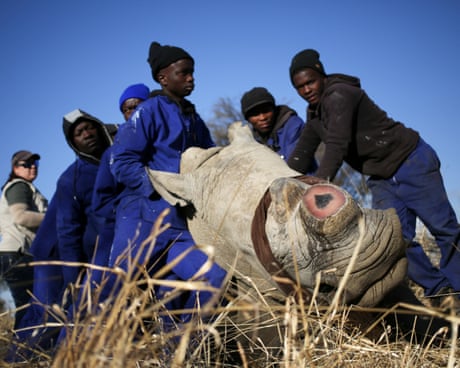
It's a sad world that we have to de-horn wildlife so that they can survive
South Africa’s anti-poaching and anti-trafficking efforts saw a 16% drop in rhino poaching in 2025 compared to 2024. Minister of Forestry, Fisheries and the Environment, Mr. Willie Aucamp, attributes the decline to “dedication and tactical, swift coordination.” Conservationists, however, caution that the fight against rhino poaching is far from over.
“From January to December 2025, 352 rhinos were poached in South Africa, with 266 being killed on state properties and 86 on privately owned parks, reserves, or farms. This was a decrease of 68 in comparison to 420 rhinos poached in 2024,” said Minister Aucamp.
Mpumalanga was the hardest-hit province, losing 178 rhinos, mostly in Kruger National Park, which reported 175 poached rhinos—up from 88 in 2024. In contrast, Hluhluwe-iMfolozi Park in KwaZulu-Natal saw poaching drop from 198 in 2024 to 63 in 2025, thanks to collaboration through the Integrated Wildlife Zones (IWZ) Programme and support from WWF,Save the Rhino International,Wildlife ACT,andPeace Parks Foundation.
This how it should be, rhinos with horns. Money the root of all evil
Ezemvelo notes that 2025’s reduction was driven by multiple measures: strategic dehorning, advanced detection technologies, early-warning systems, and the Integrity Implementation Plan, including polygraphing of all park law-enforcement personnel.
The National Integrated Strategy to Combat Wildlife Trafficking (NISCWT)is strengthening prosecutions, centralizing cases to give courts a full view of criminal syndicates, including organized crime and money laundering. A key example is ZM Muiambo, aka Thomas Chauke, who was found guilty on 19 charges, including illegal rhino hunting and theft of rhino horns. In April 2025, he was sentenced to 20 years in prison.
Minister Aucamp conveyed his gratitude to private rhino owners and the private sector for their anti-poaching efforts. He emphasized that coordinated action by the government, NGOs, and the private sector is central to sustaining progress.
“South Africa continues to strengthen its international collaboration to curb rhino poaching and wildlife trafficking. These efforts led to the country receiving the Asia Environmental Enforcement Recognition of Excellence Award late last year, which celebrates excellence in enforcement by government officials, institutions, and teams combatting transboundary environmental crimes,” said Minister Aucamp.
“Working together with the South African anti-poaching and anti-trafficking organizations, we remain committed to a balanced, intelligence-driven, and partnership-based approach to rhino protection, recognizing that sustained success requires constant adaptation, integrity, and cooperation across all sectors,” said Minister Aucamp.
“While this is much-needed progress, rhinos remain under serious threat. Urgent and coordinated action across all sectors is needed to stop poaching and ensure these animals have a future in the wild.” — Peace 4 Animals&World Animal News
Members of the public can report suspicious wildlife activities to the environmental crime hotline at 0800 205 005 or SAPS 10111.
Rhino horns made radioactive to foil traffickers in South African project
Isotopes can be detected at airports and borders even in large containers and are harmless to the animals
A South African university has launched an anti-poaching campaign to inject the horns of rhinoceroses with radioactive isotopes that it says are harmless for the animals but can be detected by customs agents.
Under the collaborative project involving the University of the Witwatersrand, nuclear energy officials and conservationists, five rhinos were injected in what the university hopes will be the start of a mass injection of the declining rhino population, which they are calling the Rhisotope Project.
Last year, about 20 rhinos at a sanctuary were injected with isotopes in trials that paved the way for Thursday’s launch. The radioactive isotopes even at low levels can be recognised by radiation detectors at airports and borders, leading to the arrest of poachers and traffickers.
Researchers at Witwatersrand’s Radiation and Health Physics Unit said tests conducted in the pilot study confirmed that the radioactive material was not harmful to the rhinos.
“We have demonstrated, beyond scientific doubt, that the process is completely safe for the animal and effective in making the horn detectable through international customs nuclear security systems,” said James Larkin, chief scientific officer at the Rhisotope Project.
“Even a single horn with significantly lower levels of radioactivity than what will be used in practice successfully triggered alarms in radiation detectors,” said Larkin.
The tests also found that horns could be detected inside full 40-foot shipping containers, he said.
The International Union for Conservation of Nature estimates that the global rhino population was about 500,000 at the beginning of the 20th century but has now declined to approximately 27,000 because of demand for rhino horns on the hidden market.
South Africa has the largest population of rhinos with an estimated 16,000 but has high levels of poaching and about 500 rhinos are killed for their horns every year.
The university has urged private wildlife park owners and national conservation authorities to have their rhinos injected.