23 May 2025: Take action against online animal cruelty during Report It! Week
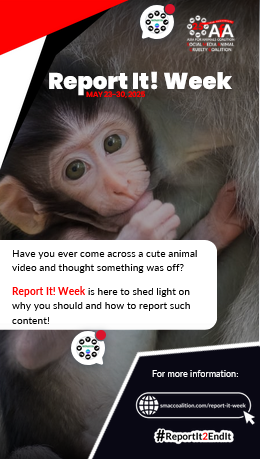
Report It! Week (23-30 May) is an event organised by the Social Media Animal Cruelty Coalition (SMACC), a collective of 34 animal protection organisations, including Action for Primates. It is a time dedicated to raising global awareness about online animal cruelty and reinforcing a powerful message on the importance of reporting this type of content to social media platforms.
During Report It! Week, SMACC is urging social media companies to take meaningful action against animal cruelty content shared on their platforms. SMACC calls upon these companies to respond to reports from the public and animal protection experts by promptly removing abusive content. The coalition also invites platforms to collaborate with its experts to strengthen animal welfare policies and improve content moderation systems—ensuring that cruelty to animals has no place online.
Report It! Week will drive home the message that reporting matters. By raising awareness, we aim to influence social media users and companies to stop overlooking this cruelty.
New data released by SMACC, reveal that shocking and harmful animal cruelty content continues to be rife on social media platforms. During 2024, 80,972 cruelty related links were identified by the public and assessed by the coalition. Facebook accounted for 87.5% of those links reported. Non-human primates (especially macaques), dogs and cats featured heavily in this cruel content.
Disturbing content of deliberate and gratuitous abuse involving animals, including baby monkeys, is posted on channels and by online groups, with some channels monetised. Particularly horrifying has been the disturbing escalation in the violence, torture and death inflicted upon baby monkeys. Other harmful content, however, may not always be easy to spot. Animal cruelty does not just comprise physical harm—it includes keeping wild animals as 'pets'; dangerous staged 'rescues' where an animal is deliberately placed in potentially harmful situations with the film maker then playing the role of 'rescuer'; and forcing animals to do unnatural tricks for 'entertainment'.

SMACC researchers also collected a separate set of data:
- 2,050 links were collected and analysed—1,094 from Facebook and 39 from Instagram—confirming that more than half of the total originated from Meta platforms; of the 1,133 Meta links, only 36.3% have been removed
- On Facebook, 24.5% of content is categorised as 'deliberate physical torture', while Instagram more frequently hosts content portraying 'animals as entertainers' (35.9%)
.jpg)
Despite social media platforms implementing policies against such content, the data demonstrate gaps in identifying and removing the flagged content.
Online animal cruelty is increasingly being recognised within global legal frameworks. The legislative landscape around digital safety is rapidly evolving, with governments placing more defined responsibilities on platforms to mitigate online harms, including animal cruelty. Under the UK's Online Safety Act 2023, animal cruelty is classified as priority illegal content. Platforms are required to proactively detect and swiftly remove such material, with non-compliance resulting in fines of up to £18 million or 10% of global annual revenue, enforced by Ofcom.

Geen opmerkingen:
Een reactie posten