Translate

Posts tonen met het label primates. Alle posts tonen

vrijdag 7 augustus 2026

More than 1,600 live primates listed for sale online in a 6 week period for $250 to $6,500 : transactions as ''rehoming" or "adoption" avoiding the words "for sale"l


  • A new report by the Association of Zoos and Aquariums, International Fund for Animal Welfare, and World Wildlife Fund found more than 1,600 live primates listed for sale on U.S. social media platforms like Facebook, Instagram, TikTok, and YouTube over a six-week period in mid-2025.


  • Sellers circumvented platform bans by disguising commercial transactions as “rehoming” or “adoption” efforts, with prices for the 12 documented species, including macaques and marmosets, ranging from $250 to $6,500.
  • Many advertised primates were infants, who are often stolen from their mothers in the wild, leading to severe trauma or death during smuggling and contributing to the 60 percent of primate species globally threatened with extinction.
  • While TikTok and Google (YouTube) said they prohibit wildlife trafficking and have taken action, experts warn that this accessible online market fuels animal cruelty, biodiversity loss, zoonotic diseases, and other illicit crimes, ranking wildlife trafficking among the top black markets.

  • Marmoset baby monkey for sale
  • The report recommends passing the federal Captive Primate Safety Act, urging social media companies to expand prohibited content policies and improve detection and reporting tools, and calling for increased funding and specialized personnel for state and federal enforcement agencies to combat this digital trade.

  • Source: Jasmine Fernández 

In full

dinsdag 2 juni 2026

More than 1600 live primates have been listed for sale in a 6 weeks period on social media networks in the US: 1,131 posted on Facebook


https://primatepet.com/our-blog/  


 More than 1,600 live primates have been openly listed for sale on U.S. social media networks, bypassing platform bans through disguised accounts, according to a new report.

The study, “Primates for Purchase: The Surge in Sales on Social Media in the U.S.,” was published Tuesday by the Association of Zoos and Aquariums, the International Fund for Animal Welfare and the World Wildlife Fund. It is the first U.S.-only report to analyze the sale of primates via social media.

Researchers monitored activity over a six-week period in mid-2025 and identified 1,614 live primates listed for sale across 1,131 posts on Facebook, Instagram, TikTok and YouTube.

The listings came from 122 social media users. Many of the advertisements were easily located through simple search terms such as “monkey rehoming” or “adoption,” despite platform policies prohibiting the sale of live wildlife.

According to the report, sellers routinely disguised commercial transactions as rescue or rehoming efforts, which allowed the listings to remain publicly visible while bypassing automated platform restrictions.

In response to the findings, TikTok and Google, the parent company of YouTube, stated that wildlife trafficking is strictly prohibited on their platforms.

TikTok does not allow “the promotion, sale, solicitation, or facilitation of access to live animals,” the company said in a statement to The Independent.

Google echoed those enforcement efforts, stating that its employees worked with WWF on a cyber spotting event in June 2025 and, as a result, removed 28 YouTube channels for violating its policies.

“The trade of endangered animals is a driver of biodiversity loss, zoonotic diseases, and funds other forms of illicit crime,” YouTube Policy Communications Manager Boot Bullwinkle said in a statement to The Independent. “We have strict content policies prohibiting the sale of endangered species, and are committed to removing content that violates our policies. We look forward to continuing to partner with WWF on future Cyber Spotter programs and other initiatives to combat this serious issue.”

The report documented 12 different types of primates for sale, including chimpanzees, spider monkeys, lemurs, bush babies, marmosets and capuchins. Macaques were the most prevalent, accounting for 839 individual listings, followed by marmosets at 293 and capuchins at 275. Prices for the animals ranged from $250 to $6,500, depending on the species, age and rarity.

Researchers found that a significant number of the advertised primates were infants or juveniles. According to the report, poachers frequently steal infant primates from their mothers in the wild to exploit a false belief among buyers that younger animals bond more easily with humans. Many of these animals suffer severe trauma or die during smuggling operations before ever reaching buyers, the report claims.

Roughly 60 percent of the world’s primate species are threatened with extinction, and approximately 75 percent have declining populations due to habitat loss, industrial agriculture, logging and hunting, according to Science Advances.


vrijdag 13 maart 2026

From kittens and puppies to primates and endangered wildlife, animals are staged, mishandled, confined, or abused for the camera for profit ( How do i report ?)


https://www.endcrueltyonline.com/report-a-concern  REPORT

It looks cute but these animals are taken from the wild and become house pets. Once they get older and bigger they start to protest and become violent at times. Scratching, biting, and get dumped. They can't live as a wild animal anymore, they never learned and they die or are killed.


WHY MACAQUES?

https://www.endcrueltyonline.com/

Content creators have learned that pet macaques make

popular social media content and that posts showing pet

macaques in clothes or expressing human-like behaviors

have the potential to generate benefits such as online

“likes” and popularity, and content monetization.


Behind viral and “cute” videos, there is often fear, stress, and exploitation created for views, engagement, and sometimes profit


From kittens and puppies to primates and endangered wildlife, animals are staged, mishandled, confined, or abused for the camera ( see photos that have been staged for profit.) Due to reports made by horrified TIK TOK viewers Monkey Koki is off line for ever. 

Link to report a concern:

  1. To provide platforms with cruelty content data from our database

  2. To help platforms identify cruelty

  3. To advise on policy adjustments

  4. To become a trusted and valued source of information

  5. To create real long-lasting change for animals, together


Baby monkeys tortured and killed in videos posted on US-based chat group


The poor little monkey is put in this horrible situation he can never get out by himself

A US-based online chat group is paying to watch videos of “monkey torture”, animal advocacy campaigners have discovered.

Individuals can either buy their own private baby monkey or they join with others for a “share” of a “community monkey”. They then pay as little as $20 for certain horrific acts to be performed on the young macaques.

Shocking footage obtained by the UK activist group Action for Primates and US organisation Lady Freethinker showed monkeys having their ears and fingers cut off, handlers using a pin to pierce the animals tongues and eyelids, and tying them to a cross before being beaten.

The online group, which has over thirty members, has been running since May this year and campaigners believe there could be other secretive groups that are feeding the demand for videos of animal cruelty.

One organizer of the cruel videos posted the rules of the “monkey adoption program” on an internet forum, boasting: “I believe we may be able to secure 2 more monkeys in the next 24 hours, and these are the youngest yet... I have a few videos in the works right now.”


  1. https://drive.google.com/file/d/1fT8XtpLlGT3r03OlcviyAwo2-jqa-eF4/view


zondag 24 augustus 2025

Natalie Herron in Scotland sentenced for 2 years and 3 months prison for taking part in global monkey torture video's with unbelievable suffering of baby monkeys

 Woman in Scotland jailed in baby monkey torture case

https://actionforprimates.org/

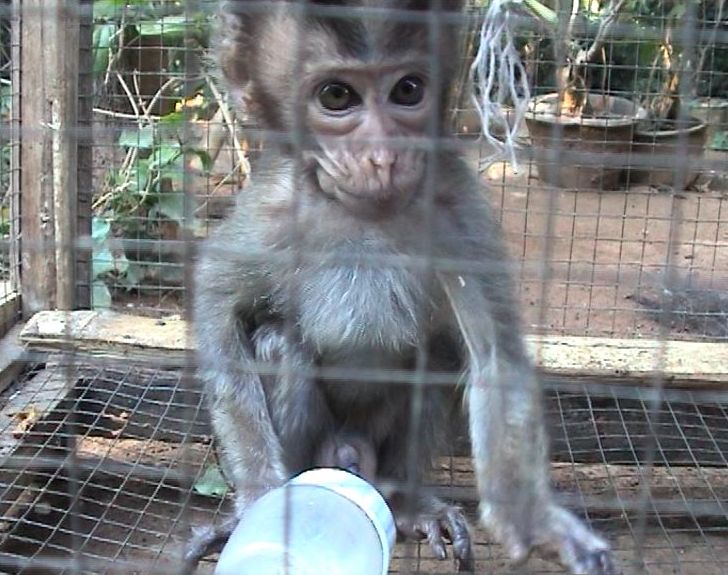
Captive infant long-tailed macaque in Indonesia; Action for Primates
Captive infant long-tailed macaque in Indonesia
Action for Primates

Natalie Herron in Scotland, has been sentenced to two years and three months at Airdrie Sheriff Court today for her part in a global monkey torture ring that paid for and ordered baby monkeys to be sadistically tortured and killed in Indonesia, to create videos to be circulated online.

The sentence has been welcomed by Action for Primates and Lady Freethinker, who have spent four years investigating the sadistic world of online monkey torture groups. The conviction is part of an international crackdown by law enforcement agencies in the UK and the USA against those people who facilitate the torture of baby monkeys. Several people in the UK and USA are already serving or have served prison sentences.

Herron was a member of the same monkey torture group as two women from England—Adriane Orme and Holly LeGresley—who were both sent to prison in November 2024 (https://www.westmercia.police.uk/news/west-mercia/news/2024/november/women-jailed-for-monkey-torture-offences/). The group was run by Michael Macartney, who called himself the "Torture King". Macartney is currently serving three years and four months in prison in the USA for conspiring to make and distribute "animal crush" videos. He ran several online Telegram groups that facilitated the torture, murder and sexually sadistic mutilation of baby long-tailed macaques as 'entertainment'. Several other members of the group are also serving time in US jails.

In the group on Telegram, Herron shared videos depicting the torture and abuse of baby monkeys, and enthusiastically discussed her enjoyment at watching horrific and disturbing videos in which monkeys suffered unimaginable agony and distress. These videos included placing an infant into a food blender; sealing an infant inside a jar with red ants; gouging out the eyes of an infant; and wrapping an infant tightly in sticky plaster in the shape of a ball, who was then kicked around. Examples of comments posted by Herron include:

  • Or watch them be blitzed in blenders and scalped, dicks cut off, set alight. If only my family and friends knew they'd never look at me the same again lol.
  • Torch its whole face off until it's just skull and melting skin haha.
  • We finally got our ants in a jar. Phenomenal!
  • Haven't you seen the video where they cellotape it into a ball? It's awesome.

Along with LeGresley, Herron was also involved in organising a poll amongst group members to suggest and then vote on which method of torture they wanted to see inflicted upon a monkey in the next video they were funding. The choices included sealing a monkey inside a jar with red ants, applying a painful substance to the wounds created by a cheese grater or gluing together various parts of a monkey's body.

Sarah Kite, co-founder and spokesperson for Action for Primates, stated: We welcome the sentence given to Herron and are extremely grateful to UK law enforcement for continuing to track down and bring to justice these sadistic and depraved people involved in online monkey torture groups. The perverted 'enjoyment' Herron and others obtained from facilitating and watching baby monkeys being abused and brutalised in the most sickening and horrifying ways shows a level of depravity that must never be tolerated.

Nina Jackel, Founder, Lady Freethinker, stated: The suffering endured by helpless, infant monkeys for online videos is heartbreaking, and the brutal nature of these acts is sickening. The perpetrators involved in the creation, funding, or sharing of animal torture content for human 'amusement' must be held accountable.

Members of these online torture groups are primarily active on platforms such as Telegram and get 'pleasure' from watching helpless and vulnerable infant monkeys in terror and pain, fighting for their lives. The extreme cruelty inflicted upon the baby monkeys included being set alight; having parts of their body cut off, including limbs, genitals, fingers and toes; their bones broken with a hammer; their heads squeezed in a clamp; beaten viciously; and having their eyes drilled out with a power tool.

The evidence obtained during the investigations by Action for Primates and Lady Freethinker has been given to various law enforcement agencies and spurred the BBC investigation and documentary about online monkey torture gangs—The Monkey Haters—which helped lead to the inclusion of animal cruelty in the UK Online Safety Act (https://www.bbc.co.uk/news/world-65951188 and https://www.bbc.co.uk/news/world-65951188).

Disturbingly, many graphic and violent videos paid for by members in Telegram groups—depicting extreme violence and sexual abuse inflicted upon baby monkeys, including genital mutilation—have appeared on mainstream social media platforms such as Facebook.

https://actionforprimates.org/

vrijdag 18 juli 2025

Animal welfare crisis in Japan: animal cafes with wildlife and primates kept as pets, the tradgic lives of captive animals in zoo's, urgently calls for legislative reforms


Animal Welfare Charities Demand Urgent Legislative Reform in Japan


A growing animal welfare crisis is unfolding in Japan, as the trend of keeping primates as pets, along with the proliferation of exotic animal cafes across major cities, raises significant ethical and welfare concerns. Global recognised charity Wild Welfare, in collaboration with the Japanese Coalition for Animal Welfare (JCAW), are urgently calling for critical legislative reforms to address these pressing animal welfare and public health issues.

Fennec Foxes in cramped Animal Cafe window, Tokyo, Japan.

Wild Welfare works tirelessly with partners around the globe to safeguard the welfare of captive wild animals in zoos, aquariums, rescue centres and sanctuaries. Along with JCAW, an organisation dedicated to raising animal welfare standards in Japan through public education and the lobbying of policymakers, a joint petition letter to the Japanese government seeking significant changes in the ‘Act on Welfare and Management of Animals’ has been developed and sent to the Japanese government for consideration.

The Japanese government is poised to review and revise the country’s animal welfare law, making now the ideal time to ensure that vital key animal welfare considerations are included within the new bill. Wild Welfare and JCAW jointly published the powerful letter, which directly addresses important issues regarding the trend for keeping pet primates and the inherent welfare issues within exotic animal cafes across Japan.
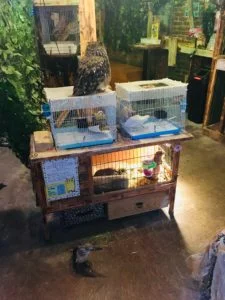
Animals stacked in cages inside an animal café in Japan.

Animals stacked in cages inside an animal café in Japan.

The letter highlights the complexities of proper husbandry required to appropriately care for highly intelligent and socially complex primates. “By not providing suitable environments and species appropriate social opportunities, the welfare of the animals is compromised, which can lead to abnormal behaviours and suffering. Although the owners might be providing care (food and water), they will not be able to meet the behavioural and psychological needs of the animals, as well as it being very difficult to appropriately provide for their nutritional and veterinary care needs” explained Simon Marsh, Director at Wild Welfare.

The joint letter further elaborates on how the absence of properly enriched environments and specialised treatments can fundamentally erode the physical and psychological health of non domesticated animals placed in these unnatural settings.

The collective appeal also outlines the increasing issue of Japan’s growing exotic animal cafe trend. Wild Welfare and JCAW have shown particular concern for the welfare of a diverse array of wild animals exhibited within these locations. From nocturnal owls confined indoors under bright unnatural light for many hours of the day, to socially complex animals such as meerkats kept segregated from groups. These unnatural and artificial environments force a high level of direct human interaction onto the animals, taking away the choice or control each animal has over their own life. “There is no place in a modern society for the keeping of exotic species in cafes for human entertainment” Simon expressed.

Wild Welfare and JCAW also highlight the heightened risk of zoonotic disease transmission within these confined and close contact facilities. As there are little to no effective national regulations governing these facilities, it is currently impossible to ensure both animals and customers are protected from the real risk of such disease exposure.

Two Prairie dogs in a small animal café cage.

Prairie dogs in a small animal café cage, Japan.

Another key issue raised by the appeal letter regards the troubling issue of illicit wildlife trade. Many of the thousands of exotic animals kept within Japanese animal cafes may also be pets, a number of which will be subject to international trade prohibitions. Without a robust system that allows traceability, there is a real risk that illegally traded animals may be exhibited at these cafe locations. In this circumstance, customers could unknowingly be supporting the illegal pet trade.

Wild Welfare and JCAW propose that deep legislative reform is necessary to tackle the many issues at hand. “Our joint letter makes a number of recommendations for reform, for instance, the prohibition or restriction of keeping primates as pets and close control of primate ownership. In the case of exotic animal cafes, the coalition recommends implementing a new regulatory framework for the industry” explained Simon.

two flamingos standing in an animal cafe in Japan

Two flamingos standing in a tiny pool by a chained Owl inside of an animal cafe in Tokyo.

Executive director of the Animal Literacy Research Institute and member of Japanese Coalition of Animal Welfare (JCAW), Sakiko Yamazaki, expressed how they are committed to lobbying for laws that protect all animals in Japan. “In recent years, there has been a global focus on issues regarding wildlife in captivity, and in Japan too, there is an array of unresolved issues related to the keeping of wildlife. JCAW believes that bringing each and every one of these issues to the attention of stakeholders as well as the general public would serve as the first step to creating a world that is compassionate to all animals.” said Sakiko.

The comprehensive report is now available to download, with content currently only provided in a Japanese language version at https://www.dokyoren.com/250426/

“Our joint report with JCAW underscores Wild Welfare’s unwavering commitment to improving wild animal welfare globally” Simon exclaimed. It is hoped that this vital work by JCAW and Wild Welfare will encourage the government to act on the proposed suggestions and take real steps towards enhancing animal welfare across Japan, reducing the risk of zoonotic disease, and protecting the public, as well as conserving important wildlife by addressing the illegal trade of wild animals.


Wild Welfare is devoted to improving the welfare of captive animals across the world. You can support our efforts by sharing this article, signing up to our newsletter, following our social media accounts (Facebook and Instagram), or by making an online donation. Every small contribution can help us to develop our vital accessible animal resources. Thank you.


Notes to Editors

For more information or interview requests please contact Wild Welfare on communications@wildwelfare.org

Wild Welfare is a global organisation committed to improving animal welfare for captive wild animals. By uniting the world’s leading zoos, zoo associations and animal welfare organisations, we build trusting partnerships that help provide long-term solutions to critical wild animal welfare issues.

Our vision is to end the suffering of captive wild animals around the world and ensure full and sustainable protection is given to all animals in human care. Find out more at wildwelfare.org. Registered charity in England (no.1165941).